• Wyszukiwanie zaawansowane
  • Kategorie
  • Kategorie BISAC
  • Książki na zamówienie
  • Promocje
  • Granty
  • Książka na prezent
  • Opinie
  • Pomoc
  • Załóż konto
  • Zaloguj się

Design and Analysis of Mechanisms: A Planar Approach » książka


zaloguj się | załóż konto
Logo Krainaksiazek.pl

koszyk

konto

szukaj
topmenu
Księgarnia internetowa
Szukaj
Książki na zamówienie
Promocje
Granty
Książka na prezent
Moje konto
Pomoc
 
 
Wyszukiwanie zaawansowane
Pusty koszyk
Bezpłatna dostawa dla zamówień powyżej 20 złBezpłatna dostawa dla zamówień powyżej 20 zł

Kategorie główne

• Nauka
 [2949965]
• Literatura piękna
 [1857847]

  więcej...
• Turystyka
 [70818]
• Informatyka
 [151303]
• Komiksy
 [35733]
• Encyklopedie
 [23180]
• Dziecięca
 [617748]
• Hobby
 [139972]
• AudioBooki
 [1650]
• Literatura faktu
 [228361]
• Muzyka CD
 [398]
• Słowniki
 [2862]
• Inne
 [444732]
• Kalendarze
 [1620]
• Podręczniki
 [167233]
• Poradniki
 [482388]
• Religia
 [509867]
• Czasopisma
 [533]
• Sport
 [61361]
• Sztuka
 [243125]
• CD, DVD, Video
 [3451]
• Technologie
 [219309]
• Zdrowie
 [101347]
• Książkowe Klimaty
 [123]
• Zabawki
 [2362]
• Puzzle, gry
 [3791]
• Literatura w języku ukraińskim
 [253]
• Art. papiernicze i szkolne
 [7933]
Kategorie szczegółowe BISAC

Design and Analysis of Mechanisms: A Planar Approach

ISBN-13: 9781119054337 / Angielski / Miękka / 2015 / 320 str.
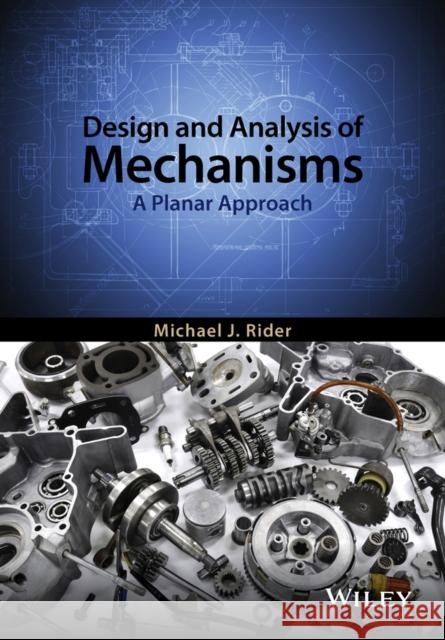
Michael Rider
Design and Analysis of Mechanisms: A Planar Approach Rider, Michael J. 9781119054337 Wiley - książkaWidoczna okładka, to zdjęcie poglądowe, a rzeczywista szata graficzna może różnić się od prezentowanej.

Design and Analysis of Mechanisms: A Planar Approach

ISBN-13: 9781119054337 / Angielski / Miękka / 2015 / 320 str.

Michael Rider
cena 296,94
(netto: 282,80 VAT:  5%)

Najniższa cena z 30 dni: 294,50
Termin realizacji zamówienia:
ok. 30 dni roboczych
Bez gwarancji dostawy przed świętami

Darmowa dostawa!

A planar or two-dimensional (2D) mechanism is the combination of two or more machine elements that are designed to convey a force or motion across parallel planes. For any mechanical engineer, young or old, an understanding of planar mechanism design is fundamental. Mechanical components and complex machines, such as engines or robots, are often designed and conceptualised in 2D before being extended into 3D. Designed to encourage a clear understanding of the nature and design of planar mechanisms, this book favours a frank and straightforward approach to teaching the basics of planar mechanism design and the theory of machines with fully worked examples throughout. Key Features:

  • Provides simple instruction in the design and analysis of planar mechanisms, enabling the student to easily navigate the text and find the desired material
  • Covers topics of fundamental importance to mechanical engineering, from planar mechanism kinematics, 2D linkage analyses and 2D linkage design to the fundamentals of spur gears and cam design
  • Shows numerous example solutions using EES (Engineering Equation Solver) and MATLAB software, with appendices dedicated to explaining the use of both computer tools
  • Follows end-of-chapter problems with clearly detailed solutions

Kategorie:
Technologie
Kategorie BISAC:
Technology & Engineering > Mechanical
Technology & Engineering > Machinery
Wydawca:
Wiley
Język:
Angielski
ISBN-13:
9781119054337
Rok wydania:
2015
Ilość stron:
320
Waga:
0.43 kg
Wymiary:
24.13 x 16.76 x 1.52
Oprawa:
Miękka
Wolumenów:
01
Dodatkowe informacje:
Bibliografia

Preface viii

1 Introduction to Mechanisms 1

1.1 Introduction 1

1.2 Kinematic Diagrams 2

1.3 Degrees of Freedom or Mobility 5

1.4 Grashof s Equation 7

1.5 Transmission Angle 7

1.6 Geneva Mechanism 10

Problems 12

Reference 15

2 Position Analysis of Planar Linkages 16

2.1 Introduction 16

2.2 Graphical Position Analysis 17

2.2.1 Graphical Position Analysis for a 4–Bar 17

2.2.2 Graphical Position Analysis for a Slider–Crank Linkage 19

2.3 Vector Loop Position Analysis 20

2.3.1 What Is a Vector? 20

2.3.2 Finding Vector Components of M 21

2.3.3 Position Analysis of 4–Bar Linkage 23

2.3.4 Position Analysis of Slider–Crank Linkage 36

2.3.5 Position Analysis of 6–Bar Linkage 47

Problems 49

Programming Exercises 62

3 Graphical Design of Planar Linkages 66

3.1 Introduction 66

3.2 Two–Position Synthesis for a Four–Bar Linkage 67

3.3 Two–Position Synthesis for a Quick Return 4–Bar Linkage 69

3.4 Two–Positions for Coupler Link 72

3.5 Three Positions of the Coupler Link 72

3.6 Coupler Point Goes Through Three Points 75

3.7 Coupler Point Goes Through Three Points with Fixed Pivots and Timing 78

3.8 Two–Position Synthesis of Slider–Crank Mechanism 82

3.9 Designing a Crank–Shaper Mechanism 84

Problems 88

4 Analytical Linkage Synthesis 95

4.1 Introduction 95

4.2 Chebyshev Spacing 95

4.3 Function Generation Using a 4–Bar Linkage 98

4.4 Three–Point Matching Method for 4–Bar Linkage 100

4.5 Design a 4–Bar Linkage for Body Guidance 103

4.6 Function Generation for Slider–Crank Mechanisms 106

4.7 Three–Point Matching Method for Slider–Crank Mechanism 108

Problems 112

Further Reading 114

5 Velocity Analysis 115

5.1 Introduction 115

5.2 Relative Velocity Method 116

5.3 Instant Center Method 123

5.4 Vector Method 137

Problems 145

Programming Exercises 152

6 Acceleration 156

6.1 Introduction 156

6.2 Relative Acceleration 157

6.3 Slider Crank Mechanism with Horizontal Motion 158

6.4 Acceleration of Mass Centers for Slider Crank Mechanism 161

6.5 Four–bar Linkage 162

6.6 Acceleration of Mass Centers for 4–bar Linkage 167

6.7 Coriolis Acceleration 168

Problems 173

Programming Exercises 179

7 Static Force Analysis 183

7.1 Introduction 183

7.2 Forces, Moments, and Free Body Diagrams 184

7.3 Multiforce Members 188

7.4 Moment Calculations Simplified 194

Problems 194

Programming Exercises 198

8 Dynamics Force Analysis 201

8.1 Introduction 201

8.2 Link Rotating about Fixed Pivot Dynamic Force Analysis 203

8.3 Double–Slider Mechanism Dynamic Force Analysis 205

Problems 208

9 Spur Gears 212

9.1 Introduction 212

9.2 Other Types of Gears 212

9.3 Fundamental Law of Gearing 213

9.4 Nomenclature 216

9.5 Tooth System 218

9.6 Meshing Gears 219

9.6.1 Operating Pressure Angle 220

9.6.2 Contact Ratio 220

9.7 Noninterference of Gear Teeth 221

9.8 Gear Racks 224

9.9 Gear Trains 225

9.9.1 Simple Gear Train 226

9.9.2 Compound Gear Train 226

9.9.3 Inverted Compound Gear Train 229

9.9.4 Kinetic Energy of a Gear 231

9.10 Planetary Gear Systems 233

9.10.1 Differential 235

9.10.2 Clutch 236

9.10.3 Transmission 236

9.10.4 Formula Method 238

9.10.5 Table Method 241

Problems 242

10 Planar Cams and Cam Followers 248

10.1 Introduction 248

10.2 Follower Displacement Diagrams 250

10.3 Harmonic Motion 252

10.4 Cycloidal Motion 253

10.5 5–4–3 Polynomial Motion 255

10.6 Fifth–Order Polynomial Motion 256

10.7 Cam with In–Line Translating Knife–Edge Follower 258

10.8 Cam with In–Line Translating Roller Follower 259

10.9 Cam with Offset Translating Roller Follower 265

10.10 Cam with Translating Flat–Face Follower 266

Problems 270

Appendix A: Engineering Equation Solver 272

Appendix B: MATLAB 289

Further Reading 299

Index 000

Michael J. Rider Ohio Northern University, USA

A planar or two–dimensional (2D) mechanism is the combination of two or more machine elements that are designed to convey a force or motion across parallel planes. For any mechanical engineer, young or old, an understanding of planar mechanism design is fundamental. Mechanical components and complex machines, such as engines or robots, are often designed and conceptualised in 2D before being extended into 3D.

Designed to encourage a clear understanding of the nature and design of planar mechanisms, this book favours a frank and straightforward approach to teaching the basics of planar mechanism design and the theory of machines with fully worked examples throughout.

Key Features:

  • Provides simple instruction in the design and analysis of planar mechanisms, enabling the student to easily navigate the text and find the desired material
  • Covers topics of fundamental importance to mechanical engineering, from planar mechanism kinematics, 2D linkage analyses and 2D linkage design to the fundamentals of spur gears and cam design
  • Shows numerous example solutions using EES (Engineering Equation Solver) and MATLAB software, with appendices dedicated to explaining the use of both computer tools
  • Follows end–of–chapter problems with clearly detailed solutions



Udostępnij

Facebook - konto krainaksiazek.pl


Opinie o Krainaksiazek.pl na Opineo.pl

Partner Mybenefit

Krainaksiazek.pl w programie rzetelna firma Krainaksiaze.pl - płatności przez paypal

Czytaj nas na:

Facebook - krainaksiazek.pl
  • książki na zamówienie
  • granty
  • książka na prezent
  • kontakt
  • pomoc
  • opinie
  • regulamin
  • polityka prywatności

Zobacz:

  • Księgarnia czeska

  • Wydawnictwo Książkowe Klimaty

1997-2025 DolnySlask.com Agencja Internetowa

© 1997-2022 krainaksiazek.pl
     
KONTAKT | REGULAMIN | POLITYKA PRYWATNOŚCI | USTAWIENIA PRYWATNOŚCI
Zobacz: Księgarnia Czeska | Wydawnictwo Książkowe Klimaty | Mapa strony | Lista autorów
KrainaKsiazek.PL - Księgarnia Internetowa

Polityka prywatnosci - link
Krainaksiazek.pl - płatnośc Przelewy24
Przechowalnia Przechowalnia





