• Wyszukiwanie zaawansowane
  • Kategorie
  • Kategorie BISAC
  • Książki na zamówienie
  • Promocje
  • Granty
  • Książka na prezent
  • Opinie
  • Pomoc
  • Załóż konto
  • Zaloguj się

Design Issues in CSCW » książka


zaloguj się | załóż konto
Logo Krainaksiazek.pl

koszyk

konto

szukaj
topmenu
Księgarnia internetowa
Szukaj
Książki na zamówienie
Promocje
Granty
Książka na prezent
Moje konto
Pomoc
 
 
Wyszukiwanie zaawansowane
Pusty koszyk
Bezpłatna dostawa dla zamówień powyżej 20 złBezpłatna dostawa dla zamówień powyżej 20 zł

Kategorie główne

• Nauka
 [2946600]
• Literatura piękna
 [1856966]

  więcej...
• Turystyka
 [72221]
• Informatyka
 [151456]
• Komiksy
 [35826]
• Encyklopedie
 [23190]
• Dziecięca
 [619653]
• Hobby
 [140543]
• AudioBooki
 [1577]
• Literatura faktu
 [228355]
• Muzyka CD
 [410]
• Słowniki
 [2874]
• Inne
 [445822]
• Kalendarze
 [1744]
• Podręczniki
 [167141]
• Poradniki
 [482898]
• Religia
 [510455]
• Czasopisma
 [526]
• Sport
 [61590]
• Sztuka
 [243598]
• CD, DVD, Video
 [3423]
• Technologie
 [219201]
• Zdrowie
 [101638]
• Książkowe Klimaty
 [124]
• Zabawki
 [2473]
• Puzzle, gry
 [3898]
• Literatura w języku ukraińskim
 [254]
• Art. papiernicze i szkolne
 [8170]
Kategorie szczegółowe BISAC

Design Issues in CSCW

ISBN-13: 9783540198109 / Angielski / Miękka / 1994 / 321 str.
Duska Rosenberg;Christopher Hutchison
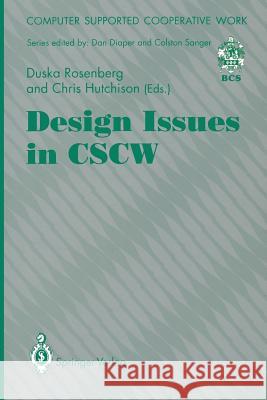
Design Issues in CSCW Duska Rosenberg, Christopher Hutchison 9783540198109 Springer-Verlag Berlin and Heidelberg GmbH &  - książkaWidoczna okładka, to zdjęcie poglądowe, a rzeczywista szata graficzna może różnić się od prezentowanej.

Design Issues in CSCW

ISBN-13: 9783540198109 / Angielski / Miękka / 1994 / 321 str.

Duska Rosenberg;Christopher Hutchison
cena 201,72 zł
(netto: 192,11 VAT:  5%)

Najniższa cena z 30 dni: 192,74 zł
Termin realizacji zamówienia:
ok. 22 dni roboczych
Bez gwarancji dostawy przed świętami

Darmowa dostawa!

One of the most significant developments in computing over the last ten years has been the growth of interest in computer based support for people working together. Recognition that much work done in offices is essentially group work has led to the emergence of a distinct subfield of computer science under the title Computer Supported Cooperative Work (CSCW). Since the term was first coined in 1984, there has been growing awareness of the relevance to the field of, and the valuable con- tributions to be made by, non-computing disciplines such as sociology, management science, social psychology and anthro- pology. This volume addresses design issues in CSCW, an- since this topic crucially involves human as well as technical considerations - brings together researchers from such a broad range of disciplines. Most of the chapters in this volume were originally presented as papers at the one-day seminar, "Design Issues in CSCW," held at the Department of Trade and Industry (DTI), London, on 17 March 1992, one in aseries of DTI-supported CSCW SIG seminars. We would like to express our gratitude to the series editors, Colston Sanger and Dan Diaper, for their useful comments on, and suggestions for revisions to, the final draft of the manuscript; to Linda Schofield, our editor at Springer, for her continued encouragement throughout the preparation of the manuscript; and, finally, to our respective families for their support and patience over so many months.


Kategorie:
Informatyka, Bazy danych
Kategorie BISAC:
Computers > Artificial Intelligence - General
Computers > Hardware - Cell Phones & Devices
Business & Economics > Management Science
Wydawca:
Springer-Verlag Berlin and Heidelberg GmbH &
Seria wydawnicza:
Computer Supported Cooperative Work
Język:
Angielski
ISBN-13:
9783540198109
Rok wydania:
1994
Dostępne języki:
Angielski
Wydanie:
Edition.
Numer serii:
000005162
Ilość stron:
321
Waga:
0.52 kg
Wymiary:
23.523.5 x 15.5
Oprawa:
Miękka
Wolumenów:
01
Dodatkowe informacje:
Komentarz
Bibliografia
Wydanie ilustrowane

1 Introduction.- 2 Computer Supported Cooperative Work: A Framework.- 2.1 Introduction.- 2.2 Cooperative Work.- 2.2.1 Cooperation.- 2.2.2 Work.- 2.2.3 Communication through the Artefact.- 2.2.4 Understanding: Soft and Hard Artefacts.- 2.2.5 Deixis.- 2.3 Computer Support: Communication.- 2.3.1 Computer Mediated Communication.- 2.3.2 Anti-CMC.- 2.4 Computerized Artefacts of Work.- 2.5 Non-Computerized Artefacts.- 2.5.1 Prosthesis.- 2.5.2 Implications for Design.- 2.5.3 Success Story: Bar Codes.- 2.6 Summary.- 3 Capturing Interactions: Requirements for CSCW.- 3.1 Design Issues for CSCW.- 3.1.1 The Life-Cycle Framework.- 3.2 Ethnographic Study of Office Work.- 3.3 Case Study of a Technical Publications Unit.- 3.3.1 Organizational Description.- 3.3.2 Authors’ Views on their Work.- 3.3.3 Life History of a Job.- 3.3.4 Job Conditions.- 3.3.5 Interaction Episodes.- 3.4 The Analysis.- 3.4.1 Strategy.- 3.4.2 Classification of Activities.- 3.5 Conclusions.- 3.5.1 What the Authors Want.- 3.5.2 What the Analysis Found.- 3.5.3 In Conclusion.- 4 Situation Theory and the Design of Interactive Information Systems.- 4.1 Introduction.- 4.2 Information.- 4.3 On Mathematics, Metaphor and Design.- 4.4 Situation Theory: A Review.- 4.5 Normative Constraints and Cognition.- 4.6 Information, Situations and Design.- 4.7 Multimedia and Multi-User.- 4.8 The Role of Situation Theory.- 4.9 Conclusion.- 5 Patterns of Language in Organizations: Implications for CSCW.- 5.1 Introduction.- 5.1.1 Aims.- 5.1.2 The Sopwith Case Study.- 5.2 Four Models of Linguistic Support for Collaborative Work.- 5.2.1 Language and Information.- 5.2.2 Sociometric Analysis.- 5.2.3 Style Checkers: Form versus Content.- 5.2.4 Language and Reality: An Overview of Systemic Functional Linguistics.- 5.2.5 Language, Information and Organizations.- 5.3 Conclusions.- Appendix A.- A.1 The Message from Leyland.- A. 2 How the Sunday Times Rewrote It.- Appendix B.- B.1 Alcatraz on the Third Floor or Communications and Information Free of Time and Space (CIFTS!).- 6 Coordination Issues in Tools for CSCW.- 6.1 Introduction.- 6.2 Early Experiences with CSCW.- 6.3 Cognitive Issues in CSCW.- 6.4 Conversation Analysis.- 6.4.1 Turn Management in Conversations.- 6.4.2 An Example of Conversation Analysis.- 6.5 Coordination in CSCW.- 6.6 Studies of Turn Management in CSCW.- 6.7 Discussion.- 6.8 Concluding Remarks.- Appendix A.- A.1 Annotated Bibliography.- 7 Software Engineering Design: A Paradigm Case of Computer Supported Cooperative Working.- 7.1 Introduction.- 7.1.1 What is Design Theory?.- 7.1.2 Is Design a Natural Phenomenon?.- 7.1.3 A View of Design from Cognitive Science.- 7.2 Use of Abstract Representations.- 7.2.1 Implications for Design Methods and Tool Support.- 7.2.2 Philosophical Issues: Are they relevant?.- 7.2.3 The Role of Concepts in Structuring Knowledge.- 7.3 The Design Frameworks Approach.- 7.4 An Approach to Design-for-Reuse.- 7.4.1 Considerations Regarding the Use of Frameworks in Design.- 7.5 Conclusions.- 8 Where Are Designers? Styles of Design Practice, Objects of Design and Views of Users in CSCW.- 8.1 Design as Technique, as Social Function and as Politics.- 8.2 Three Interpretations of the Significance of “Users”.- 8.3 Users as Clients: The “Specify and Deliver” Style.- 8.4 Users as Codesigners: The “Reflect and Reinterpret” Style.- 8.5 Users as Actor-Constructors: The “Enable and Empower” Style.- 8.6 Where are Designers? The Geo-Economic “Location” Problem.- 8.7 Taking Design with Us.- 9 Coping with Complexity and Interference: Design Issues in Multimedia Conferencing Systems.- 9.1 Introduction.- 9.2 The CAR Multimedia Conferencing System.- 9.3 Design Principles.- 9.3.1 WYSIWIS.- 9.3.2 Seamlessness.- 9.4 Design and Usability Issues.- 9.4.1 Screen Clutter.- 9.4.2 Unexpected Events.- 9.4.3 Notification of Events.- 9.4.4 Floor Control.- 9.4.5 Pointers.- 9.5 Discussion: Design Principles for Multimedia Conferencing.- 9.6 Conclusions.- 10 The Role of Replication in the Development of Remote CSCW Systems.- 10.1 Designing for the Future.- 10.1.1 The System Designer as Creative Problem Solver.- 10.1.2 The Difficulty of Exchanging Creation for Facilitation.- 10.1.3 Single-User Product Innovation.- 10.2 Designing for the Present: Replication.- 10.3 An Experiment in Replication.- 10.3.1 The ROCOCO Station.- 10.3.2 User Interface.- 10.4 Evaluating the System.- 10.4.1 The LookingGlass.- 10.4.2 An Investigation of the LookingGlass in Use.- 10.5 Conclusion.- 11 Computer Supported Conflict Management in Design Teams.- 11.1 The Challenge: Supporting Collaboration in Design Groups.- 11.2 Contributions and Limitations of Existing Work.- 11.3 The Design Collaboration Support System.- 11.3.1 Describing Design Actions and Rationale.- 11.3.2 Detecting Conflicts.- 11.3.3 Resolving Conflicts.- 11.4 Evaluation and Future Work.- 12 ShareLib: A Toolkit for CSCW Applications Programming Using X Windows.- 12.1 Introduction.- 12.2 Existing Applications.- 12.3 Other Similar Work.- 12.4 What Programming Support Should Provide.- 12.4.1 Features of CSCW.- 12.4.2 Tailorability.- 12.5 Design of ShareLib: Architecture.- 12.5.1 A New Level of Abstraction.- 12.5.2 Features and Tailorability Provided by the CSCW Layer.- 12.6 Design of ShareLib: Implementation.- 12.6.1 The X Window System.- 12.6.2 ShareLib as a Layer above X Windows.- 12.7 Example Implementation: The Telepointer.- 12.7.1 Writing Xlib Applications.- 12.7.2 The Telepointer Type.- 12.7.3 Initializing the Telepointer.- 12.7.4 Processing Telepointer Events.- 12.7.5 Floor Control.- 12.7.6 Drawing the Telepointer Pixmap.- 12.8 Summary and Further Work.- 13 Adapting a Design History Editor for Concurrent Engineering.- 13.1 Introduction.- 13.1.1 Motivation.- 13.1.2 Starting Point.- 13.1.3 Outline of the DHE Work.- 13.2 Design History Editor.- 13.2.1 Inherent Difficulties with Current Approaches.- 13.2.2 Conventional Logbooks and Hypertext.- 13.2.3 The Impact of Prescription.- 13.3 User Requirements of the Design History Editor.- 13.3.1 Page Emulation.- 13.3.2 Representation of Finer Structure.- 13.3.3 The Lemma.- 13.4 Technology.- 13.4.1 The SMART Frame Server.- 13.4.2 The Blackboard Architecture.- 13.4.3 Managing Knowledge Assets.- 13.4.4 Khoros.- 13.5 Technology Transfer.- 13.6 Concluding Remarks.- 14 “Nouvelle Design”: A Pragmatic Approach to CSCW Systems Building.- 14.1 Introduction.- 14.2 Background.- 14.3 Conversation Analysis.- 14.4 User Centred Design.- 14.5 Requirements Capture ? Structured Observation.- 14.5.1 Basic System Functionality.- 14.5.2 Prototyping.- 14.5.3 Evaluation.- 14.5.4 Subject Selection.- 14.5.6 Types of Data.- 14.6 System Specification ? Analyse Observations.- 14.6.1 Aims of Analysis Phase.- 14.6.2 Data Analysis.- 14.7 Build and Release ? Review, Interpret, Modify.- 14.7.1 Aims of this Phase.- 14.8 Application of the Design Process.- 14.8.1 Programme.- 14.8.2 Evaluation.- 14.9 Summary and Conclusions.- References.- Name Index.


Udostępnij

Facebook - konto krainaksiazek.pl


Opinie o Krainaksiazek.pl na Opineo.pl

Partner Mybenefit

Krainaksiazek.pl w programie rzetelna firma Krainaksiaze.pl - płatności przez paypal

Czytaj nas na:

Facebook - krainaksiazek.pl
  • książki na zamówienie
  • granty
  • książka na prezent
  • kontakt
  • pomoc
  • opinie
  • regulamin
  • polityka prywatności

Zobacz:

  • Księgarnia czeska

  • Wydawnictwo Książkowe Klimaty

1997-2025 DolnySlask.com Agencja Internetowa

© 1997-2022 krainaksiazek.pl
     
KONTAKT | REGULAMIN | POLITYKA PRYWATNOŚCI | USTAWIENIA PRYWATNOŚCI
Zobacz: Księgarnia Czeska | Wydawnictwo Książkowe Klimaty | Mapa strony | Lista autorów
KrainaKsiazek.PL - Księgarnia Internetowa

Polityka prywatnosci - link
Krainaksiazek.pl - płatnośc Przelewy24
Przechowalnia Przechowalnia






