• Wyszukiwanie zaawansowane
  • Kategorie
  • Kategorie BISAC
  • Książki na zamówienie
  • Promocje
  • Granty
  • Książka na prezent
  • Opinie
  • Pomoc
  • Załóż konto
  • Zaloguj się

Delegate Apportionment in the US Presidential Primaries: A Mathematical Analysis » książka


zaloguj się | załóż konto
Logo Krainaksiazek.pl

koszyk

konto

szukaj
topmenu
Księgarnia internetowa
Szukaj
Książki na zamówienie
Promocje
Granty
Książka na prezent
Moje konto
Pomoc
 
 
Wyszukiwanie zaawansowane
Pusty koszyk
Bezpłatna dostawa dla zamówień powyżej 20 złBezpłatna dostawa dla zamówień powyżej 20 zł

Kategorie główne

• Nauka
 [2949965]
• Literatura piękna
 [1857847]

  więcej...
• Turystyka
 [70818]
• Informatyka
 [151303]
• Komiksy
 [35733]
• Encyklopedie
 [23180]
• Dziecięca
 [617748]
• Hobby
 [139972]
• AudioBooki
 [1650]
• Literatura faktu
 [228361]
• Muzyka CD
 [398]
• Słowniki
 [2862]
• Inne
 [444732]
• Kalendarze
 [1620]
• Podręczniki
 [167233]
• Poradniki
 [482388]
• Religia
 [509867]
• Czasopisma
 [533]
• Sport
 [61361]
• Sztuka
 [243125]
• CD, DVD, Video
 [3451]
• Technologie
 [219309]
• Zdrowie
 [101347]
• Książkowe Klimaty
 [123]
• Zabawki
 [2362]
• Puzzle, gry
 [3791]
• Literatura w języku ukraińskim
 [253]
• Art. papiernicze i szkolne
 [7933]
Kategorie szczegółowe BISAC

Delegate Apportionment in the US Presidential Primaries: A Mathematical Analysis

ISBN-13: 9783031249532 / Angielski
Michael a. Jones; David McCune; Jennifer M. Wilson
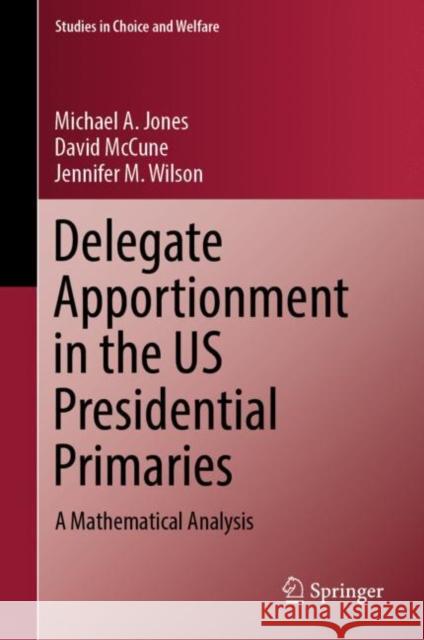
Delegate Apportionment in the US Presidential Primaries: A Mathematical Analysis Michael a. Jones David McCune Jennifer M. Wilson 9783031249532 Springer - książkaWidoczna okładka, to zdjęcie poglądowe, a rzeczywista szata graficzna może różnić się od prezentowanej.

Delegate Apportionment in the US Presidential Primaries: A Mathematical Analysis

ISBN-13: 9783031249532 / Angielski

Michael a. Jones; David McCune; Jennifer M. Wilson
cena 403,47 zł
(netto: 384,26 VAT:  5%)

Najniższa cena z 30 dni: 385,52 zł
Termin realizacji zamówienia:
ok. 22 dni roboczych
Bez gwarancji dostawy przed świętami

Darmowa dostawa!
inne wydania

This book provides a comprehensive mathematical description and analysis of the delegate allocation processes in the US Democratic and Republican presidential primaries, focusing on the role of apportionment methods and the effect of thresholds—the minimum levels of support required to receive delegates.  The analysis involves a variety of techniques, including theoretical arguments, simplicial geometry, Monte Carlo simulation, and examination of presidential primary data from 2004 to 2020.The book is divided into two parts: Part I defines the classical apportionment problem and explains how the implementation and goals of delegate apportionment differ from those of apportionment for state representation in the US House of Representatives and for party representation in legislatures based on proportional representation. The authors then describe how delegates are assigned to states and congressional districts and formally define the delegate apportionment methods used in each state by the two major parties to allocate delegates to presidential candidates.Part II analyzes and compares the apportionment methods introduced in Part I based on their level of bias and adherence to various notions of proportionality. It explores how often the methods satisfy the quota condition and quantifies their biases in favor or against the strongest and weakest candidates. Because the methods are quota-based, they are susceptible to classical paradoxes like the Alabama and population paradoxes. They also suffer from other paradoxes that are more relevant in the context of delegate apportionment such as the elimination and aggregation paradoxes. The book evaluates the extent to which each method is susceptible to each paradox. Finally, it discusses the appointment of delegates based on divisor methods and notions of regressive proportionality.This book appeals to scholars and students interested in mathematical economics and political science, with an emphasis on apportionment and social choice theory.


This book provides a comprehensive mathematical description and analysis of the delegate allocation processes in the US Democratic and Republican presidential primaries, focusing on the role of apportionment methods and the effect of thresholds—the minimum levels of support required to receive delegates.  The analysis involves a variety of techniques, including theoretical arguments, simplicial geometry, Monte Carlo simulation, and examination of presidential primary data from 2004 to 2020.

The book is divided into two parts: Part I defines the classical apportionment problem and explains how the implementation and goals of delegate apportionment differ from those of apportionment for state representation in the US House of Representatives and for party representation in legislatures based on proportional representation. The authors then describe how delegates are assigned to states and congressional districts and formally define the delegate apportionment methods used in each state by the two major parties to allocate delegates to presidential candidates.

Part II analyzes and compares the apportionment methods introduced in Part I based on their level of bias and adherence to various notions of proportionality. It explores how often the methods satisfy the quota condition and quantifies their biases in favor or against the strongest and weakest candidates. Because the methods are quota-based, they are susceptible to classical paradoxes like the Alabama and population paradoxes. They also suffer from other paradoxes that are more relevant in the context of delegate apportionment such as the elimination and aggregation paradoxes. The book evaluates the extent to which each method is susceptible to each paradox. Finally, it discusses the appointment of delegates based on divisor methods and notions of regressive proportionality.
This book appeals to scholars and students interested in mathematical economics and political science, with an emphasis on apportionment and social choice theory.

Kategorie:
Nauka, Ekonomia i biznes
Kategorie BISAC:
Business & Economics > Economics - Theory
Mathematics > Matematyka stosowana
Political Science > Political Ideologies - Democracy
Wydawca:
Springer
Seria wydawnicza:
Studies in Choice and Welfare
Język:
Angielski
ISBN-13:
9783031249532

Part I. Description of Delegate Allocation Rules.- Chapter 1. Apportionment in the US Presidential Primaries.- Chapter 2. The Democratic Party Primary.- Chapter 3. The Iowa and Nevada Democratic Caucuses.- Chapter 4. The Republican Party Primary.- Part II. Analysis of Delegate Allocation Rules.- Chapter 5. Properties of the Apportionment Methods used in the Primaries.- Chapter 6. Paradoxes.- Chapter 7. Exploring Alternative Ways to Allocate Delegates


Michael A. Jones is Associate Editor and Managing Editor of Mathematical Reviews, a division of the American Mathematical Society.  Previously, he held faculty positions at Montclair State University in New Jersey (USA), Loyola University Chicago and the US Military Academy at West Point.  From 2015 to 2019, he served as the editor of the Mathematical Association of America’s Mathematics Magazine.  He earned his doctorate in game theory under Donald G. Saari from Northwestern University’s Department of Mathematics in 1994. His research often focuses on the application of mathematics to the social sciences.
 
David McCune earned his PhD in algebra from the University of Nebraska-Lincoln (USA) in 2011. He is Associate Professor of mathematics at William Jewell College (USA), where he has worked since 2012. His main area of research is mathematical political science, with an emphasis on apportionment and social choice theory.

Jennifer M. Wilson earned her PhD in 1993 from Princeton University (USA). She is currently Associate Professor in the Department of Natural Sciences and Mathematics at Eugene Lang College, The New School, where she has been on the faculty since 2003. Her research focuses on the idea of fairness and its application to mathematical problems in the social sciences. She has published articles on cooperative game theory, social choice theory, resource allocation, and apportionment. She also writes and teaches on connections between mathematics and the arts, and was a member of the Visualizing Finance Lab at Parsons, The New School, for many years.


This book provides a comprehensive mathematical description and analysis of the delegate allocation processes in the US Democratic and Republican presidential primaries, focusing on the role of apportionment methods and the effect of thresholds—the minimum levels of support required to receive delegates.  The analysis involves a variety of techniques, including theoretical arguments, simplicial geometry, Monte Carlo simulation, and examination of presidential primary data from 2004 to 2020.

The book is divided into two parts: Part I defines the classical apportionment problem and explains how the implementation and goals of delegate apportionment differ from those of apportionment for state representation in the US House of Representatives and for party representation in legislatures based on proportional representation. The authors then describe how delegates are assigned to states and congressional districts and formally define the delegate apportionment methods used in each state by the two major parties to allocate delegates to presidential candidates.

Part II analyzes and compares the apportionment methods introduced in Part I based on their level of bias and adherence to various notions of proportionality. It explores how often the methods satisfy the quota condition and quantifies their biases in favor or against the strongest and weakest candidates. Because the methods are quota-based, they are susceptible to classical paradoxes like the Alabama and population paradoxes. They also suffer from other paradoxes that are more relevant in the context of delegate apportionment such as the elimination and aggregation paradoxes. The book evaluates the extent to which each method is susceptible to each paradox. Finally, it discusses the appointment of delegates based on divisor methods and notions of regressive proportionality.


This book appeals to scholars and students interested in mathematical economics and political science, with an emphasis on apportionment and social choice theory.




Udostępnij

Facebook - konto krainaksiazek.pl


Opinie o Krainaksiazek.pl na Opineo.pl

Partner Mybenefit

Krainaksiazek.pl w programie rzetelna firma Krainaksiaze.pl - płatności przez paypal

Czytaj nas na:

Facebook - krainaksiazek.pl
  • książki na zamówienie
  • granty
  • książka na prezent
  • kontakt
  • pomoc
  • opinie
  • regulamin
  • polityka prywatności

Zobacz:

  • Księgarnia czeska

  • Wydawnictwo Książkowe Klimaty

1997-2025 DolnySlask.com Agencja Internetowa

© 1997-2022 krainaksiazek.pl
     
KONTAKT | REGULAMIN | POLITYKA PRYWATNOŚCI | USTAWIENIA PRYWATNOŚCI
Zobacz: Księgarnia Czeska | Wydawnictwo Książkowe Klimaty | Mapa strony | Lista autorów
KrainaKsiazek.PL - Księgarnia Internetowa

Polityka prywatnosci - link
Krainaksiazek.pl - płatnośc Przelewy24
Przechowalnia Przechowalnia



