• Wyszukiwanie zaawansowane
  • Kategorie
  • Kategorie BISAC
  • Książki na zamówienie
  • Promocje
  • Granty
  • Książka na prezent
  • Opinie
  • Pomoc
  • Załóż konto
  • Zaloguj się

Decision Support for Forest Management » książka


zaloguj się | załóż konto
Logo Krainaksiazek.pl

koszyk

konto

szukaj
topmenu
Księgarnia internetowa
Szukaj
Książki na zamówienie
Promocje
Granty
Książka na prezent
Moje konto
Pomoc
 
 
Wyszukiwanie zaawansowane
Pusty koszyk
Bezpłatna dostawa dla zamówień powyżej 20 złBezpłatna dostawa dla zamówień powyżej 20 zł

Kategorie główne

• Nauka
 [2949965]
• Literatura piękna
 [1857847]

  więcej...
• Turystyka
 [70818]
• Informatyka
 [151303]
• Komiksy
 [35733]
• Encyklopedie
 [23180]
• Dziecięca
 [617748]
• Hobby
 [139972]
• AudioBooki
 [1650]
• Literatura faktu
 [228361]
• Muzyka CD
 [398]
• Słowniki
 [2862]
• Inne
 [444732]
• Kalendarze
 [1620]
• Podręczniki
 [167233]
• Poradniki
 [482388]
• Religia
 [509867]
• Czasopisma
 [533]
• Sport
 [61361]
• Sztuka
 [243125]
• CD, DVD, Video
 [3451]
• Technologie
 [219309]
• Zdrowie
 [101347]
• Książkowe Klimaty
 [123]
• Zabawki
 [2362]
• Puzzle, gry
 [3791]
• Literatura w języku ukraińskim
 [253]
• Art. papiernicze i szkolne
 [7933]
Kategorie szczegółowe BISAC

Decision Support for Forest Management

ISBN-13: 9789048177271 / Angielski / Miękka / 2010 / 224 str.
Annika Kangas;Jyrki Kangas;Mikko Kurttila
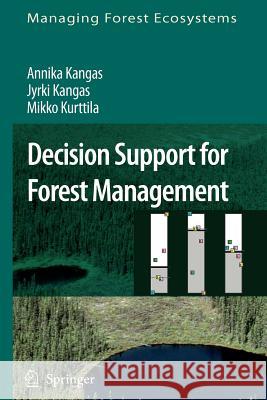
Decision Support for Forest Management Annika Kangas, Jyrki Kangas, Mikko Kurttila 9789048177271 Springer - książkaWidoczna okładka, to zdjęcie poglądowe, a rzeczywista szata graficzna może różnić się od prezentowanej.

Decision Support for Forest Management

ISBN-13: 9789048177271 / Angielski / Miękka / 2010 / 224 str.

Annika Kangas;Jyrki Kangas;Mikko Kurttila
cena 339,36 zł
(netto: 323,20 VAT:  5%)

Najniższa cena z 30 dni: 324,26 zł
Termin realizacji zamówienia:
ok. 22 dni roboczych
Bez gwarancji dostawy przed świętami

Darmowa dostawa!

The goal of Kangas, Kangas and Kurttila's Decision Support for Forest Management is to provide students and researchers with a toolbox of methods for approaching the different planning situations that may arise in practice. It draws together a wide range of methods used in planning forest management regimes and presents a systematic overview of current methodological approaches. While earlier books concerning forest planning have tended to focus on linear programming, economic aspects, or specific multi-criteria decision aid tools, this book provides a much broader range of tools to meet a variety of planning situations. The methods themselves cover a range of decision situations - from cases involving single decision makers, through group decision making, to participatory planning. They include traditional decision support tools, from optimization to utility functions, as well as methods that are just gaining ground in forest planning - such as problem structuring methods and social choice theory. Including examples which illustrate the application of each technique to specific management planning problems, the book offers an invaluable resource for both researchers and advanced students specializing in management and planning issues relating to forestry.


Kategorie:
Nauka, Biologia i przyroda
Kategorie BISAC:
Technology & Engineering > Agriculture - Forestry
Business & Economics > Operations Research
Technology & Engineering > Environmental - General
Wydawca:
Springer
Seria wydawnicza:
Managing Forest Ecosystems
Język:
Angielski
ISBN-13:
9789048177271
Rok wydania:
2010
Dostępne języki:
Angielski
Numer serii:
000206834
Ilość stron:
224
Waga:
0.45 kg
Wymiary:
23.523.5 x 15.5
Oprawa:
Miękka
Wolumenów:
01

From the reviews:

"It introduces many numerical techniques, and a fairly advanced level of knowledge ... . If today's forest managers are to successfully manage the multiple values in a forest, they need to be aware of the decision support techniques that are available to them, and this book will certainly provide that information. Forestry students also need to know about these techniques if they wish to become successful forest managers ... . It can therefore be recommended to all those involved in forest management." (John Innes, International Forestry Review, Vol. 10 (4), 2008)

Preface. Acknowledgements. 1. Introduction. 1.1 Planning and decision support. 1.2 Forest management planning. 1.3 History of forest planning.- Discrete problems. 2. Unidimensional problems. 2.1 Decisions under risk and uncertainty. 2.2 Measuring utility and value. 2.2.1 Estimating a utility function. 2.2.2 Estimating a value function.- 3. Multi-criteria decision problems. 3.1 Theoretical aspects. 3.2 Multi-attribute utility functions. 3.2.1 Function forms. 3.2.2 Basis for estimating the weights. 3.2.3 SMART. 3.3 Even Swaps. 3.4 Analytic hierarchy process. 3.4.1 Decision problem. 3.4.2 Phases of AHP. 3.4.3 Uncertainty in AHP. 3.4.4 ANP. 3.5 A'WOT.- 4. Uncertainty in multi-criteria decision making. 4.1 Nature of uncertainty. 4.2 Fuzzy set theory. 4.2.1 Membership functions and fuzzy numbers. 4.2.2 Fuzzy goals in decision making. 4.2.3 Fuzzy additive weighting. 4.3 Possibility theory in decision making. 4.4 Evidence theory. 4.5 Outranking methods. 4.5.1 Outline. 4.5.2 PROMETHEE method. 4.5.3 ELECTRE method. 4.5.4 Other outranking methods. 4.6 Probabilistic uncertainty in decision analysis. 4.6.1 Stochastic multicriteria acceptability analysis (SMAA). 4.6.2 SMAA-O. 4.6.3 Pairwise probabilities.- Continuous problems. 5. Optimization. 5.1 Linear programming. 5.1.1 Primal problem. 5.1.2 Dual problem. 5.1.3 Forest planning problem with several stands. 5.1.4 JLP software. 5.2 Goal programming. 5.3 Integer programming. 5.4 Uncertainty in optimization. 5.5 Robust portfolio modelling. 5.5.1 Principles of the method. 5.5.2 Use of RPM in forest planning.- 6. Heuristic optimization. 6.1 Principles. 6.2 Objective function forms. 6.3 HERO. 6.4 Simulated annealing and threshold accepting. 6.5 Tabu search. 6.6 Genetic algorithms. 6.7 Improving the heuristic search. 6.7.1 Parameters of heuristic optimisation techniques. 6.7.2 Expanding the neighbourhood. 6.7.3 Combining optimisation techniques.- Cases with several decision makers. 7. Group decision making and participatory planning. 7.1 Decision makers and stakeholders. 7.2 Public participation process. 7.2.1 Types of participation process. 7.2.2 Success of the participation process. 7.2.3 Defining the appropriate process. 7.3 Tools for eliciting the public preferences. 7.3.1 Surveys. 7.3.2 Public hearings. 7.4 Problem structuring methods. 7.4.1 Background. 7.4.2 Strategic options development and analysis (SODA). 7.4.3 Soft systems methodology (SSM). 7.5 Decision support for group decision making.- 8. Voting methods. 8.1 Social choice theory. 8.1.1 Outline. 8.1.2 Evaluation criteria for voting systems. 8.2 Positional voting schemes. 8.2.1 Plurality voting. 8.2.2 Approval voting. 8.2.3 Borda count. 8.3 Pairwise voting. 8.4 Fuzzy voting. 8.5 Probability voting. 8.6 Multicriteria approval. 8.6.1 Original method. 8.6.2 Fuzzy MA. 8.6.3 Multicriteria approval voting.- Application viewpoints. 9. Behavioural aspects. 9.1 Criticism towards decision theory. 9.1.1 Outline. 9.1.2 Satisficing or maximizing?. 9.1.3 Rules or rational behaviour?. 9.2 Image theory. 9.3 Prospect theory.- 10. Practical examples of using MCDS methods. 10.1 Landscape ecological planning. 10.2 Participatory planning. 10.3 Spatial objectives and heuristic optimisation in practical forest planning.- 11. Final remarks.-

The goal of Kangas, Kangas and Kurttila's Decision Support for Forest Management is to provide students and researchers with a toolbox of methods for approaching the different planning situations that may arise in practice. It draws together a wide range of methods used in planning forest management regimes and presents a systematic overview of current methodological approaches.

While earlier books concerning forest planning have tended to focus on linear programming, economic aspects, or specific multi-criteria decision aid tools, this book provides a much broader range of tools to meet a variety of planning situations. The methods themselves cover a range of decision situations – from cases involving single decision makers, through group decision making, to participatory planning. They include traditional decision support tools, from optimization to utility functions, as well as methods that are just gaining ground in forest planning – such as problem structuring methods and social choice theory.

Including examples which illustrate the application of each technique to specific management planning problems, the book offers an invaluable resource for both researchers and advanced students specializing in management and planning issues relating to forestry.




Udostępnij

Facebook - konto krainaksiazek.pl


Opinie o Krainaksiazek.pl na Opineo.pl

Partner Mybenefit

Krainaksiazek.pl w programie rzetelna firma Krainaksiaze.pl - płatności przez paypal

Czytaj nas na:

Facebook - krainaksiazek.pl
  • książki na zamówienie
  • granty
  • książka na prezent
  • kontakt
  • pomoc
  • opinie
  • regulamin
  • polityka prywatności

Zobacz:

  • Księgarnia czeska

  • Wydawnictwo Książkowe Klimaty

1997-2025 DolnySlask.com Agencja Internetowa

© 1997-2022 krainaksiazek.pl
     
KONTAKT | REGULAMIN | POLITYKA PRYWATNOŚCI | USTAWIENIA PRYWATNOŚCI
Zobacz: Księgarnia Czeska | Wydawnictwo Książkowe Klimaty | Mapa strony | Lista autorów
KrainaKsiazek.PL - Księgarnia Internetowa

Polityka prywatnosci - link
Krainaksiazek.pl - płatnośc Przelewy24
Przechowalnia Przechowalnia



