• Wyszukiwanie zaawansowane
  • Kategorie
  • Kategorie BISAC
  • Książki na zamówienie
  • Promocje
  • Granty
  • Książka na prezent
  • Opinie
  • Pomoc
  • Załóż konto
  • Zaloguj się

Data Science Concepts and Techniques with Applications » książka


zaloguj się | załóż konto
Logo Krainaksiazek.pl

koszyk

konto

szukaj
topmenu
Księgarnia internetowa
Szukaj
Książki na zamówienie
Promocje
Granty
Książka na prezent
Moje konto
Pomoc
 
 
Wyszukiwanie zaawansowane
Pusty koszyk
Bezpłatna dostawa dla zamówień powyżej 20 złBezpłatna dostawa dla zamówień powyżej 20 zł

Kategorie główne

• Nauka
 [2949965]
• Literatura piękna
 [1857847]

  więcej...
• Turystyka
 [70818]
• Informatyka
 [151303]
• Komiksy
 [35733]
• Encyklopedie
 [23180]
• Dziecięca
 [617748]
• Hobby
 [139972]
• AudioBooki
 [1650]
• Literatura faktu
 [228361]
• Muzyka CD
 [398]
• Słowniki
 [2862]
• Inne
 [444732]
• Kalendarze
 [1620]
• Podręczniki
 [167233]
• Poradniki
 [482388]
• Religia
 [509867]
• Czasopisma
 [533]
• Sport
 [61361]
• Sztuka
 [243125]
• CD, DVD, Video
 [3451]
• Technologie
 [219309]
• Zdrowie
 [101347]
• Książkowe Klimaty
 [123]
• Zabawki
 [2362]
• Puzzle, gry
 [3791]
• Literatura w języku ukraińskim
 [253]
• Art. papiernicze i szkolne
 [7933]
Kategorie szczegółowe BISAC

Data Science Concepts and Techniques with Applications

ISBN-13: 9783031174414 / Angielski / Miękka / 2023 / 474 str.
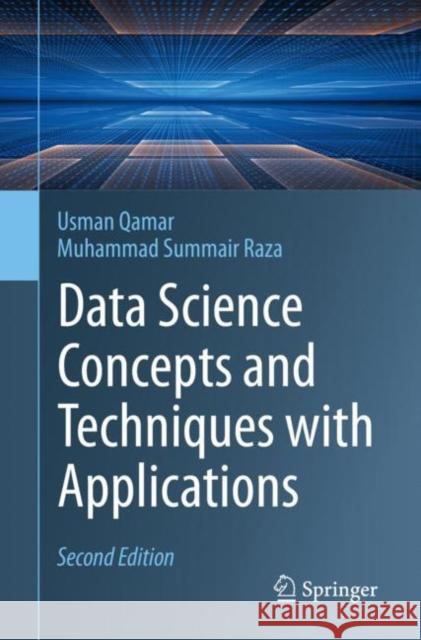
Usman Qamar; Muhammad Summair Raza
Data Science Concepts and Techniques with Applications Usman Qamar Muhammad Summair Raza 9783031174414 Springer - książkaWidoczna okładka, to zdjęcie poglądowe, a rzeczywista szata graficzna może różnić się od prezentowanej.

Data Science Concepts and Techniques with Applications

ISBN-13: 9783031174414 / Angielski / Miękka / 2023 / 474 str.

Usman Qamar; Muhammad Summair Raza
cena 282,42
(netto: 268,97 VAT:  5%)

Najniższa cena z 30 dni: 269,85
Termin realizacji zamówienia:
ok. 22 dni roboczych
Bez gwarancji dostawy przed świętami

Darmowa dostawa!

This textbook comprehensively covers both fundamental and advanced topics related to data science. Data science is an umbrella term that encompasses data analytics, data mining, machine learning, and several other related disciplines.The chapters of this book are organized into three parts: The first part (chapters 1 to 3) is a general introduction to data science. Starting from the basic concepts, the book will highlight the types of data, its use, its importance and issues that are normally faced in data analytics, followed by presentation of a wide range of applications and widely used techniques in data science. The second part, which has been updated and considerably extended compared to the first edition, is devoted to various techniques and tools applied in data science. Its chapters 4 to 10 detail data pre-processing, classification, clustering, text mining, deep learning, frequent pattern mining, and regression analysis. Eventually, the third part (chapters 11 and 12) present a brief introduction to Python and R, the two main data science programming languages, and shows in a completely new chapter practical data science in the WEKA (Waikato Environment for Knowledge Analysis), an open-source tool for performing different machine learning and data mining tasks. An appendix explaining the basic mathematical concepts of data science completes the book.This textbook is suitable for advanced undergraduate and graduate students as well as for industrial practitioners who carry out research in data science. They both will not only benefit from the comprehensive presentation of important topics, but also from the many application examples and the comprehensive list of further readings, which point to additional publications providing more in-depth research results or provide sources for a more detailed description of related topics."This book delivers a systematic, carefully thoughtful material on Data Science." from the Foreword by Witold Pedrycz, U Alberta, Canada.

This textbook comprehensively covers both fundamental and advanced topics related to data science. Data science is an umbrella term that encompasses data analytics, data mining, machine learning, and several other related disciplines. The chapters of this book are organized into three parts: The first part (chapters 1 to 3) is a general introduction to data science. Starting from the basic concepts, the book will highlight the types of data, its use, its importance and issues that are normally faced in data analytics, followed by presentation of a wide range of applications and widely used techniques in data science. The second part, which has been updated and considerably extended compared to the first edition, is devoted to various techniques and tools applied in data science. Its chapters 4 to 10 detail data pre-processing, classification, clustering, text mining, deep learning, frequent pattern mining, and regression analysis. Eventually, the third part (chapters 11 and 12) present a brief introduction to Python and R, the two main data science programming languages, and shows in a completely new chapter practical data science in the WEKA (Waikato Environment for Knowledge Analysis), an open-source tool for performing different machine learning and data mining tasks. An appendix explaining the basic mathematical concepts of data science completes the book. This textbook is suitable for advanced undergraduate and graduate students as well as for industrial practitioners who carry out research in data science. They both will not only benefit from the comprehensive presentation of important topics, but also from the many application examples and the comprehensive list of further readings, which point to additional publications providing more in-depth research results or provide sources for a more detailed description of related topics. 


"This book delivers a systematic, carefully thoughtful material on Data Science." from the Foreword by Witold Pedrycz, U Alberta, Canada.

Kategorie:
Informatyka, Bazy danych
Kategorie BISAC:
Computers > Data Science - Data Analytics
Mathematics > Prawdopodobieństwo i statystyka
Computers > Artificial Intelligence - General
Wydawca:
Springer
Język:
Angielski
ISBN-13:
9783031174414
Rok wydania:
2023
Dostępne języki:
Ilość stron:
474
Oprawa:
Miękka
Dodatkowe informacje:
Wydanie ilustrowane

Section-1: Data Science – The “What”


Chapter-1: Introduction
First chapter will set the basic foundation of the subject for students. Like many other books, this introductory level chapter will comprise of the basic concepts. Introduction of the following concepts will be discussed:
• Data Science
• Importance of data science
• Applications of data science
• Data Driven Decision Making
• Data analysis
Chapter-2: Widely used techniques in data science
This chapter will discuss the concepts required for one to start working on data analysis. Chapter will comprise of the concepts that student should know before performing any task on data analysis and some of the tasks that can be performed as part of data analysis. Following concepts will be discussed.
• Supervised vs Unsupervised data
• Data understanding
• Data preparation
• Modeling
• Overfitting
• Random sampling
• Cross Validation
• Feature selection
• Outlier detection
• Rule extraction
Section-2: Data science: The “How”

Chapter-3: Statistical Inference
Every part of data analysis involves statistics and statistical inference to properly utilize data and perform decision making. This chapter will provide statistical concepts to support the data analysis tasks performed by students for decision making with real life data. Following topics will be discussed:
• Probability theory
• Transformations and expectations
• Common families of distribution
• Random variables
• Preparation of random samples
• Asymptotic evaluations
• Regression and regression models

Chapter-4: Supervised Learning 
In real world, we come across two types of data, supervised and unsupervised. In this chapter, we will discuss the concepts, tools and techniques related to processing of supervised data with examples and decision making out of it. The following concepts will be discussed:
• Supervised Learning
• Classification and Regression
• Generalization, Overfitting and Underfitting
• Evaluation models
• Supervised learning algorithms
Chapter-5: Unsupervised Learning
The unsupervised data forms the other half of the data available in real world applications. Like previous chapter, this chapter will include the concepts, tools and techniques related to unsupervised data with examples. Following contents will be included:
• Challenges of unsupervised learning
• Processing and scaling
• Clustering
• Dimensionality reduction, feature extraction and manifold learning
• Unsupervised learning algorithms
Chapter-6: Natural language processing
In this chapter, we will focus on one particular sort of data that has become extremely common i.e. text data. We will see in this chapter the fundamental principles of natural language processing and will look at one of the common application of NLP that is sentiment analysis. Following contents will be discussed:
• Why Text Is Important
• Why Text Is Difficult
• Representation
• Sentiment Analysis
• Lexicon-based Approaches for Text Mining
Section-3: Data Science – The “Where”

Chapter-7: Customers Analytics
In this chapter, we will introduce he use of analytics for understanding customers and predicting their behaviour in different situations. This includes the understanding of loyalty programs, market research, understanding customer lifetime value, predicting churn, and identifying potential defaulters. These are few examples of what will be contained in this chapter. 

Chapter-8: Operations Analytics
In this chapter, we will prepare our readers to understand and acknowledge the use of data science for improving business operations. For example, we will discuss how analyzing data can help avoid service outages, or at least predict the service outage in order to prepare contingency plans. Analyzing data can also help in identifying redundancies which can be removed in order to significantly reduce operational costs. We will give examples on how various manufacturing and service industries are using real-time sensor data to track their systems wear and tear. This helps them improve their mean time to repair by forecasting breakdown of different components well ahead in time.

Usman Qamar has over 15 years of experience in data engineering and decision sciences both in academia and industry. He is currently Tenured Professor of Data Sciences at the National University of Sciences and Technology (NUST) Pakistan and director of Knowledge and Data Science Research Centre, a Centre of Excellence at NUST, Pakistan. He has authored nearly 200 peer-reviewed publications and has also received multiple research awards.

Muhammad Summair Raza currently associated with the Virtual University of Pakistan as an assistant professor. He has published various papers in international-level journals and conferences with a focus on rough set theory. His research interests include feature selection, rough set theory, trend analysis, software design, software architecture, and non-functional requirements.


This textbook comprehensively covers both fundamental and advanced topics related to data science. Data science is an umbrella term that encompasses data analytics, data mining, machine learning, and several other related disciplines.

The chapters of this book are organized into three parts: The first part (chapters 1 to 3) is a general introduction to data science. Starting from the basic concepts, the book will highlight the types of data, its use, its importance and issues that are normally faced in data analytics, followed by presentation of a wide range of applications and widely used techniques in data science. The second part, which has been updated and considerably extended compared to the first edition, is devoted to various techniques and tools applied in data science. Its chapters 4 to 10 detail data pre-processing, classification, clustering, text mining, deep learning, frequent pattern mining, and regression analysis. Eventually, the third part (chapters 11 and 12) present a brief introduction to Python and R, the two main data science programming languages, and shows in a completely new chapter practical data science in the WEKA (Waikato Environment for Knowledge Analysis), an open-source tool for performing different machine learning and data mining tasks. An appendix explaining the basic mathematical concepts of data science completes the book.

This textbook is suitable for advanced undergraduate and graduate students as well as for industrial practitioners who carry out research in data science. They both will not only benefit from the comprehensive presentation of important topics, but also from the many application examples and the comprehensive list of further readings, which point to additional publications providing more in-depth research results or provide sources for a more detailed description of related topics. 

"This book delivers a systematic, carefully thoughtful material on Data Science." from the Foreword by Witold Pedrycz, U Alberta, Canada.


Udostępnij

Facebook - konto krainaksiazek.pl


Opinie o Krainaksiazek.pl na Opineo.pl

Partner Mybenefit

Krainaksiazek.pl w programie rzetelna firma Krainaksiaze.pl - płatności przez paypal

Czytaj nas na:

Facebook - krainaksiazek.pl
  • książki na zamówienie
  • granty
  • książka na prezent
  • kontakt
  • pomoc
  • opinie
  • regulamin
  • polityka prywatności

Zobacz:

  • Księgarnia czeska

  • Wydawnictwo Książkowe Klimaty

1997-2025 DolnySlask.com Agencja Internetowa

© 1997-2022 krainaksiazek.pl
     
KONTAKT | REGULAMIN | POLITYKA PRYWATNOŚCI | USTAWIENIA PRYWATNOŚCI
Zobacz: Księgarnia Czeska | Wydawnictwo Książkowe Klimaty | Mapa strony | Lista autorów
KrainaKsiazek.PL - Księgarnia Internetowa

Polityka prywatnosci - link
Krainaksiazek.pl - płatnośc Przelewy24
Przechowalnia Przechowalnia





