• Wyszukiwanie zaawansowane
  • Kategorie
  • Kategorie BISAC
  • Książki na zamówienie
  • Promocje
  • Granty
  • Książka na prezent
  • Opinie
  • Pomoc
  • Załóż konto
  • Zaloguj się

Data Mining and Machine Learning in Building Energy Analysis » książka

zaloguj się | załóż konto
Logo Krainaksiazek.pl

koszyk

konto

szukaj
topmenu
Księgarnia internetowa
Szukaj
Książki na zamówienie
Promocje
Granty
Książka na prezent
Moje konto
Pomoc
 
 
Wyszukiwanie zaawansowane
Pusty koszyk
Bezpłatna dostawa dla zamówień powyżej 20 złBezpłatna dostawa dla zamówień powyżej 20 zł

Kategorie główne

• Nauka
 [2949965]
• Literatura piękna
 [1857847]

  więcej...
• Turystyka
 [70818]
• Informatyka
 [151303]
• Komiksy
 [35733]
• Encyklopedie
 [23180]
• Dziecięca
 [617748]
• Hobby
 [139972]
• AudioBooki
 [1650]
• Literatura faktu
 [228361]
• Muzyka CD
 [398]
• Słowniki
 [2862]
• Inne
 [444732]
• Kalendarze
 [1620]
• Podręczniki
 [167233]
• Poradniki
 [482388]
• Religia
 [509867]
• Czasopisma
 [533]
• Sport
 [61361]
• Sztuka
 [243125]
• CD, DVD, Video
 [3451]
• Technologie
 [219309]
• Zdrowie
 [101347]
• Książkowe Klimaty
 [123]
• Zabawki
 [2362]
• Puzzle, gry
 [3791]
• Literatura w języku ukraińskim
 [253]
• Art. papiernicze i szkolne
 [7933]
Kategorie szczegółowe BISAC

Data Mining and Machine Learning in Building Energy Analysis

ISBN-13: 9781848214224 / Angielski / Twarda / 2016 / 186 str.
Fr'd'ric Magoul's; Frederic Magoules; Hai-Xiang Zhao
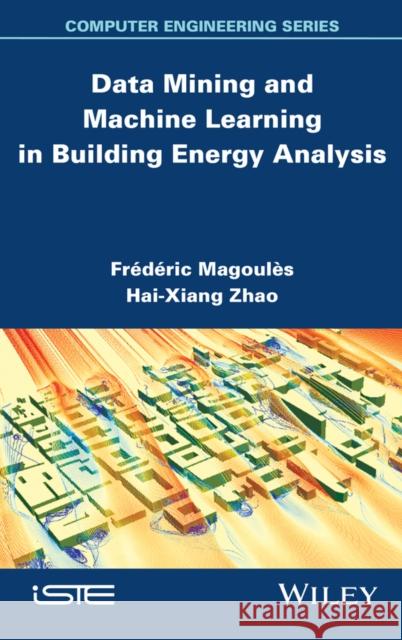
Data Mining and Machine Learning in Building Energy Analysis Fr'd'ric Magoul's Frederic Magoules Hai-Xiang Zhao 9781848214224 Wiley-Iste - książkaWidoczna okładka, to zdjęcie poglądowe, a rzeczywista szata graficzna może różnić się od prezentowanej.

Data Mining and Machine Learning in Building Energy Analysis

ISBN-13: 9781848214224 / Angielski / Twarda / 2016 / 186 str.

Fr'd'ric Magoul's; Frederic Magoules; Hai-Xiang Zhao
cena 713,44 zł
(netto: 679,47 VAT:  5%)

Najniższa cena z 30 dni: 706,15 zł
Termin realizacji zamówienia:
ok. 30 dni roboczych
Bez gwarancji dostawy przed świętami

Darmowa dostawa!

Focusing on up-to-date artificial intelligence models to solve building energy problems, "Artificial Intelligence for Building Energy Analysis" reviews recently developed models for solving these issues, including detailed and simplified engineering methods, statistical methods, and artificial intelligence methods. The text also simulates energy consumption profiles for single and multiple buildings. Based on these datasets, Support Vector Machine (SVM) models are trained and tested to do the prediction. Suitable for novice, intermediate, and advanced readers, this is a vital resource for building designers, engineers, and students.


Kategorie:
Informatyka
Kategorie BISAC:
Computers > Artificial Intelligence - General
Wydawca:
Wiley-Iste
Seria wydawnicza:
Iste
Język:
Angielski
ISBN-13:
9781848214224
Rok wydania:
2016
Numer serii:
000448034
Ilość stron:
186
Waga:
0.44 kg
Wymiary:
23.39 x 15.6 x 1.27
Oprawa:
Twarda
Wolumenów:
01
Dodatkowe informacje:
Bibliografia

Preface ix

Introduction  xi

Chapter 1. Overview of Building Energy Analysis 1

1.1. Introduction 1

1.2. Physical models 3

1.3. Gray models 6

1.4. Statistical models 6

1.5. Artificial intelligence models 8

1.5.1. Neural networks  8

1.5.2. Support vector machines 13

1.6. Comparison of existing models  14

1.7. Concluding remarks . 16

Chapter 2. Data Acquisition for Building Energy Analysis 17

2.1. Introduction  17

2.2. Surveys or questionnaires 18

2.3. Measurements 21

2.4. Simulation 25

2.4.1. Simulation software 26

2.4.2. Simulation process  28

2.5. Data uncertainty  34

2.6. Calibration 35

2.7. Concluding remarks  37

Chapter 3. Artificial Intelligence Models 39

3.1. Introduction  39

3.2. Artificial neural networks 40

3.2.1. Single–layer perceptron 41

3.2.2. Feed forward neural network 43

3.2.3. Radial basis functions network 44

3.2.4. Recurrent neural network 47

3.2.5. Recursive deterministic perceptron 49

3.2.6. Applications of neural networks 51

3.3. Support vector machines 53

3.3.1. Support vector classification 54

3.3.2. –support vector regression 59

3.3.3. One–class support vector machines 62

3.3.4. Multiclass support vector machines 63

3.3.5. v–support vector machines 64

3.3.6. Transductive support vector machines 65

3.3.7. Quadratic problem solvers . 67

3.3.8. Applications of support vector machines 75

3.4. Concluding remarks  76

Chapter 4. Artificial Intelligence for Building Energy Analysis 79

4.1. Introduction  79

4.2. Support vector machines for building energy prediction  80

4.2.1. Energy prediction definition 80

4.2.2. Practical issues 81

4.2.3. Support vector machines for prediction 85

4.3. Neural networks for fault detection and diagnosis 91

4.3.1. Description of faults  94

4.3.2. RDP in fault detection 95

4.3.3. RDP in fault diagnosis 100

4.4. Concluding remarks 102

Chapter 5. Model Reduction for Support Vector Machines 103

5.1. Introduction  103

5.2. Overview of model reduction 104

5.2.1. Wrapper methods 105

5.2.2. Filter methods 106

5.2.3. Embedded methods 107

5.3. Model reduction for energy consumption 108

5.3.1. Introduction 108

5.3.2. Algorithm 109

5.3.3. Feature set description 111

5.4. Model reduction for single building energy 112

5.4.1. Feature set selection  112

5.4.2. Evaluation in experiments  114

5.5. Model reduction for multiple buildings energy 116

5.6. Concluding remarks  119

Chapter 6. Parallel Computing for Support Vector Machines 121

6.1. Introduction  121

6.2. Overview of parallel support vector machines 122

6.3. Parallel quadratic problem solver  123

6.4. MPI–based parallel support vector machines  127

6.4.1. Message passing interface programming model  127

6.4.2. Pisvm  129

6.4.3. Psvm  130

6.5. MapReduce–based parallel support vector machines  130

6.5.1. MapReduce programming model  131

6.5.2. Caching technique 133

6.5.3. Sparse data representation 133

6.5.4. Comparison of MRPsvm with Pisvm  134

6.6. MapReduce–based parallel –support vector regression 138

6.6.1. Implementation aspects  138

6.6.2. Energy consumption datasets 139

6.6.3. Evaluation for building energy prediction  140

6.7. Concluding remarks  142

Summary and Future of Building Energy Analysis  145

Bibliography 149

Index 163

Frédéric Magoulès is Professor at the Ecole Centrale Paris in France and Honorary Professor at the University of Pècs in Hungary. His research focuses on parallel computing, numerical linear algebra and machine learning.

Hai–Xiang Zhao is Senior Researcher at Amadeus in France. His research focuses on parallel computing, data mining and machine learning.

Magoules, Frederic Frederic Magoules est professeur a l'Ecole Central... więcej >


Udostępnij

Facebook - konto krainaksiazek.pl


Opinie o Krainaksiazek.pl na Opineo.pl

Partner Mybenefit

Krainaksiazek.pl w programie rzetelna firma Krainaksiaze.pl - płatności przez paypal

Czytaj nas na:

Facebook - krainaksiazek.pl
  • książki na zamówienie
  • granty
  • książka na prezent
  • kontakt
  • pomoc
  • opinie
  • regulamin
  • polityka prywatności

Zobacz:

  • Księgarnia czeska

  • Wydawnictwo Książkowe Klimaty

1997-2025 DolnySlask.com Agencja Internetowa

© 1997-2022 krainaksiazek.pl
     
KONTAKT | REGULAMIN | POLITYKA PRYWATNOŚCI | USTAWIENIA PRYWATNOŚCI
Zobacz: Księgarnia Czeska | Wydawnictwo Książkowe Klimaty | Mapa strony | Lista autorów
KrainaKsiazek.PL - Księgarnia Internetowa

Polityka prywatnosci - link
Krainaksiazek.pl - płatnośc Przelewy24
Przechowalnia Przechowalnia






