• Wyszukiwanie zaawansowane
  • Kategorie
  • Kategorie BISAC
  • Książki na zamówienie
  • Promocje
  • Granty
  • Książka na prezent
  • Opinie
  • Pomoc
  • Załóż konto
  • Zaloguj się

Critical Regimes of Two-Phase Flows with a Polydisperse Solid Phase » książka


zaloguj się | załóż konto
Logo Krainaksiazek.pl

koszyk

konto

szukaj
topmenu
Księgarnia internetowa
Szukaj
Książki na zamówienie
Promocje
Granty
Książka na prezent
Moje konto
Pomoc
 
 
Wyszukiwanie zaawansowane
Pusty koszyk
Bezpłatna dostawa dla zamówień powyżej 20 złBezpłatna dostawa dla zamówień powyżej 20 zł

Kategorie główne

• Nauka
 [2939893]
• Literatura piękna
 [1808953]

  więcej...
• Turystyka
 [70366]
• Informatyka
 [150555]
• Komiksy
 [35137]
• Encyklopedie
 [23160]
• Dziecięca
 [608786]
• Hobby
 [136447]
• AudioBooki
 [1631]
• Literatura faktu
 [225099]
• Muzyka CD
 [360]
• Słowniki
 [2914]
• Inne
 [442115]
• Kalendarze
 [1068]
• Podręczniki
 [166599]
• Poradniki
 [468390]
• Religia
 [506548]
• Czasopisma
 [506]
• Sport
 [61109]
• Sztuka
 [241608]
• CD, DVD, Video
 [3308]
• Technologie
 [218981]
• Zdrowie
 [98614]
• Książkowe Klimaty
 [124]
• Zabawki
 [2174]
• Puzzle, gry
 [3275]
• Literatura w języku ukraińskim
 [260]
• Art. papiernicze i szkolne
 [7376]
Kategorie szczegółowe BISAC

Critical Regimes of Two-Phase Flows with a Polydisperse Solid Phase

ISBN-13: 9789048188376 / Angielski / Twarda / 2010 / 366 str.
Eugene Barsky
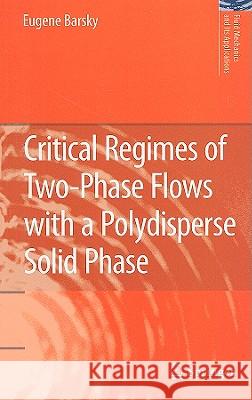
Critical Regimes of Two-Phase Flows with a Polydisperse Solid Phase Eugene Barsky 9789048188376 Springer - książkaWidoczna okładka, to zdjęcie poglądowe, a rzeczywista szata graficzna może różnić się od prezentowanej.

Critical Regimes of Two-Phase Flows with a Polydisperse Solid Phase

ISBN-13: 9789048188376 / Angielski / Twarda / 2010 / 366 str.

Eugene Barsky
cena 603,81
(netto: 575,06 VAT:  5%)

Najniższa cena z 30 dni: 578,30
Termin realizacji zamówienia:
ok. 22 dni roboczych.

Darmowa dostawa!

Critical regimes of two-phase flows with a polydisperse solid phase form the basis of such widespread industrial processes as separation of various powdery materials and minerals dressing. It is impossible to describe such complicated flows analytically. Therefore, this study concentrates on invariants experimentally revealed and theoretically grounded for such flows. This approach can be compared with the situation in gases, where in order to determine principal parameters of their state, one does not need to measure the kinetic energy and velocity of each molecule and find its contribution to the temperature and pressure. These parameters are determined in a simple way for the system on the whole. A novel conception of two-phase flows allowing the formulation of their statistical parameters is physically substantiated. On the basis of the invariants and these parameters, a comprehensive method of estimating and predicting mass transfer in such flows is developed. It is noteworthy that the presented results are mostly phenomenological. Such an approach can be successfully extended to the separation of liquids, gases and isotopes. The book is intended for students and specialists engaged in chemical technology, mineral dressing, ceramics, microelectronics, pharmacology, power generation, thermal engineering and other fields in which flows carrying solid particles are used in the technological process.


Kategorie:
Technologie
Kategorie BISAC:
Technology & Engineering > Mechanical
Science > Chemistry - Industrial & Technical
Mathematics > Matematyka stosowana
Wydawca:
Springer
Seria wydawnicza:
Fluid Mechanics and Its Applications
Język:
Angielski
ISBN-13:
9789048188376
Rok wydania:
2010
Numer serii:
000034492
Ilość stron:
366
Waga:
0.65 kg
Wymiary:
23.62 x 15.75 x 2.54
Oprawa:
Twarda
Wolumenów:
01
Dodatkowe informacje:
Bibliografia
Wydanie ilustrowane

Introduction; Chapter I. General ideas of mass transfer processes in critical regimes; 1. Granulometric characteristics of bulk material ; 2. Distribution of different fractions in the process of separation; 3. Fractional separation curves and their properties; Chapter II. Principles of modeling processes in moving media; 1. Correlation between a full-scale process and its model; 2. Mathematical models construction ; 3. Similarity criteria determination; Chapter III. System of particles of the same size class in a critical flow.; 1. Dynamics of mass motion of particles in a flow; 2. Definition of a statistical system; 3. Estimation of the state of a statistical system; 4. Principal statistical characteristics of the separation factor; Chapter IV. System of particles of several size classes; 1. Interaction of particles in a flow; 2. Forces caused by interactions of particles of various classes; 3. Two-phase flow entropy in critical flow regimes; 4. Main features of entropy in critical regimes; 5. Mobility factor; 6. Statistical identities; Chapter V. Principal statistical relationships of mass transfer in critical flow; 1. Mass exchange between the zone and the apparatus; 2. Determination of average values; 3. Cell and apparatus, entropy; 4. Separation at low concentrations; 5. General regularities for the zone; Chapter VI. Correlation between the apparatus and the cell.; 1. Coarse particles separation; 2. Fine particles separation; 3. Definition of mass transfer parameters; 4. Cellular model of separation; 5. Physical meaning of separation factors; 6. Extraction from a cell located in the zone; Chapter VII. Structural model of mass transfer in critical regimes of two-phase flows.; 1. Validation of the distribution coefficient; 2. Physical meaning of the distribution coefficient ; 3. Analysis of distribution coefficient; 4. Analysis of experimental dependencies from the standpoint of structural models; 5. Check of the structural model adequacy; 6. Correlation between the structural and cellular models of the process; Chapter VIII. Correlation between statistical and empirical results; 1. Approximation of universal separation curve; 2. Principal separation parameters depending on the apparatus height; 3. Equal extractability of various size classes; Chapter IX. Entropy of composition. Optimization criterion.; 1. Entropy and particles stratification; 2. Evaluation of heterogeneity of powder composition; 3. Binary separation; 4. Multi-product separation; 5. Algorithms of optimization of separation into n components; 6. Mathematical model of separation into n components; 7. Optimum conditions for binary separation; 8. Optimum conditions for multi-product separation; Chapter X. Stability and kinetic aspects of mass distribution in critical regimes; 1. Entropy stability; 2. Particles distribution over the channel height; 3. Velocity distribution of particles of a narrow size class; 4. Kinetic aspect of the material distribution; Chapter XI. Critical regimes of two-phase flows in complicated systems; 1. Problem setting; 2. Mathematical model of a duplex cascade; 3. Mathematical model of a cascade process allowing control of the effect of the material feed site on separation results; 4. Cascade model with two or more material inputs into the apparatus; 5. Combined cascade classifiers; 6. Quality criterion for combined cascades; 7. Fractal principle of the construction of schemes of combined classifiers; 8. Some methods of combined schemes optimization; Chapter XII. Stochastic model of critical regimes of two-phase flows; 1. Principal definitions; 2. Statistical description of gravitational separation in turbulent flows; 3. Equations of particles motion taking into account their rotation around the center of mass in a turbulent flow; 4. Description of one-dimensional stationary process of gravitation separation in a turbulent flow; 5. One-dimensional model of a non-stationary process; 6. Statistical equations of random process of gra

This book brings to light peculiarities of the formation of critical regimes of two-phase flows with a polydisperse solid phase. A definition of entropy is formulated on the basis of statistical analysis of these peculiarities. The physical meaning of entropy and its correlation with other parameters determining two-phase flows are clearly defined. The interrelations and main differences between this entropy and the thermodynamic one are revealed. The main regularities of two-phase flows both in critical and in other regimes are established using the notion of entropy. This parameter serves as a basis for a deeper insight into the physics of the process and for the development of exhaustive techniques of mass exchange estimation in such flows.

The book is intended for graduate and postgraduate students of engineering studying two-phase flows, and to scientists and engineers engaged in specific problems of such fields as chemical technology, mineral dressing, modern ceramics, microelectronics, pharmacology, power engineering, thermal engineering, etc. using flows with solid particles in their respective production methods.


Udostępnij

Facebook - konto krainaksiazek.pl


Opinie o Krainaksiazek.pl na Opineo.pl

Partner Mybenefit

Krainaksiazek.pl w programie rzetelna firma Krainaksiaze.pl - płatności przez paypal

Czytaj nas na:

Facebook - krainaksiazek.pl
  • książki na zamówienie
  • granty
  • książka na prezent
  • kontakt
  • pomoc
  • opinie
  • regulamin
  • polityka prywatności

Zobacz:

  • Księgarnia czeska

  • Wydawnictwo Książkowe Klimaty

1997-2026 DolnySlask.com Agencja Internetowa

© 1997-2022 krainaksiazek.pl
     
KONTAKT | REGULAMIN | POLITYKA PRYWATNOŚCI | USTAWIENIA PRYWATNOŚCI
Zobacz: Księgarnia Czeska | Wydawnictwo Książkowe Klimaty | Mapa strony | Lista autorów
KrainaKsiazek.PL - Księgarnia Internetowa

Polityka prywatnosci - link
Krainaksiazek.pl - płatnośc Przelewy24
Przechowalnia Przechowalnia






