• Wyszukiwanie zaawansowane
  • Kategorie
  • Kategorie BISAC
  • Książki na zamówienie
  • Promocje
  • Granty
  • Książka na prezent
  • Opinie
  • Pomoc
  • Załóż konto
  • Zaloguj się

Creep in Structures VI » książka


zaloguj się | załóż konto
Logo Krainaksiazek.pl

koszyk

konto

szukaj
topmenu
Księgarnia internetowa
Szukaj
Książki na zamówienie
Promocje
Granty
Książka na prezent
Moje konto
Pomoc
 
 
Wyszukiwanie zaawansowane
Pusty koszyk
Bezpłatna dostawa dla zamówień powyżej 20 złBezpłatna dostawa dla zamówień powyżej 20 zł

Kategorie główne

• Nauka
 [2946600]
• Literatura piękna
 [1856966]

  więcej...
• Turystyka
 [72221]
• Informatyka
 [151456]
• Komiksy
 [35826]
• Encyklopedie
 [23190]
• Dziecięca
 [619653]
• Hobby
 [140543]
• AudioBooki
 [1577]
• Literatura faktu
 [228355]
• Muzyka CD
 [410]
• Słowniki
 [2874]
• Inne
 [445822]
• Kalendarze
 [1744]
• Podręczniki
 [167141]
• Poradniki
 [482898]
• Religia
 [510455]
• Czasopisma
 [526]
• Sport
 [61590]
• Sztuka
 [243598]
• CD, DVD, Video
 [3423]
• Technologie
 [219201]
• Zdrowie
 [101638]
• Książkowe Klimaty
 [124]
• Zabawki
 [2473]
• Puzzle, gry
 [3898]
• Literatura w języku ukraińskim
 [254]
• Art. papiernicze i szkolne
 [8170]
Kategorie szczegółowe BISAC

Creep in Structures VI

ISBN-13: 9783031390692 / Angielski / Twarda / 2023
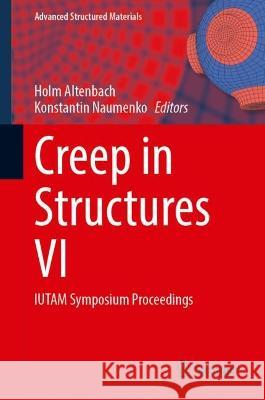
Creep in Structures VI  9783031390692 Springer Nature Switzerland - książkaWidoczna okładka, to zdjęcie poglądowe, a rzeczywista szata graficzna może różnić się od prezentowanej.

Creep in Structures VI

ISBN-13: 9783031390692 / Angielski / Twarda / 2023

cena 726,29 zł
(netto: 691,70 VAT:  5%)

Najniższa cena z 30 dni: 655,41 zł
Termin realizacji zamówienia:
ok. 22 dni roboczych
Bez gwarancji dostawy przed świętami

Darmowa dostawa!
inne wydania

This book offers a current state of the art in analysis and modeling of creep phenomena with applications to the structural mechanics. It presents the some presentations from the IUTAM-Symposium series "Creep in Structures", which held in Magdeburg (Germany) in September 2023, and it discusses many advances and new results in the field. These are for example: interlinks of mechanics with materials science in multi-scale analysis of deformation and damage mechanisms over a wide range of stresses and temperature;  development and analysis of new alloys for (ultra)high-temperature applications; formulation and calibration of advanced constitutive models of inelastic behavior under transient loading and temperature conditions; development of efficient procedures and machine learning techniques for identification of material parameters in advanced constitutive laws; introduction of gradient-enhanced and non-local theories to account for damage and fracture processes; and application of new experimental methods, such as digital image correlation, for the analysis of inelastic deformation under multi-axial stress state.


Kategorie:
Nauka, Fizyka
Kategorie BISAC:
Science > Mechanics - Solids
Technology & Engineering > Materials Science - General
Science > Termodynamika
Wydawca:
Springer Nature Switzerland
Seria wydawnicza:
Advanced Structured Materials
Język:
Angielski
ISBN-13:
9783031390692
Rok wydania:
2023
Waga:
0.76 kg
Wymiary:
23.5 x 15.5
Oprawa:
Twarda

Chapter 1: Phase-Field Damage Modeling in Generalized Mechanics by using a Mixed Finite Element Method (FEM)

1.1 Introduction to Standard Phase-Field Formulation 
1.2 Extension to Generalized Mechanics 
1.3 Strain Gradient Parameters
1.4 Numerical Implementation and Results 
1.5 Conclusion 
References 
Chapter 2: Creep-Damage Processes in Cyclic Loaded Double Walled Structures
2.1 Introduction 
2.2 Constitutive Equations 
2.2.1 Static Loading 
2.2.2 Cyclic Loading. Stresses Lower the Yield Limit 
2.2.3 Cyclic Load. Overloading with Transition to Plastic Deformation 
2.3 Problem Statement 
2.4 Comparison Between Data of Direct Approach and Use of Averaged Function ���� 
2.5 Numerical Simulation of the Cyclic Creep-damage in DWTC System Model 
2.5.1 Description of the Calculation Model 
2.5.2 Determination of the Temperature and Stress Field in the Blade 
2.5.3 Creep Calculations for a Two-dimensional Model of a Blade Made of Nickel Based Alloy 
2.5.4 Creep Calculations for a Two-dimensional Model of a Blade Made of an Inconel X Alloy 
2.6 Conclusions 
References 
Chapter 3: Creep Mechanics – Some Historical Remarks and New Trends 
3.1 Starting Point - the Early Period of Creep Mechanics 
3.2 IUTAM Symposia and Other Events Devoted to Problems in Creep Mechanics 
3.3 Research Directions and Magdeburg’s Contributions 
3.3.1 Kachanov-Rabotnov Approach and Mechanism-Based Models 
3.3.2 Non-Classical Creep 
3.3.3 Benchmark Tests for Creep Problems 
3.3.4 Rheological Models 
3.3.5 Thesis 
3.4 Outlook 
References 
Chapter 4: Various State-of-the-Art Methods for Creep Evaluation of Power Plant Components in a Wide Load and Temperature Range 
4.1 Introduction 
4.2 Applied Creep Models 
4.2.1 Norton-Bailey Equation
4.2.2 Modified Garofalo Eequation
4.2.3 Constitutive Model
4.3 Structural Analysis 
4.3.1 Verification of the Creep Models Based on Creep Tests 
4.3.2 Relaxation Test with Cube-one-Element Model
4.3.3 Pipe Benchmark FE Model 
4.3.4 Performance Evaluation of User-Creep Routines
4.3.5 Temperature Interpolation for Norton-Bailey Creep Equation 
4.3.6 Isothermal Steam Turbine Valve FE Model with a Constant Loading 
4.4 Conclusions 
References 
Chapter 5: Creep and Irradiation Effects in Reactor Vessel Internals 
5.1 Introduction 
5.2 Problem Statement and Description of Solution Approaches
5.3 Constitutive Equations 
5.3.1 Materials with Isotropy of Properties 
5.3.2 Materials with Transversal Isotropy of Properties
5.4 Deformation, Damage Accumulation and Fracture in RVI 
5.4.1 Creep of T-joint of Tubes
5.4.2 Damage Accumulation and Fracture of Reactor Fuel Element 
5.4.3 Transversal-Isotropic Creep-Damage Behaviour of Aluminium Notched Plate 
5.5 Conclusions 
References
Chapter 6: Analysis of Damage and Fracture in Anisotropic Sheet Metals Based on Biaxial Experiments 
6.1 Introduction 
6.2 Constitutive Framework
6.3 Numerical Simulations and Results 
6.4 Conclusions 
References 
Chapter 7: Effect of Physical Aging on the Flexural Creep in 3D Printed Thermoplastic 
7.1 Introduction 
7.2 Theoretical Background 
7.2.1 Viscoelasticity of Thermoplastics
7.2.2 Physical Aging 
7.3 Material and Methods 
7.3.1 Test Specimens 
7.3.2 Sequential Creep Tests 
7.3.3 Long Term Creep Test 
7.4 Experimental Results 
7.4.1 Sequential Creep Tests 
7.4.2 Long Term Creep Test
7.5 Discussion
References 
Chapter 8: Development of a Microstructure-Based Finite Element Model of Thermomechanical Response of a Fully Metallic Composite Phase Change Material 
8.1 Introduction 
8.2 Microstructure-Based FE model of a Al-Sn C-PCM with Free Expansion 
8.3 Results and Discussion 
8.4 Final Remarks 
References 
Chapter 9: The Effect of Dynamic Loads on the Creep of Geomaterials 
9.1 Introduction
9.2 Materials and Methods 
9.2.1 Materials 
9.2.2 Methods 
9.3 Results and Discussion 
9.4 Conclusion 
References 
Chapter 10: A Novel Simulation Method for Phase Transition of Single Crystal Ni based Superalloys in Elevated Temperature Creep Regions via Discrete Cosine Transform and Maximum Entropy Method 
10.1 Introduction
10.2 Materials and Experiments 
10.2.1 A Single Crystal Ni Based Superalloy, CMSX-4 
10.2.2 Creep Tests 
10.2.3 Two Dimensional Discrete Cosine Transform 
10.2.4 Maximum Entropy Method 
10.3 Estimation of Phase Transition and Results 
10.4 Discussion 
10.5 Conclusion 
References 
Chapter 11: Anisotropic Creep Analysis of Fiber Reinforced Load Point Support Structures for Thermoplastic Sandwich Panels
11.1 Introduction 
11.2 Material Model 
11.2.1 Basic One-Dimensional Formulation
11.2.2 Generalization to Three Dimensions 
11.2.3 Unidirectionally Fiber Reinforced Thermoplastics
11.2.4 Discontinuously Fiber Reinforced Thermoplastics 
11.3 Experimental Investigation 
11.3.1 Coupon Experiments 
11.3.2 Structural Experiments
11.4 Multiscale Simulation 
11.5 Results 
11.5.1 Parameter Identification on Coupon Experiments 
11.5.2 Validation on Structural Level 
11.6 Summary and Conclusion 
References
Chapter 12: Time-Swelling Superposition Principle for the Linear Viscoelastic Properties of Polyacrylamide Hydrogels
12.1 Introduction 
12.2 Experiment 
12.2.1 Materials 
12.2.2 Mixed Solvents for Transient Equilibrium Swelling 
12.2.3 Measurement of Swelling 
12.2.4 Measurement of Dynamic Moduli 
12.3 Experimenta Results 
12.3.1 Transient Equilibrium Swelling 
12.3.2 Linear Viscoelastic Behavior 
12.4 Swelling–Dependent Linear Viscoelasticity 
12.4.1 Model Formulation 
12.4.2 Time-Swelling Superpostion Principle 
12.5 Discussion 
12.5.1 Master Curves of Dynamic Moduli 
12.5.2 Swelling Dependence of Linear Viscoelastic Properties 
12.5.3 Frequency Dependence of Complex Shear Moduli 
12.6 Conclusion 
Appendix A: Validity for Transient Equilibrium Swelling Using Ethanol 
Appendix B: Experimental Data 
References 
Chapter 13: Application of Nonlinear Viscoelastic Material Models for the Shrinkage and Warpage Analysis of Blow Molded Parts 
13.1 Introduction 
13.2 Material Models 
13.2.1 Linear Viscoelastic Material Model
13.2.2 Abaqus Parallel Rheological Framework Model 
13.3 Shrinkage and Warpage Analysis 
13.4 Calibration Strategy 
13.4.1 Experimental Data 
13.4.2 Implementation of a One-Dimensional Model to Reduce Computation Time 
13.4.3 Reduction of Material Parameters 
13.4.4 Calibration Workflow 
13.5 Results 
13.6 Discussion and Outlook 
References 
Chapter 14: Modeling Solid Materials in DEM Using the Micropolar Theory 
14.1 Introduction 
14.2 Formulation of the Thermo-Elasto-Viscoplastic Contact Model 
14.2.1 Short introduction to DEM basics 
14.2.2 DEM Interaction Force Model Based on Micropolar Theory
14.2.3 Visco-Plasticity 
14.3 Model Verification
14.3.1 Simulation Set-up 
14.3.2 Results and Discussion 
14.4 Concluding Remarks 
References 
Chapter 15: The Development of a Cavitation-Based Model for Creep Lifetime Prediction Using Cu-40Zn-2Pb Material 
15.1 Introduction 
15.2 Stress Breakdown and Creep Lifetime 
15.3 Creep Cavitation and Cavitation Data Concerns 
15.3.1 How to Use Cavitation Data 
15.3.2 Current Approach to Cavitation Modelling and Creep Life Prediction 
15.4 Aims 
15.5 Experimental Data and Method 
15.5.1 Experimental Data 
15.5.2 Method 
15.5.3 Determination of Cavitation Constants 
15.5.4 Cavity Size Distribution Modelling 
15.6 Conclusions and Future Work 
References 
Chapter 16: Self-heating Analysis with Respect to Holding Times of an Additive Manufactured Aluminium Alloy 
16.1 Introduction 
16.2 Thermomechanical Experiment 
16.2.1 Experimental Set-Up 
16.2.2 Temperature and Deformationfield Measurement by Digital Image Correlation 
16.2.3 Experimental Results with Respect to Holding Time 
16.3 Theoretical Framework 
16.3.1 Energy Balance and Heat Conduction 
16.3.2 Material Model 
16.4 Modelling Methods 
16.4.1 Parameter Identification 
16.4.2 Concept for Thermomechanic FE Analysis
16.5 Results 
16.6 Discussion 
16.7 Conclusion and Outlook 
References 
Chapter 17: Creep Under High Temperature Thermal Cycling and Low Mechanical Loadings 
17.1 Introduction 
17.2 Experimental Methods 
17.2.1 Materials 
17.2.2 Creep Test Equipment 
17.3 Observation of Accelerated Creep Under Anisothermal Testing Conditions 
17.3.1 Anisothermal Creep Tests 
17.3.2 Influencing Factors 
17.3.3 Observations on the Creep Behavior Within a Cycle 
17.4 Discussion 
17.4.1 Possible causes of accelerated creep under thermal cycling
17.4.2 Microstructural Processes Under Anisothermal Creep Testing 
17.5 Summary 
References 
Chapter 18: The Development and Application of Optimisation Technique for the Calibrating of Creep Cavitation Model Based on Cavity Histogram 
18.1 Introduction 
18.2 Background Theories and Knowledge
18.2.1 Cavitation Model Theory 
18.2.2 Current Calibration Methods 
18.3 Optimisation with Excel Solver 
18.4 Cavitation Data 
18.5 Results 
18.6 Discussion and Conclusion 
References 
Chapter 19: A Temperature-Dependent Viscoelastic Approach to the Constitutive Behavior of Semi-Crystalline Thermoplastics at Finite Deformations 
19.1 Introduction 
19.2 Preliminaries of the Finite Thermo-Viscoelasticity 
19.3 Constitutive Formulation of Finite Thermo-Viscoelasticity 
19.3.1 Helmholtz Energy 
19.3.2 Creep Law 
19.3.3 Governing Equations 
19.4 Numerical Study 
19.4.1 Stress-Controlled loading 
19.4.2 Strain-Controlled loading 
19.5 Summary 
References 

This book offers a current state of the art in analysis and modeling of creep phenomena with applications to the structural mechanics. It presents the some presentations from the IUTAM-Symposium series "Creep in Structures", which held in Magdeburg (Germany) in September 2023, and it discusses many advances and new results in the field. These are for example: interlinks of mechanics with materials science in multi-scale analysis of deformation and damage mechanisms over a wide range of stresses and temperature;  development and analysis of new alloys for (ultra)high-temperature applications; formulation and calibration of advanced constitutive models of inelastic behavior under transient loading and temperature conditions; development of efficient procedures and machine learning techniques for identification of material parameters in advanced constitutive laws; introduction of gradient-enhanced and non-local theories to account for damage and fracture processes; and application of new experimental methods, such as digital image correlation, for the analysis of inelastic deformation under multi-axial stress state.




Udostępnij

Facebook - konto krainaksiazek.pl


Opinie o Krainaksiazek.pl na Opineo.pl

Partner Mybenefit

Krainaksiazek.pl w programie rzetelna firma Krainaksiaze.pl - płatności przez paypal

Czytaj nas na:

Facebook - krainaksiazek.pl
  • książki na zamówienie
  • granty
  • książka na prezent
  • kontakt
  • pomoc
  • opinie
  • regulamin
  • polityka prywatności

Zobacz:

  • Księgarnia czeska

  • Wydawnictwo Książkowe Klimaty

1997-2025 DolnySlask.com Agencja Internetowa

© 1997-2022 krainaksiazek.pl
     
KONTAKT | REGULAMIN | POLITYKA PRYWATNOŚCI | USTAWIENIA PRYWATNOŚCI
Zobacz: Księgarnia Czeska | Wydawnictwo Książkowe Klimaty | Mapa strony | Lista autorów
KrainaKsiazek.PL - Księgarnia Internetowa

Polityka prywatnosci - link
Krainaksiazek.pl - płatnośc Przelewy24
Przechowalnia Przechowalnia



