Cosmography in the Age of Discovery and the Scientific Revolution » książka





Cosmography in the Age of Discovery and the Scientific Revolution
ISBN-13: 9783031298844 / Angielski
Cosmography in the Age of Discovery and the Scientific Revolution
ISBN-13: 9783031298844 / Angielski
(netto: 614,84 VAT: 5%)
Najniższa cena z 30 dni: 616,85
ok. 22 dni roboczych.
Darmowa dostawa!
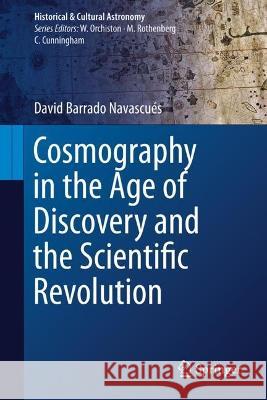
This book tells the comprehensive history of cosmography from the 15thCentury Age of Discovery onward. During this time, cosmography—a science that combined geography and astronomy to inform us about our place in the universe—was deeply tied to ongoing developments in politics, exploration, culture, and technology.The book offers in-depth historical context over nearly four centuries, focusing in particular on the often neglected role that Portugal and Spain played in the development of cosmography. It details the great activity emerging from the Iberian and Italic peninsulas, including numerous voyagers of exploration, a clear commercial intention, and advancements in map-making techniques. In doing so, it provides a unique perspective on the “Longitude problem” not available in most other literature on the topic.Rigorously researched and sweeping in scope, this book will serve as an invaluable source for historians and readers interested in the history of science, of astronomy, and of exploration from a southern European perspective.
This book tells the comprehensive history of cosmography from the 15th Century Age of Discovery onward. During this time, cosmography—a science that combined geography and astronomy to inform us about our place in the universe—was deeply tied to ongoing developments in politics, exploration, culture, and technology.The book offers in-depth historical context over nearly four centuries, focusing in particular on the often neglected role that Portugal and Spain played in the development of cosmography. It details the great activity emerging from the Iberian and Italic peninsulas, including numerous voyagers of exploration, a clear commercial intention, and advancements in map-making techniques. In doing so, it provides a unique perspective on the “Longitude problem” not available in most other literature on the topic.Rigorously researched and sweeping in scope, this book will serve as an invaluable source for historians and readers interested in the history of science, of astronomy, and of exploration from a southern European perspective.
I PLUS ULTRA: THE IBERIAN EXPLORATIONS AND CARTOGRAPHY............. 4
1 The background of the Iberian hatching............................................................................... 4
1.1 The "discovery" of the Orient...................................................................................... 4
1.2 The possibility of the trip to Asia travelling westwards........................................... 6
1.3 The discovery of the oceanic islands.......................................................................... 7
2 Portuguese exploration.......................................................................................................... 12
2.1 Atlantic and African exploration: the impulse of Henrique "the Navigator"..... 12
2.2 The exploration of East Africa: after the lands of Preste John............................. 18
2.3 The Portuguese crossing of the equator: the transition from the Middle Ages to the Contemporary Era.......................................................................................................................... 19
3 The explorations of the kingdoms of Castile and Aragon................................................ 20
3.1 The cartographic school of Mallorca....................................................................... 20
3.2 Columbus' mistake and a new continent.................................................................. 20
3.3 Other explorers: de la Cosa, Caboto, Ojeda, Pinzón and Vespucci.................... 24
3.4 The division of the world: the conflicts between Portugal and Spain.................. 26
3.5 The Pacific Ocean: more than the "Spanish Lake". .............................................. 29
3.6 Exploration versus conquest: the rationale for the process.................................. 37
4 Ptolemy, Mercator and the New Cosmography................................................................. 40
4.1 Maximo Planudes: the quasi anonymous hero........................................................ 40
4.2 Claudius Ptolemy, a bridge between the science of Antiquity and the Renaissance 41
4.3 The manuscript of Geographia and its family tree................................................. 42
4.4 The resurrection of Geographia................................................................................ 47
4.5 Beyond Ptolemy and his maps of the inhabited world........................................... 494.6 Cartography in the early 16th century: de la Cosa and Waldseemüller............. 50
4.7 The name of America and the new continent........................................................... 54
4.8 The basic tool of imperial rule: cartography.......................................................... 55
4.9 Celestial cartography: celestial and terrestrial planispheres and globes........... 56
II HUMANISM AS A TRIGGER FOR THE SCIENTIFIC REVOLUTION................ 601 Humanism and its pan-European impact............................................................................ 60
1.1 Reconnecting with the Greco-Roman world............................................................ 60
1.2 Erasmus and Humanism beyond the Italian and Iberian peninsulas................... 67
1.3 Humanism in Spain: Nebrija as its greatest exponent........................................... 68
1.4 The emergence of the printing press and its impact............................................... 75
1.5 The end of humanism in Spain................................................................................... 81
2 Cosmography in the age of humanism................................................................................ 84
2.1 Dante Alighieri's Cosmography: from Medieval times to humanism.................. 84
2.2 Science in the context of humanism.......................................................................... 88
2.3 Leonardo da Vinci: the ignored humanist............................................................... 90
2.4 Astronomy in the 15th century................................................................................... 94
2.5 Astronomy in the 16th century up to the publication of De revolutionibus......... 98
2.6 Humanism and Science in the Crowns of Aragon and Castile........................... 101
2.7 Calendar reform as an astronomical, social and religious problem................. 108
2.8 Ptolemy, Pico della Mirandola and the End of Astrology................................... 110
3 The causes of the Scientific Revolution........................................................................... 113
3.1 Scientific revolution: definition and background................................................. 113
3.2 The Republic of Letters............................................................................................ 114
III THE NEW ASTRONOMY AT THE DAWN OF THE SCIENTIFIC REVOLUTION 116
1 The Heliocentric Revolutionand Copernicus................................................................... 116
1.1 The publication of De revolutionibus..................................................................... 116
1.2 Background of heliocentrism................................................................................... 119
1.3 Heliocentrism up to the beginning of the Scientific Revolution.......................... 1221.4 Giordano Bruno and the infinite worlds................................................................ 124
2 Tycho Brahe : new stars and accurate stellar catalogues............................................... 127
3 Kepler: the last Pythagorean?............................................................................................ 129
3.1 Kepler's Pythagorean Heritage............................................................................... 130
3.2 Kepler and the multiple harmonies of the cosmos................................................ 131
3.3 The collaboration with Tycho Brahe: the orbit of Mars and the Rudolfian Tables 133
4 "Eppur si muove": Galileo and the immobility of the Earth.......................................... 134
4.1 The telescope, Sidereus Nuncius and the new kosmos......................................... 134
4.2 The epistolary relationship between Galileo and Kepler.................................... 137
4.3 The controversy with Simon Marius and the discovery of Jupiter's satellites.. 139
4.4 First denunciations, the admonition of 1616 and the condemnation of 1633... 141
4.5 The Immediate Effect on Other Catholic Theologians and Scientists................ 147
4.6 The Influence of Copernicus, Kepler and Galileo in Spain................................. 152
4.7 The proof sought by Galileo: light and the motion of the Earth......................... 154
4.8 The "absolution" of heliocentrism and the topicality of the "Galileo case"..... 156
5 Science and Literature: The Effect of the New Cosmography...................................... 158
5.1 Cosmography in the works of Cervantes and other authors............................... 158
5.2 Scientific Satire in the 18th Century: Jonathan Swift and Gulliver's Travels.. 162
IV THE MEASURE OF LONGITUDE: FROM IBERIA TO ALBION........................ 169
1 The measurement of position on the terrestrial sphere................................................... 169
2 Determining length: methods............................................................................................. 170
2.1 Background in pre-scientific navigation................................................................ 171
2.2 Astronomical methods.............................................................................................. 172
2.3 Relevant innovations................................................................................................. 178
2.4 Mechanical methods................................................................................................. 188
2.5 After the chimera: other proposals......................................................................... 193
2.6 Precise determination of the geographical location............................................ 194
3 The calculation of length and the implications for different European powers.......... 195
3.1 Spanish imperial expansion: navigation as a science.......................................... 195
3.2 The trading power: The United Provinces............................................................ 204
3.3 France and the academic impulse.......................................................................... 205
3.4 The foundations of the Pax Britannica: The Royal Astronomers....................... 208
V THE SHAPE OF THE EARTH AND GEOGRAPHICAL EXPLORATION......... 212
1 The size and shape of the Earth......................................................................................... 212
1.1 The measure of the Earth......................................................................................... 212
1.2 The pendulum and the measurement of time: a new tool.................................... 214
1.3 Determining the Shape of the Earth and the Law of Gravity.............................. 215
1.4 Meridian arcs: a systematic program for determining the shape of meridian arcs 216
1.5 A corollary: the mapping of France....................................................................... 220
1.6 The new determination of the meridian and the decimal metric system............ 221
2 Symmetries: new continents.............................................................................................. 225
2.1 The Antipodes and the Balance of the World........................................................ 225
2.2 The identification of Oceania.................................................................................. 226
2.3 The white continent: Antarctica.............................................................................. 227
3 The Strait of Anian: the mythical Northwest Passage.................................................... 227
3.1 Northwest course....................................................................................................... 227
3.2 The South Sea and the route to the East Indies..................................................... 228
3.3 Spain back in the race.............................................................................................. 231
3.4 The British Admiralty and the role of John Barrow............................................. 232
4 Cartographers, explorers and missionaries: the exploration of Africa......................... 233
4.1 The Nile in Antiquity................................................................................................. 233
4.2 The beginning of European penetration in Africa................................................ 234
4.3 The last frontier: the race of the 19th century...................................................... 235
VI COSMOGRAPHY SINCE THE XVIII CENTURY...................................................... 238
1 The scale of the Solar System............................................................................................ 238
1.1 The transits of Venus and Mercury......................................................................... 238
1.2 Le Gentil's eventful expedition................................................................................ 244
2 Plus ultra: new members of the Solar System................................................................. 246
2.1 William Herschel and Uranus, a new wanderer in the kosmos.......................... 246
2.2 The visibility of Uranus............................................................................................ 249
2.3 Hegel and the number of planets in the Solar System.......................................... 250
2.4 Ceres, the little brother of the planets, and the "celestial police"...................... 251
2.5 Extending the Limits of the Solar System: Neptune.............................................. 255
2.6 Nationalism in science.............................................................................................. 263
2.7 The Solar System from its confines......................................................................... 268
3 Cosmography and Empire in the 21st Century................................................................ 270
VII CULTURAL TRANSMISSION: TECHNICAL REVOLUTIONS AND BIASES 272
COLOPHON : CULTURE, SCIENCE VERSUS HUMANITIES.............................................. 276
CONCLUSIONS..................................................................................................................................... 277
APPENDIX: COSMOGRAPHY NOW............................................................................................ 284
A.1 Notes on Contemporary Astronomical Discoveries.................................................. 284
A.1.1 Serendipity: the discovery of the rings of Uranus........................................... 284
A.1.2 Serendipity and serendipity in science.............................................................. 285
A.1.3 The definition of planets in the Solar System................................................... 286
A.1.4 Exoplanets: the newcomers to the celestial bestiary....................................... 287A.2 The Return of Cosmography: Mapping in the Solar System and Beyond.............. 288
A.2.1 Earth and Mars: differences and similarities in the astrobiological context 288
A.2.2 Interstellar navigation: maps with uncertain destination.............................. 290
A.2.3 Exoplanets and the beginning of mapping beyond the Solar System............ 291
1.3 The Space Act and space exploration.......................................................................... 292
A.3.1 The basics of the Space Law............................................................................... 293
A.3.2 Responsibility in Space....................................................................................... 293
A.3.3 Orbits Around Space: A Scarce Resource........................................................ 2941.3.4 Military use........................................................................................................... 294
This book tells the comprehensive history of cosmography from the 15th Century Age of Discovery onward. During this time, cosmography—a science that combined geography and astronomy to inform us about our place in the universe—was deeply tied to ongoing developments in politics, exploration, culture, and technology.
The book offers in-depth historical context over nearly four centuries, focusing in particular on the often neglected role that Portugal and Spain played in the development of cosmography. It details the great activity emerging from the Iberian and Italic peninsulas, including numerous voyagers of exploration, a clear commercial intention, and advancements in map-making techniques. In doing so, it provides a unique perspective on the “Longitude problem” not available in most other literature on the topic.
Rigorously researched and sweeping in scope, this book will serve as an invaluable source for historians and readers interested in the history of science, of astronomy, and of exploration from a southern European perspective.




Czytaj nas na:
1997-2026 DolnySlask.com Agencja Internetowa
KrainaKsiazek.PL - Księgarnia Internetowa


