• Wyszukiwanie zaawansowane
  • Kategorie
  • Kategorie BISAC
  • Książki na zamówienie
  • Promocje
  • Granty
  • Książka na prezent
  • Opinie
  • Pomoc
  • Załóż konto
  • Zaloguj się

Convergence of Knowledge, Technology and Society: Beyond Convergence of Nano-Bio-Info-Cognitive Technologies » książka


zaloguj się | załóż konto
Logo Krainaksiazek.pl

koszyk

konto

szukaj
topmenu
Księgarnia internetowa
Szukaj
Książki na zamówienie
Promocje
Granty
Książka na prezent
Moje konto
Pomoc
 
 
Wyszukiwanie zaawansowane
Pusty koszyk
Bezpłatna dostawa dla zamówień powyżej 20 złBezpłatna dostawa dla zamówień powyżej 20 zł

Kategorie główne

• Nauka
 [2948695]
• Literatura piękna
 [1824038]

  więcej...
• Turystyka
 [70868]
• Informatyka
 [151073]
• Komiksy
 [35227]
• Encyklopedie
 [23181]
• Dziecięca
 [621575]
• Hobby
 [138961]
• AudioBooki
 [1642]
• Literatura faktu
 [228651]
• Muzyka CD
 [371]
• Słowniki
 [2933]
• Inne
 [445341]
• Kalendarze
 [1243]
• Podręczniki
 [164416]
• Poradniki
 [479493]
• Religia
 [510449]
• Czasopisma
 [502]
• Sport
 [61384]
• Sztuka
 [243086]
• CD, DVD, Video
 [3417]
• Technologie
 [219673]
• Zdrowie
 [100865]
• Książkowe Klimaty
 [124]
• Zabawki
 [2168]
• Puzzle, gry
 [3372]
• Literatura w języku ukraińskim
 [260]
• Art. papiernicze i szkolne
 [7838]
Kategorie szczegółowe BISAC

Convergence of Knowledge, Technology and Society: Beyond Convergence of Nano-Bio-Info-Cognitive Technologies

ISBN-13: 9783319022031 / Angielski / Twarda / 2014 / 558 str.
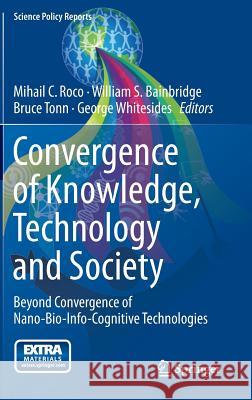
Mihail C. Roco; William Bainbridge; Bruce Tonn
Convergence of Knowledge, Technology and Society: Beyond Convergence of Nano-Bio-Info-Cognitive Technologies Roco, Mihail C. 9783319022031 Springer - książkaWidoczna okładka, to zdjęcie poglądowe, a rzeczywista szata graficzna może różnić się od prezentowanej.

Convergence of Knowledge, Technology and Society: Beyond Convergence of Nano-Bio-Info-Cognitive Technologies

ISBN-13: 9783319022031 / Angielski / Twarda / 2014 / 558 str.

Mihail C. Roco; William Bainbridge; Bruce Tonn
cena 803,21
(netto: 764,96 VAT:  5%)

Najniższa cena z 30 dni: 771,08
Termin realizacji zamówienia:
ok. 22 dni roboczych.

Darmowa dostawa!

This volume aims to document the most important worldwide accomplishments in converging knowledge and technology, including converging platforms, methods of convergence, societal implications, and governance in the last ten years. Convergence in knowledge, technology, and society is the accelerating, transformative interaction among seemingly distinct scientific disciplines, technologies, and communities to achieve mutual compatibility, synergism, and integration, and through this process to create added value for societal benefit. It is a movement that is recognized by scientists and thought leaders around the world as having the potential to provide far-reaching solutions to many of today's complex knowledge, technology, and human development challenges. Four essential and interdependent convergence platforms of human activity are defined in the first part of this report: nanotechnology-biotechnology-information technology and cognitive science ("NBIC") foundational tools; Earth-scale environmental systems; human-scale activities; and convergence methods for societal-scale activities. The report then presents the main implications of convergence for human physical potential, cognition and communication, productivity and societal outcomes, education and physical infrastructure, sustainability, and innovative and responsible governance. As a whole, the report presents a new model for convergence. To effectively take advantage of this potential, a proactive governance approach is suggested. The study identifies an international opportunity to develop and apply convergence for technological, economic, environmental, and societal benefits. The panel also suggests an opportunity in the United States for implementing a program aimed at focusing disparate R and D energies into a coherent activity - a "Societal Convergence Initiative." This study received input from leading academic, industry, government, and NGO experts from the United States, Latin America, Europe, Asia, and Australia.


Kategorie:
Nauka, Ekonomia i biznes
Kategorie BISAC:
Technology & Engineering > Nanotechnology & MEMS
Science > Biotechnology
Computers > Internet - General
Wydawca:
Springer
Seria wydawnicza:
Science Policy Reports
Język:
Angielski
ISBN-13:
9783319022031
Rok wydania:
2014
Wydanie:
2013
Numer serii:
000419046
Ilość stron:
558
Waga:
1.28 kg
Wymiary:
23.39 x 16.36 x 3.86
Oprawa:
Twarda
Wolumenów:
01

Acknowledgements.- Study Team and Report Authors.- External Reviewers.- Preface (Executive Summary).- Overview and Recommendations.- 1 Convergence Platforms: Foundational Science and Technology Tools.- 2 Convergence Platforms: Human-Scale Convergence and the Quality of Life.- 3 Convergence Platforms: Earth-Scale Systems.- 4 Methods to Improve and Expedite Convergence.- 5 Implications: Human Health and Physical Potential.- 6 Implications: Human Cognition and Communication and the Emergence of Cognitive Society.- 7 Implications: Societal Collective Outcomes, including Manufacturing.- 8 Implications: People and Physical Infrastructure.- 9 Implications: Convergence of Knowledge and Technology for a Sustainable Society.- 10 Innovative and Responsible Governance of Converging Technologies.- Appendices A - H.

Dr. Mihail C. Roco is the Senior Advisor for Nanotechnology at the National Science Foundation (NSF) and a key architect of the National Nanotechnology Initiative. Dr. Roco is the founding Chair of the U.S. National Science and Technology Council’s Subcommittee on Nanoscale Science, Engineering and Technology (NSET) and established the Nanotechnology Group of the International Risk Governance Council. Prior to joining National Science Foundation, he was Professor of mechanical and chemical engineering. Dr. Roco is credited with thirteen patents and has contributed over two hundred archival articles in sixteen books including recently 'Managing Nano-Bio-Info-Cognition Innovations' (2007) and 'Mapping Nanotechnology Knowledge and Innovation: Global and Longitudinal Patent and Literature Analysis' (2009). Dr. Roco is a corresponding member of the Swiss Academy of Engineering Sciences and a member of the International Risk Governance Council. His research included experimental and simulation methods to investigate nanosystems. He formally proposed the National Nanotechnology Initiative (NNI) in a presentation at The White House OSTP, Committee on Technology, on March 11, 1999. He conducted research, teaching, consulting to industry, and international organizations in the Americas, Europe, Japan, and Australia. He is a Fellow of ASME, Fellow of AIChE and Fellow of the Institute of Physics. He was elected Engineer of the Year by the U.S. Society of Professional Engineers and NSF in 1999 and again in 2004. He was honored as recipient of the Carl Duisberg Award in Germany, the 'Burgers Professorship Award' in The Netherlands, and the 'University Research Professorship' and Fingerson/TSI awards in the U.S. He received the National Materials Advancement Award from the Federation of Materials Societies in 2007 as 'the individual most responsible for support and investment in nanotechnology by government, industry, and academia worldwide'.
William Sims Bainbridge is an American sociologist who currently resides in Virginia. He is co-director of Human-Centered Computing at the National Science Foundation (NSF). He is the first Senior Fellow to be appointed by the Institute for Ethics and Emerging Technologies. Professor Bainbridge is most well known for his work on the sociology of religion. He has published extensively on the sociology of computer gaming, and he has pioneered the use of online virtual worlds for scientific conferences and research proposal review panels. He has edited two major reference works relevant to NBIC, The Encyclopedia of Human-Computer Interaction and Leadership in Science and Technology. His doctoral research and first book concerned the social movement dedicated to exploration of outer space, and he has returned to that topic for the book he is currently writing, examining the social and intellectual barriers to future progress in that direction.  
Bruce Tonn, is a professor at the University of Tennesee. Dr. Tonn's research focuses on environmental and energy policy, futures studies, sustainability, and policy decision making methods. It also includes uncertainty methods, technology policy, computers in society, and social theory.
George Whitesides, is a Woodford L. and Ann A. Flowers Professor at Harvard University. His research interests are: physical and organic chemistry, materials science, biophysics, complexity and emergence, surface science, microfluidics, optics, self-assembly, micro- and nanotechnology, science for developing economies, catalysis, energy production and conservation, origin of life, rational drug design, cell-surface biochemistry, simplicity, and infochemistry.

Convergence of knowledge and technology for the benefit of society (CKTS) is the core opportunity for progress in the 21st century, based on five principles: (1) the interdependence of all components of nature and society, (2) enhancement of creativity and innovation through evolutionary processes of convergence that combine existing principles, and divergence that generates new ones, (3) decision analysis for research and development based on system-logic deduction, (4) higher-level cross-domain languages to generate new solutions and support transfer of new knowledge, and (5) vision-inspired basic research embodied in grand challenges. Solutions are outlined for key societal challenges, including creating new industries and jobs, improving lifelong wellness and human potential, achieving personalized and integrated healthcare and education, and securing a sustainable quality of life for all. This report provides a ten-year “NBIC2” vision within a longer-term framework for converging technology and human progress that began with a previous study on “NBIC” fields: nanotechnology, biotechnology, information technology, and cognitive science (Roco and Bainbridge, 2003).

 This is truly an impressive body of work, which advances a transformative collection of concepts that could impact many areas of society and science. The ideas of this study are exciting.

  Tinsley Oden, University of Texas, Austin (April 2013)

  The CKTS study presents inspirational ideas behind the concept of convergence and identifies ground-breaking opportunities for human progress through such convergence.

  Christos Tokamanis, Nanotechnology and Converging Technologies, EU, Brussels (May 2013)

 The study provides a systematic and unified, internationally benchmarked framework for convergence that is relevant to policymakers, entrepreneurs, researchers, and the general public.

  Jo-Won Lee, Hanyang University, Korea (June 2013)

 I consider .. the first NBIC study in 2001.. as an historical landmark that has caused a new dynamic in the reflection on these new technologies within the broad scientific and governmental community.

  Frank Theys, Co-producer for public broadcasters ZDF/ARTE, Germany & France (June 2013)

Roco, Mihail C. Dr. Mihail C. Roco is a senior advisor on nanotech... więcej >


Udostępnij

Facebook - konto krainaksiazek.pl


Opinie o Krainaksiazek.pl na Opineo.pl

Partner Mybenefit

Krainaksiazek.pl w programie rzetelna firma Krainaksiaze.pl - płatności przez paypal

Czytaj nas na:

Facebook - krainaksiazek.pl
  • książki na zamówienie
  • granty
  • książka na prezent
  • kontakt
  • pomoc
  • opinie
  • regulamin
  • polityka prywatności

Zobacz:

  • Księgarnia czeska

  • Wydawnictwo Książkowe Klimaty

1997-2026 DolnySlask.com Agencja Internetowa

© 1997-2022 krainaksiazek.pl
     
KONTAKT | REGULAMIN | POLITYKA PRYWATNOŚCI | USTAWIENIA PRYWATNOŚCI
Zobacz: Księgarnia Czeska | Wydawnictwo Książkowe Klimaty | Mapa strony | Lista autorów
KrainaKsiazek.PL - Księgarnia Internetowa

Polityka prywatnosci - link
Krainaksiazek.pl - płatnośc Przelewy24
Przechowalnia Przechowalnia






