• Wyszukiwanie zaawansowane
  • Kategorie
  • Kategorie BISAC
  • Książki na zamówienie
  • Promocje
  • Granty
  • Książka na prezent
  • Opinie
  • Pomoc
  • Załóż konto
  • Zaloguj się

Control of Variable-Geometry Vehicle Suspensions: Design and Analysis » książka


zaloguj się | załóż konto
Logo Krainaksiazek.pl

koszyk

konto

szukaj
topmenu
Księgarnia internetowa
Szukaj
Książki na zamówienie
Promocje
Granty
Książka na prezent
Moje konto
Pomoc
 
 
Wyszukiwanie zaawansowane
Pusty koszyk
Bezpłatna dostawa dla zamówień powyżej 20 złBezpłatna dostawa dla zamówień powyżej 20 zł

Kategorie główne

• Nauka
 [2949524]
• Literatura piękna
 [1817948]

  więcej...
• Turystyka
 [70715]
• Informatyka
 [151291]
• Komiksy
 [35671]
• Encyklopedie
 [23176]
• Dziecięca
 [612440]
• Hobby
 [136066]
• AudioBooki
 [1740]
• Literatura faktu
 [226030]
• Muzyka CD
 [378]
• Słowniki
 [2918]
• Inne
 [445441]
• Kalendarze
 [1181]
• Podręczniki
 [166545]
• Poradniki
 [469898]
• Religia
 [508035]
• Czasopisma
 [502]
• Sport
 [61392]
• Sztuka
 [242759]
• CD, DVD, Video
 [3348]
• Technologie
 [219537]
• Zdrowie
 [98738]
• Książkowe Klimaty
 [124]
• Zabawki
 [2382]
• Puzzle, gry
 [3543]
• Literatura w języku ukraińskim
 [259]
• Art. papiernicze i szkolne
 [7107]
Kategorie szczegółowe BISAC

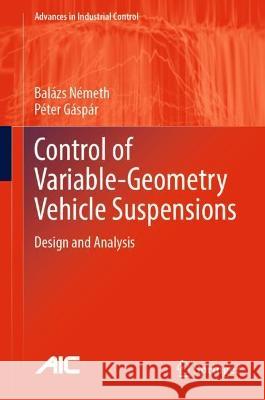
Control of Variable-Geometry Vehicle Suspensions: Design and Analysis

ISBN-13: 9783031305368 / Angielski
Balázs Németh; Péter Gáspár
Control of Variable-Geometry Vehicle Suspensions: Design and Analysis Bal?zs N?meth P?ter G?sp?r 9783031305368 Springer - książkaWidoczna okładka, to zdjęcie poglądowe, a rzeczywista szata graficzna może różnić się od prezentowanej.

Control of Variable-Geometry Vehicle Suspensions: Design and Analysis

ISBN-13: 9783031305368 / Angielski

Balázs Németh; Péter Gáspár
cena 644,07
(netto: 613,40 VAT:  5%)

Najniższa cena z 30 dni: 578,30
Termin realizacji zamówienia:
ok. 16-18 dni roboczych.

Darmowa dostawa!
inne wydania
Kategorie:
Technologie
Kategorie BISAC:
Technology & Engineering > Automotive
Technology & Engineering > Automation
Computers > Artificial Intelligence - General
Wydawca:
Springer
Seria wydawnicza:
Advances in Industrial Control
Język:
Angielski
ISBN-13:
9783031305368

1 Introduction 

1.1 Motivation of variable geometry suspension systems 
1.2 Overview of variable geometry suspension systems: constructions and control methods 
1.3 Motivation of using learning features in suspension control systems 
1.4 Contents of the book 
References 

Part I Variable Geometry Suspension for Wheel Tilting Control

2 LPV-based modeling of variable geometry suspension 
2.1 Lateral vehicle model extension with wheel tilting effect 
2.2 Model formulation of variable geometry vehicle suspensions
2.3 Examination on the motion characteristics of variable geometry suspension 
2.4 Mechanical analysis of actuator intervention 
References 

3 LPV-based control of variable geometry suspension 
3.1 Performances of variable geometry suspension systems 
3.2 Optimization of vehicle suspension constructions 
3.3 Formulation of weighting functions for control design 
3.4 Robust control design for suspension actuator 
3.5 Illustration on the vehicle suspension control design 
References 

4 SOS-based modeling, analysis and control 
4.1 Motivations 
4.2 Analysis-oriented formulation of nonlinear lateral vehicle dynamics 
4.3 Analysis of actuation efficiency through nonlinear method 
4.4 LPV-based design for suspension control system 
4.5 Demonstration example 
References 

Part II Independent Steering with Variable Geometry Suspension

5 Modeling variable geometry suspension system 
5.1 Dynamical formulation of suspension motion 
5.2 Modeling lateral dynamics considering variable geometry vehicle suspensions 
5.3 Model formulation for suspension actuator 
References 

6 Hierarchical control design method for vehicle suspensions 
6.1 Suspension control design for wheel tilting 
6.2 Design methods of steering control and uncertainty 
6.3 Coordination of steering control and torque vectoring 
6.4 Designing control for electro-hydraulic suspension actuator 
References 

7 Coordinated control strategy for variable geometry suspension 
7.1 Motivations 
7.2 Distribution method of steering and forces on the wheels 
7.3 Reconfiguration strategy 
7.4 Illustration of the reconfiguration strategy 
References 

8 Control implementation on suspension testbed 
8.1 Introduction to test bed for variable geometry vehicle suspension 
8.2 Implemented control algorithm on the suspension test bed 
8.3 Illustration on tuning parameter selection 
8.4 Demonstration on the control evaluation under HiL environment 
References 

Part III Guaranteed Suspension Control with Learning Methods

9 Data-driven framework for variable geometry suspension control 
9.1 Control-oriented model formulation of the test bed 
9.2 Design of LPV control to achieve low-level operations 
9.3 Demonstration on the operation of the control system 
References 

10 Guaranteeing performance requirements for suspensions via robust LPV framework 
10.1 Fundamentals of the control design structure 
10.2 Selection process for measured disturbances and scheduling variables 
10.3 Iteration-based control design for suspension systems 
References 

11 Control design for Variable Geometry Suspension with learning methods 
11.1 Control design with guarantees for variable geometry suspension 
11.2 Simulation results with learning-based agent 
11.3 Simulation results with driver-in-the-loop 
References 

Index 

Balázs Németh has been a senior research fellow of the Systems and Control Laboratory (SCL) in the Institute for Computer Science and Control (SZTAKI) since 2007. He received his Ph.D. degree in Transportation Sciences from Budapest University of Technology and Economics (BME) in 2013. He is an honorary associate professor of BME, and he lectures in B.Sc., M.Sc., and Ph.D. courses on control system theory and vehicle control. He has published 102 journal papers, 4 books, and 107 papers in conference proceedings. His main research areas are analysis and synthesis of autonomous vehicle control systems, energy-optimal control of road vehicles, integration of learning and control methods, and ethics of autonomous vehicle systems.


Péter Gáspár received both M.Sc. and Ph.D. degrees from the Faculty of Transportation Engineering and Vehicle Engineering, Budapest University of Technology and Economics (BME) in 1985 and 1997, respectively, and his D.Sc. degree in Control from the Hungarian Academy of Sciences (MTA) in 2007. Since 2022 he has been a full member of the MTA. He is head of the Systems and Control Laboratory (SCL) in the Institute for Computer Science and Control (SZTAKI) and is also a full professor at the Department of Control for Transportation and Vehicle Systems, BME. He is a member of IFAC Technical Committees on both Automotive Control and Transportation Systems. He is a co-author of 4 monographs on systems and control theory and vehicle control and the co-author of 7 university textbooks. He has published 226 journal papers, 5 book chapters, and 310 papers in conference proceedings with more than 2250 citations. His research interests include linear and nonlinear systems, robust control, system identification, and machine learning methods. His research and industrial works have involved mechanical systems, vehicle structures, and vehicle dynamics and control.


This book provides a thorough and fresh treatment of the control of innovative variable-geometry vehicle suspension systems. A deep survey on the topic, which covers the varying types of existing variable-geometry suspension solutions, introduces the study. The book discusses three important aspects of the subject:


• robust control design;

• nonlinear system analysis; and

• integration of learning and control methods.


The importance of variable-geometry suspensions and the effectiveness of design methods implemented in the autonomous functionalities of electric vehicles—functionalities like independent steering and torque vectoring—are illustrated. The authors detail the theoretical background of modeling, control design, and analysis for each functionality. The theoretical results achieved through simulation examples and hardware-in-the-loop scenarios are confirmed. The book highlights emerging ideas of applying machine-learning-based methods in the control system with guarantees on safety performance. The authors propose novel control methods, based on the theory of robust linear parameter-varying systems, with examples for various suspension systems.


Academic researchers interested in automotive systems and their counterparts involved in industrial research and development will find much to interest them in the eleven chapters of Control of Variable-Geometry Vehicle Suspensions.




Udostępnij

Facebook - konto krainaksiazek.pl


Opinie o Krainaksiazek.pl na Opineo.pl

Partner Mybenefit

Krainaksiazek.pl w programie rzetelna firma Krainaksiaze.pl - płatności przez paypal

Czytaj nas na:

Facebook - krainaksiazek.pl
  • książki na zamówienie
  • granty
  • książka na prezent
  • kontakt
  • pomoc
  • opinie
  • regulamin
  • polityka prywatności

Zobacz:

  • Księgarnia czeska

  • Wydawnictwo Książkowe Klimaty

1997-2026 DolnySlask.com Agencja Internetowa

© 1997-2022 krainaksiazek.pl
     
KONTAKT | REGULAMIN | POLITYKA PRYWATNOŚCI | USTAWIENIA PRYWATNOŚCI
Zobacz: Księgarnia Czeska | Wydawnictwo Książkowe Klimaty | Mapa strony | Lista autorów
KrainaKsiazek.PL - Księgarnia Internetowa

Polityka prywatnosci - link
Krainaksiazek.pl - płatnośc Przelewy24
Przechowalnia Przechowalnia



