• Wyszukiwanie zaawansowane
  • Kategorie
  • Kategorie BISAC
  • Książki na zamówienie
  • Promocje
  • Granty
  • Książka na prezent
  • Opinie
  • Pomoc
  • Załóż konto
  • Zaloguj się

Control, Identification, and Input Optimization » książka


zaloguj się | załóż konto
Logo Krainaksiazek.pl

koszyk

konto

szukaj
topmenu
Księgarnia internetowa
Szukaj
Książki na zamówienie
Promocje
Granty
Książka na prezent
Moje konto
Pomoc
 
 
Wyszukiwanie zaawansowane
Pusty koszyk
Bezpłatna dostawa dla zamówień powyżej 20 złBezpłatna dostawa dla zamówień powyżej 20 zł

Kategorie główne

• Nauka
 [2946600]
• Literatura piękna
 [1856966]

  więcej...
• Turystyka
 [72221]
• Informatyka
 [151456]
• Komiksy
 [35826]
• Encyklopedie
 [23190]
• Dziecięca
 [619653]
• Hobby
 [140543]
• AudioBooki
 [1577]
• Literatura faktu
 [228355]
• Muzyka CD
 [410]
• Słowniki
 [2874]
• Inne
 [445822]
• Kalendarze
 [1744]
• Podręczniki
 [167141]
• Poradniki
 [482898]
• Religia
 [510455]
• Czasopisma
 [526]
• Sport
 [61590]
• Sztuka
 [243598]
• CD, DVD, Video
 [3423]
• Technologie
 [219201]
• Zdrowie
 [101638]
• Książkowe Klimaty
 [124]
• Zabawki
 [2473]
• Puzzle, gry
 [3898]
• Literatura w języku ukraińskim
 [254]
• Art. papiernicze i szkolne
 [8170]
Kategorie szczegółowe BISAC

Control, Identification, and Input Optimization

ISBN-13: 9781468476644 / Angielski / Miękka / 2012 / 442 str.
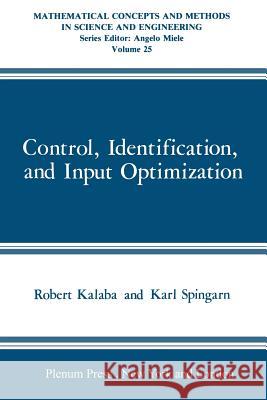
Robert Kalaba; Karl Spingarn
Control, Identification, and Input Optimization Robert Kalaba Karl Spingarn 9781468476644 Springer - książkaWidoczna okładka, to zdjęcie poglądowe, a rzeczywista szata graficzna może różnić się od prezentowanej.

Control, Identification, and Input Optimization

ISBN-13: 9781468476644 / Angielski / Miękka / 2012 / 442 str.

Robert Kalaba; Karl Spingarn
cena 201,72 zł
(netto: 192,11 VAT:  5%)

Najniższa cena z 30 dni: 192,74 zł
Termin realizacji zamówienia:
ok. 22 dni roboczych
Bez gwarancji dostawy przed świętami

Darmowa dostawa!

This book is a self-contained text devoted to the numerical determination of optimal inputs for system identification. It presents the current state of optimal inputs with extensive background material on optimization and system identification. The field of optimal inputs has been an area of considerable research recently with important advances by R. Mehra, G. c. Goodwin, M. Aoki, and N. E. Nahi, to name just a few eminent in- vestigators. The authors' interest in optimal inputs first developed when F. E. Yates, an eminent physiologist, expressed the need for optimal or preferred inputs to estimate physiological parameters. The text assumes no previous knowledge of optimal control theory, numerical methods for solving two-point boundary-value problems, or system identification. As such it should be of interest to students as well as researchers in control engineering, computer science, biomedical en- gineering, operations research, and economics. In addition the sections on beam theory should be of special interest to mechanical and civil en- gineers and the sections on eigenvalues should be of interest to numerical analysts. The authors have tried to present a balanced viewpoint; however, primary emphasis is on those methods in which they have had first-hand experience. Their work has been influenced by many authors. Special acknowledgment should go to those listed above as well as R. Bellman, A. Miele, G. A. Bekey, and A. P. Sage. The book can be used for a two-semester course in control theory, system identification, and optimal inputs.


Kategorie:
Nauka, Matematyka
Kategorie BISAC:
Mathematics > Rachunek różniczkowy
Mathematics > Optimization
Wydawca:
Springer
Seria wydawnicza:
Mathematical Concepts and Methods in Science and Engineering
Język:
Angielski
ISBN-13:
9781468476644
Rok wydania:
2012
Wydanie:
Softcover Repri
Numer serii:
000075124
Ilość stron:
442
Waga:
0.59 kg
Wymiary:
22.86 x 15.24 x 2.29
Oprawa:
Miękka
Wolumenów:
01
Dodatkowe informacje:
Wydanie ilustrowane

I. Introduction.- 1. Introduction.- 1.1. Optimal Control.- 1.2. System Identification.- 1.3. Optimal Inputs.- 1.4. Computational Preliminaries.- Exercises.- II. Optimal Control and Methods for Numerical Solutions.- 2. Optimal Control.- 2.1. Simplest Problem in the Calculus of Variations.- 2.1.1. Euler-Lagrange Equations.- 2.1.2. Dynamic Programming.- 2.1.3. Hamilton-Jacobi Equations.- 2.2. Several Unknown Functions.- 2.3. Isoperimetric Problems.- 2.4. Differential Equation Auxiliary Conditions.- 2.5. Pontryagin’s Maximum Principle.- 2.6. Equilibrium of a Perfectly Flexible Inhomogeneous Suspended Cable.- 2.7. New Approaches to Optimal Control and Filtering.- 2.8. Summary of Commonly Used Equations.- Exercises.- 3. Numerical Solutions for Linear Two-Point Boundary-Value Problems..- 3.1. Numerical Solution Methods.- 3.1.1. Matrix Riccati Equation.- 3.1.2. Method of Complementary Functions.- 3.1.3. Invariant Imbedding.- 3.1.4. Analytical Solution.- 3.2. An Optimal Control Problem for a First-Order System.- 3.2.1. The Euler-Lagrange Equations.- 3.2.2. Pontryagin’s Maximum Principle.- 3.2.3. Dynamic Programming.- 3.2.4. Kalaba’s Initial-Value Method.- 3.2.5. Analytical Solution.- 3.2.6. Numerical Results.- 3.3. An Optimal Control Problem for a Second-Order System.- 3.3.1. Numerical Methods.- 3.3.2. Analytical Solution.- 3.3.3. Numerical Results and Discussion.- Exercises.- 4. Numerical Solutions for Nonlinear Two-Point Boundary-Value Problems.- 4.1. Numerical Solution Methods.- 4.1.1. Quasilinearization.- 4.1.2. Newton-Raphson Method.- 4.2. Examples of Problems Yielding Nonlinear Two-Point Boundary-Value Problems.- 4.2.1. A First-Order Nonlinear Optimal Control Problem.- 4.2.2. Optimization of Functionals Subject to Integral Constraints.- 4.2.3. Design of Linear Regulators with Energy Constraints.- 4.3. Examples Using Integral Equation and Imbedding Methods.- 4.3.1. Integral Equation Method for Buckling Loads.- 4.3.2. An Imbedding Method for Buckling Loads.- 4.3.3. An Imbedding Method for a Nonlinear Two-Point Boundary-Value Problem.- 4.3.4. Post-Buckling Beam Configurations via an Imbedding Method.- 4.3.5. A Sequential Method for Nonlinear Filtering.- Exercises.- III. System Identification.- 5. Gauss-Newton Method for System Identification.- 5.1. Least-Squares Estimation.- 5.1.1. Scalar Least-Squares Estimation.- 5.1.2. Linear Least-Squares Estimation.- 5.2. Maximum Likelihood Estimation.- 5.3. Cramér-Rao Lower Bound.- 5.4. Gauss-Newton Method.- 5.5. Examples of the Gauss-Newton Method.- 5.5.1. First-Order System with Single Unknown Parameter.- 5.5.2. First-Order System with Unknown Initial Condition and Single Unknown Parameter.- 5.5.3. Second-Order System with Two Unknown Parameters and Vector Measurement.- 5.5.4. Second-Order System with Two Unknown Parameters and Scalar Measurement.- Exercises.- 6. Quasilinearization Method for System Identification.- 6.1. System Identification via Quasilinearization.- 6.2. Examples of the Quasilinearization Method.- 6.2.1. First-Order System with Single Unknown Parameter.- 6.2.2. First-Order System with Unknown Initial Condition and Single Unknown Parameter.- 6.2.3. Second-Order System with Two Unknown Parameters and Vector Measurement.- 6.2.4. Second-Order System with Two Unknown Parameters and Scalar Measurement.- Exercises.- 7. Applications of System Identification.- 7.1. Blood Glucose Regulation Parameter Estimation.- 7.1.1. Introduction.- 7.1.2. Physiological Experiments.- 7.1.3. Computational Methods.- 7.1.4. Numerical Results.- 7.1.5. Discussion and Conclusions.- 7.2. Fitting of Nonlinear Models of Drug Metabolism to Experimental Data.- 7.2.1. Introduction.- 7.2.2. A Model Employing Michaelis and Menten Kinetics for Metabolism.- 7.2.3. An Estimation Problem.- 7.2.4. Quasilinearization.- 7.2.5. Numerical Results.- 7.2.6. Discussion.- Exercises.- IV. Optimal Inputs for System Identification.- 8. Optimal Inputs.- 8.1. Historical Background.- 8.2. Linear Optimal Inputs.- 8.2.1. Optimal Inputs and Sensitivities for Parameter Estimation.- 8.2.2. Sensitivity of Parameter Estimates to Observations.- 8.2.3. Optimal Inputs for a Second-Order Linear System.- 8.2.4. Optimal Inputs Using Mehra’s Method.- 8.2.5. Comparison of Optimal Inputs for Homogeneous and Nonhomogeneous Boundary Conditions.- 8.3. Nonlinear Optimal Inputs.- 8.3.1. Optimal Input System Identification for Nonlinear Dynamic Systems.- 8.3.2. General Equations for Optimal Inputs for Nonlinear Process Parameter Estimation.- Exercises.- 9. Additional Topics for Optimal Inputs.- 9.1. An Improved Method for the Numerical Determination of Optimal Inputs.- 9.1.1. Introduction.- 9.1.2. A Nonlinear Example.- 9.1.3. Solution via Newton-Raphson Method.- 9.1.4. Numerical Results and Discussion.- 9.2. Multiparameter Optimal Inputs.- 9.2.1. Optimal Inputs for Vector Parameter Estimation.- 9.2.2. Example of Optimal Inputs for Two-Parameter Estimation.- 9.2.3. Example of Optimal Inputs for a Single-Input, Two-Output System.- 9.2.4. Example of Weighted Optimal Inputs.- 9.3. Observability, Controllability, and Identifiability.- 9.4. Optimal Inputs for Systems with Process Noise.- 9.5. Eigenvalue Problems.- 9.5.1. Convergence of the Gauss-Seidel Method.- 9.5.2. Determining the Eigenvalues of Saaty’s Matrices for Fuzzy Sets.- 9.5.3. Comparison of Methods for Determining the Weights of Belonging to Fuzzy Sets.- 9.5.4. Variational Equations for the Eigenvalues and Eigenvectors of Nonsymmetric Matrices.- 9.5.5. Individual Tracking of an Eigenvalue and Eigenvector of a Parametrized Matrix.- 9.5.6. A New Differential Equation Method for Finding the Perron Root of a Positive Matrix.- Exercises.- 10. Applications of Optimal Inputs.- 10.1. Optimal Inputs for Blood Glucose Regulation Parameter Estimation.- 10.1.1. Formulation Using Bolie Parameters for Solution by Linear or Dynamic Programming.- 10.1.2. Formulation Using Bolie Parameters for Solution by Method of Complementary Functions or Riccati Equation Method.- 10.1.3. Improved Method Using Bolie and Bergman Parameters for Numerical Determination of the Optimal Inputs.- 10.2. Optimal Inputs for Aircraft Parameter Estimation.- Exercises.- V. Computer Programs.- 11. Computer Programs for the Solution of Boundary-Value and Identification Problems.- 11.1. Two-Point Boundary-Value Problems.- 11.2. System Identification Problems.- References.- Author Index.


Udostępnij

Facebook - konto krainaksiazek.pl


Opinie o Krainaksiazek.pl na Opineo.pl

Partner Mybenefit

Krainaksiazek.pl w programie rzetelna firma Krainaksiaze.pl - płatności przez paypal

Czytaj nas na:

Facebook - krainaksiazek.pl
  • książki na zamówienie
  • granty
  • książka na prezent
  • kontakt
  • pomoc
  • opinie
  • regulamin
  • polityka prywatności

Zobacz:

  • Księgarnia czeska

  • Wydawnictwo Książkowe Klimaty

1997-2025 DolnySlask.com Agencja Internetowa

© 1997-2022 krainaksiazek.pl
     
KONTAKT | REGULAMIN | POLITYKA PRYWATNOŚCI | USTAWIENIA PRYWATNOŚCI
Zobacz: Księgarnia Czeska | Wydawnictwo Książkowe Klimaty | Mapa strony | Lista autorów
KrainaKsiazek.PL - Księgarnia Internetowa

Polityka prywatnosci - link
Krainaksiazek.pl - płatnośc Przelewy24
Przechowalnia Przechowalnia





