• Wyszukiwanie zaawansowane
  • Kategorie
  • Kategorie BISAC
  • Książki na zamówienie
  • Promocje
  • Granty
  • Książka na prezent
  • Opinie
  • Pomoc
  • Załóż konto
  • Zaloguj się

Continuum Mechanics of Anisotropic Materials » książka


zaloguj się | załóż konto
Logo Krainaksiazek.pl

koszyk

konto

szukaj
topmenu
Księgarnia internetowa
Szukaj
Książki na zamówienie
Promocje
Granty
Książka na prezent
Moje konto
Pomoc
 
 
Wyszukiwanie zaawansowane
Pusty koszyk
Bezpłatna dostawa dla zamówień powyżej 20 złBezpłatna dostawa dla zamówień powyżej 20 zł

Kategorie główne

• Nauka
 [2946912]
• Literatura piękna
 [1852311]

  więcej...
• Turystyka
 [71421]
• Informatyka
 [150889]
• Komiksy
 [35717]
• Encyklopedie
 [23177]
• Dziecięca
 [617324]
• Hobby
 [138808]
• AudioBooki
 [1671]
• Literatura faktu
 [228371]
• Muzyka CD
 [400]
• Słowniki
 [2841]
• Inne
 [445428]
• Kalendarze
 [1545]
• Podręczniki
 [166819]
• Poradniki
 [480180]
• Religia
 [510412]
• Czasopisma
 [525]
• Sport
 [61271]
• Sztuka
 [242929]
• CD, DVD, Video
 [3371]
• Technologie
 [219258]
• Zdrowie
 [100961]
• Książkowe Klimaty
 [124]
• Zabawki
 [2341]
• Puzzle, gry
 [3766]
• Literatura w języku ukraińskim
 [255]
• Art. papiernicze i szkolne
 [7810]
Kategorie szczegółowe BISAC

Continuum Mechanics of Anisotropic Materials

ISBN-13: 9781461450245 / Angielski / Twarda / 2013 / 425 str.
Stephen C Cowin
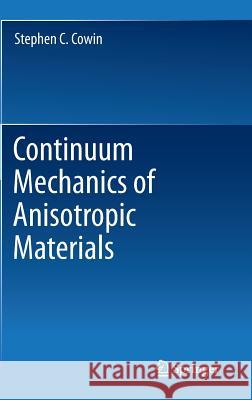
Continuum Mechanics of Anisotropic Materials Stephen C Cowin 9781461450245  - książkaWidoczna okładka, to zdjęcie poglądowe, a rzeczywista szata graficzna może różnić się od prezentowanej.

Continuum Mechanics of Anisotropic Materials

ISBN-13: 9781461450245 / Angielski / Twarda / 2013 / 425 str.

Stephen C Cowin
cena 201,72
(netto: 192,11 VAT:  5%)

Najniższa cena z 30 dni: 192,74
Termin realizacji zamówienia:
ok. 22 dni roboczych
Bez gwarancji dostawy przed świętami

Darmowa dostawa!
inne wydania

Continuum Mechanics of Anisotropic Materials(CMAM) presents an entirely new and unique development of material anisotropy in the context of an appropriate selection and organization of continuum mechanics topics. These features will distinguish this continuum mechanics book from other books on this subject. Textbooks on continuum mechanics are widely employed in engineering education, however, none of them deal specifically with anisotropy in materials. For the audience of Biomedical, Chemical and Civil Engineering students, these materials will be dealt with more frequently and greater accuracy in their analysis will be desired. Continuum Mechanics of Anisotropic Materials' author has beena leaderin the field of developing new approaches for the understanding of anisotropic materials.


Kategorie:
Nauka, Medycyna
Kategorie BISAC:
Science > Biofizyka
Science > Mechanics - General
Technology & Engineering > Engineering (General)
Język:
Angielski
ISBN-13:
9781461450245
Rok wydania:
2013
Wydanie:
2013
Ilość stron:
425
Waga:
0.97 kg
Wymiary:
23.37 x 16.0 x 2.79
Oprawa:
Twarda
Wolumenów:
01
Dodatkowe informacje:
Bibliografia
Wydanie ilustrowane

Chapter 1. Introduction

Chapter 2. Mechanical modeling of materials

2.1 Introduction

2.2 Models and the real physical world

2.3 Guidelines for modeling objects and solving mechanics problems

2.4 The types of models used in mechanics

2.5 The particle model

2.6 The rigid object model

2.7 The deformable continuum model

2.8 Lumped parameter models

2.9 Statistical models

2.10 Cellular automata

2.11 The limits of reductionism

2.12 References

Appendix 2A Laplace transform refresher

Appendix 2B First order differential equations

Appendix 2C Electrical analogs of the spring and dashpot models

Chapter 3. Basic continuum kinematics

3.1 The deformable material model, the continuum

3.2 Rates of change and the spatial representation of motion

3.3 Infinitesimal motions

3.4 The strain conditions of compatibility

Chapter 4. Continuum formulations of conservation laws

4.1 The conservation principles

4.2 The conservation of mass

4.3 The state of stress at a point

4.4 The stress equations of motion

4.5 The conservation of energy

Chapter 5. Formulation of constitutive equations

5.1 Guidelines for the formulation of constitutive equations

5.2 Constitutive ideas

5.3 Localization

5.4 Invariance under rigid object motions

5.5 Determinism

5.6 Linearization

5.7 Coordinate invariance

5.8 Homogeneous versus inhomogeneous constitutive models

5.9 Restrictions due to material symmetry

5.10 The symmetry of the material coefficient tensors

5.11 Restrictions on the coefficients representing material properties

5.12 Summary of results

5.13 Relevant literature

Chapter 6 Modeling material symmetry

6.1 Introduction

6.2 The representative volume element (RVE)

6.3 Crystalline materials and textured materials

6.4 Planes of mirror symmetry

6.5 Characterization of material symmetries by planes of symmetry

6.6 The forms of the 3D symmetric linear transformation A

6.7 The forms of the 6D symmetric linear transformation

6.8 Curvilinear anisotropy

6.9 Symmetries that permit chirality

6.10 Relevant literature

Chapter 7. Four linear continuum theories

7.1 Formation of continuum theories

7.2 The theory of fluid flow through rigid porous media

7.3 The theory of elastic solids

7.4 The theory of viscous fluids

7.5 The theory of viscoelastic materials

7.6 Relevant literature

Chapter 8 Modeling material microstructure

8.1 Introduction

8.2 The representative volume element (RVE)

8.3 Effective material parameters

8.4 Effective elastic constants

8.5 Effective permeability

8.6 Structural gradients

8.7 Tensorial representations of microstructure

8.8 Relevant literature

Chapter 9. Poroelasticity

9.1 Poroelastic materials

9.2 The stress-strain-pore pressure constitutive relation

9.3 The fluid content-stress-pore pressure constitutive relation

9.4 Darcy’s Law

9.5 Matrix material and pore fluid incompressibility constraints

9.6 The undrained elastic coefficients

9.7 Expressions of mass and momentum conservation

9.8 The basic equations of poroelasticity

9.9 The basic equations of incompressible poroelasticity

9.10 Some example isotropic poroelastic problems

9.11 An example: the unconfined compression of an anisotropic disc

9.12 Relevant literature

Chapter 10 Mixture

10.1 Introduction

10.2 Kinematics of mixtures

10.3 The conservation laws for mixtures

10.4 A statement of irreversibility in mixture processes

10.5 Donnan equilibrium and osmotic pressure

10.6 Continuum model for a charged porous medium; the governing equations

10.7 Linear irreversible thermodynamics and the four constituent mixture

10.8 Modeling swelling and compression experiments on the intervertebral disc

10.9 Relevant literature

Chapter 11. Kinematics and mechanics of large deformations

11.1 Large deformations

11.2 Large homogeneous deformations

11.3 Polar decomposition of the deformation gradients

11.4 The strain measures for large deformations

11.5 Measures of volume and surface change in large deformations

11.6 Stress measures

11.7 Finite deformation elasticity

11.8 The isotropic finite deformation stress-strain relation

11.9 Finite deformation hyperelasticity

11.10 Incompressible elasticity

11.11 Relevant literature


Chapter 12. Plasticity Theory

12.1 Extension of von Mises criterion to anisotropic materials

12.2 Yield criteria for pressure sensitive anisotropic materials

12.3 Some particular deformation characteristics exhibited by granular materials (dilatancy/contractancy, anisotropy, hardening/softening, and shear localization).

12.4 Dilatant double shearing kinematics

12.5 Evolution equations for the material parameters

12.6 Numerical biaxial compression test of anisotropic granular materials

12.6 Numerical triaxial compression test of anisotropic granular materials

12.7 Plasticity theories for crystalline materials

Appendix A. Matrices and tensors

A.1 Introduction and rationale

A.2 Definition of square, column and row matrices

A.3 The types and algebra of square matrices

A.4 The algebra of n-tuples

A.5 Linear transformations

A.6 Vector spaces

A.7 Second rank tensors

A.8 The moment of inertia tensor

A.9 The alternator and vector cross products

A.10 Connection to Mohr’s circles

A.11 Special vectors and tensors in six dimensions

A.12 The gradient operator and the divergence theorem

A.13 Tensor components in cylindrical coordinates

Stephen C. Cowin is Distinguished Professor of Mechanical Engineering at The City College of The City University of New York

Continuum Mechanics of Anisotropic Materials(CMAM) presents an entirely new and unique development of material anisotropy in the context of an appropriate selection and organization of continuum mechanics topics. These features will distinguish this continuum mechanics book from other books on this subject. Textbooks on continuum mechanics are widely employed in engineering education, however, none of them deal specifically with anisotropy in materials. For the audience of Biomedical, Chemical and Civil Engineering students, these materials will be dealt with more frequently and greater accuracy in their analysis will be desired. Continuum Mechanics of Anisotropic Materials' author has been a leader in the field of developing new approaches for the understanding of anisotropic materials.



Udostępnij

Facebook - konto krainaksiazek.pl


Opinie o Krainaksiazek.pl na Opineo.pl

Partner Mybenefit

Krainaksiazek.pl w programie rzetelna firma Krainaksiaze.pl - płatności przez paypal

Czytaj nas na:

Facebook - krainaksiazek.pl
  • książki na zamówienie
  • granty
  • książka na prezent
  • kontakt
  • pomoc
  • opinie
  • regulamin
  • polityka prywatności

Zobacz:

  • Księgarnia czeska

  • Wydawnictwo Książkowe Klimaty

1997-2025 DolnySlask.com Agencja Internetowa

© 1997-2022 krainaksiazek.pl
     
KONTAKT | REGULAMIN | POLITYKA PRYWATNOŚCI | USTAWIENIA PRYWATNOŚCI
Zobacz: Księgarnia Czeska | Wydawnictwo Książkowe Klimaty | Mapa strony | Lista autorów
KrainaKsiazek.PL - Księgarnia Internetowa

Polityka prywatnosci - link
Krainaksiazek.pl - płatnośc Przelewy24
Przechowalnia Przechowalnia




