• Wyszukiwanie zaawansowane
  • Kategorie
  • Kategorie BISAC
  • Książki na zamówienie
  • Promocje
  • Granty
  • Książka na prezent
  • Opinie
  • Pomoc
  • Załóż konto
  • Zaloguj się

Contextual Approach to Quantum Formalism » książka


zaloguj się | załóż konto
Logo Krainaksiazek.pl

koszyk

konto

szukaj
topmenu
Księgarnia internetowa
Szukaj
Książki na zamówienie
Promocje
Granty
Książka na prezent
Moje konto
Pomoc
 
 
Wyszukiwanie zaawansowane
Pusty koszyk
Bezpłatna dostawa dla zamówień powyżej 20 złBezpłatna dostawa dla zamówień powyżej 20 zł

Kategorie główne

• Nauka
 [2946912]
• Literatura piękna
 [1852311]

  więcej...
• Turystyka
 [71421]
• Informatyka
 [150889]
• Komiksy
 [35717]
• Encyklopedie
 [23177]
• Dziecięca
 [617324]
• Hobby
 [138808]
• AudioBooki
 [1671]
• Literatura faktu
 [228371]
• Muzyka CD
 [400]
• Słowniki
 [2841]
• Inne
 [445428]
• Kalendarze
 [1545]
• Podręczniki
 [166819]
• Poradniki
 [480180]
• Religia
 [510412]
• Czasopisma
 [525]
• Sport
 [61271]
• Sztuka
 [242929]
• CD, DVD, Video
 [3371]
• Technologie
 [219258]
• Zdrowie
 [100961]
• Książkowe Klimaty
 [124]
• Zabawki
 [2341]
• Puzzle, gry
 [3766]
• Literatura w języku ukraińskim
 [255]
• Art. papiernicze i szkolne
 [7810]
Kategorie szczegółowe BISAC

Contextual Approach to Quantum Formalism

ISBN-13: 9789048181643 / Angielski / Miękka / 2010 / 354 str.
Springer
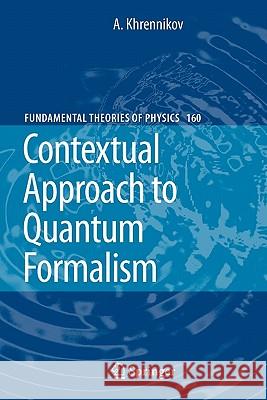
Contextual Approach to Quantum Formalism Springer 9789048181643 Springer - książkaWidoczna okładka, to zdjęcie poglądowe, a rzeczywista szata graficzna może różnić się od prezentowanej.

Contextual Approach to Quantum Formalism

ISBN-13: 9789048181643 / Angielski / Miękka / 2010 / 354 str.

Springer
cena 602,40
(netto: 573,71 VAT:  5%)

Najniższa cena z 30 dni: 578,30
Termin realizacji zamówienia:
ok. 22 dni roboczych
Dostawa w 2026 r.

Darmowa dostawa!

The aim of this book is to show that the probabilistic formalisms of classical statistical mechanics and quantum mechanics can be unified on the basis of a general contextual probabilistic model. By taking into account the dependence of (classical) probabilities on contexts (i.e. complexes of physical conditions), one can reproduce all distinct features of quantum probabilities such as the interference of probabilities and the violation of Bell's inequality. Moreover, by starting with a formula for the interference of probabilities (which generalizes the well known classical formula of total probability), one can construct the representation of contextual probabilities by complex probability amplitudes or, in the abstract formalism, by normalized vectors of the complex Hilbert space or its hyperbolic generalization. Thus the Hilbert space representation of probabilities can be naturally derived from classical probabilistic assumptions. An important chapter of the book critically reviews known no-go theorems: the impossibility to establish a finer description of micro-phenomena than provided by quantum mechanics; and, in particular, the commonly accepted consequences of Bell's theorem (including quantum non-locality). Also, possible applications of the contextual probabilistic model and its quantum-like representation in complex Hilbert spaces in other fields (e.g. in cognitive science and psychology) are discussed.


Kategorie:
Nauka, Fizyka
Kategorie BISAC:
Mathematics > Prawdopodobieństwo i statystyka
Science > Fizyka kwantowa
Science > Fizyka matematyczna
Wydawca:
Springer
Język:
Angielski
ISBN-13:
9789048181643
Rok wydania:
2010
Numer serii:
000036058
Ilość stron:
354
Waga:
0.59 kg
Wymiary:
23.5 x 15.5
Oprawa:
Miękka
Wolumenów:
01

From the reviews:

"In this book the author presents an unorthodox account of quantum probability theory according to which all the latter's key features can be reproduced and brought under a common formalism (known as the 'Växjö model') with classical statistical mechanics by using a formalism based on contextual probability ... . the ideas contained in this book are of potentially very high importance." (Dean Rickles, Mathematical Reviews, Issue 2011 i)

Part I: Quantum and Classical Probability Chapter 1: Quantum Mechanics: Postulates and Interpretations 1.1 Quantum Mechanics 1.1.1 Mathematical Basis 1.1.2 Postulates 1.2 Projection Postulate, Collapse of Wave Function, Schr\'odinger's Cat 1.2.1 Von Neumann's Projection Postulate 1.2.2 Collapse of Wave Function 1.2.3 Schr\'odinger's Cat 1.2.4 L\'uders Projection Postulate 1.3 Statistical Mixtures 1.4 Von Neumann's and L\'uders' Postulates for Mixed States 1.5 Conditional Probability 1.6 Derivation of Interference of Probabilities Chapter 2: Classical Probability Theories 2.1 Kolmogorov Measure-Theoretic Model 2.1.1 Formalism 2.1.2 Discussion 2.2 Von Mises Frequency Model 2.2.1 Collective (Random Sequence) 2.2.2 Difficulties with Definition of Randomness 2.2.3 $S$-sequences 2.2.4 Operations for Collectives 2.3 Combining and Independence of Collectives Part I I: Contextual Probability and\\ Quantum-Like Models Chapter 1: Contextual Probability and Interference 1.1 V\'axj\'o model: Contextual Probability 1.1.1 Contexts 1.1.2 Observables 1.1.3 Contextual Probability Space and Model 1.1.4 V\'axj\'o Models Induced by the Kolmogorov Model 1.1.5 V\'axj\'o Models Induced by QM 1.1.6 V\'axj\'o Models Induced by the von Mises Model 1.2 Contextual Probabilistic Description of Double Slit Experiment 1.3 Formula of Total Probability and Measures of Supplementarity 1.4 Supplementary Observables 1.5 Principle of Supplementarity 1.6 Supplementarity and Kolmogorovness 1.6.1 Double Stochasticity as the Law of Probabilistic Balance 1.6.2 Probabilistically Balanced Observables 1.6.3 Symmetrically Conditioned Observables 1.7 Incompatibility, Supplementarity and Existence of Joint Probability Distribution 1.7.1 Joint Probability Distribution 1.7.2 Incompatible and Supplementary Observables 1.7.3 Compatibility and Probabilistic Compatibility 1.8 Interpretational Questions 1.8.1 Contextuality 1.8.2 Realism 1.9 Historical Remark: Comparing with Mackey's Model 1.10 Subjective and Contextual Probabilities in Quantum Theory Chapter 2: Quantum-Like Representation of Contextual Probabilistic Model 2.1 Trigonometric, Hyperbolic, and Hyper-Trigonometric Contexts 2.2 Quantum-Like Representation Algorithm -- QLRA 2.2.1 Probabilistic Data about Context 2.2.2 Construction of Complex Probabilistic Amplitudes 2.3 Hilbert Space Representation of $b$-Observable 2.3.1 Born's Rule 2.3.2 Fundamental Physical Observable: Views of De Broglie and Bohm 2.3.3 $b$-Observable as Multiplication Operator 2.3.4 Interference 2.4 Hilbert Space Representation of $a$-Observable 2.4.1 Conventional Quantum and Quantum-Like Representations 2.4.2 $a$-Basis from Interference 2.4.3 Necessary and Sufficient Conditions for Born's Rule 2.4.4 Choice of Probabilistic Phases 2.4.5 Contextual Dependence of $a$-Basis 2.4.6 Existence of Quantum-Like Representation with Born's Rule for Both Reference Observables 2.4.7 ``Pathologies'' 2.5 Properties of Mapping of Trigonometric Contexts into Complex Amplitudes 2.5.1 Classical-Like Contexts 2.5.2 Non Injectivity of Representation Map 2.6 Non-Double Stochastic Matrix: Quantum-Like Representations 2.7 Noncommutativity of Operators Representing Observables 2.8 Symmetrically Conditioned Observables 2.8.1 $b$-Selections are Trigonometric Contexts 2.8.2 Extension of Representation Map 2.9 Formalization of the Notion of Quantum-Like Representation 2.10 Domain of Application of Quantum-Like Representation Algorithm Chapter 3: Ensemble Representation o

Prof. Andrei Khrennikov is the director of International center for mathematical modeling in physics, engineering and cognitive science, University of Växjö, Sweden, which was created 8 years ago to perform interdisciplinary research.

Two series of conferences on quantum foundations (especially probabilistic aspects) were established on the basis of this center: "Foundations of Probability and Physics" and "Quantum Theory: Reconsideration of Foundations". These series became well known in the quantum community (including quantum information groups). Hundreds of theoreticians (physicists and mathematicians), experimenters and even philosophers participated in these conferences presenting a huge diversity of views to quantum foundations. Contacts with these people played the crucial role in creation of the present book.

Prof. Andrei Khrennikov published about 300 papers in internationally recognized journals in mathematics, physics and biology and 9 monographs – in p-adic and non-Archimedean analysis with applications to mathematical physics and cognitive sciences as well as foundations of probabilityu theory.

The aim of this book is to show that the probabilistic formalisms of classical statistical mechanics and quantum mechanics can be unified on the basis of a general contextual probabilistic model. By taking into account the dependence of (classical) probabilities on contexts (i.e. complexes of physical conditions), one can reproduce all distinct features of quantum probabilities such as the interference of probabilities and the violation of Bell’s inequality. Moreover, by starting with a formula for the interference of probabilities (which generalizes the well known classical formula of total probability), one can construct the representation of contextual probabilities by complex probability amplitudes or, in the abstract formalism, by normalized vectors of the complex Hilbert space or its hyperbolic generalization. Thus the Hilbert space representation of probabilities can be naturally derived from classical probabilistic assumptions. An important chapter of the book critically reviews known no-go theorems: the impossibility to establish a finer description of micro-phenomena than provided by quantum mechanics; and, in particular, the commonly accepted consequences of Bell’s theorem (including quantum non-locality). Also, possible applications of the contextual probabilistic model and its quantum-like representation in complex Hilbert spaces in other fields (e.g. in cognitive science and psychology) are discussed.




Udostępnij

Facebook - konto krainaksiazek.pl


Opinie o Krainaksiazek.pl na Opineo.pl

Partner Mybenefit

Krainaksiazek.pl w programie rzetelna firma Krainaksiaze.pl - płatności przez paypal

Czytaj nas na:

Facebook - krainaksiazek.pl
  • książki na zamówienie
  • granty
  • książka na prezent
  • kontakt
  • pomoc
  • opinie
  • regulamin
  • polityka prywatności

Zobacz:

  • Księgarnia czeska

  • Wydawnictwo Książkowe Klimaty

1997-2025 DolnySlask.com Agencja Internetowa

© 1997-2022 krainaksiazek.pl
     
KONTAKT | REGULAMIN | POLITYKA PRYWATNOŚCI | USTAWIENIA PRYWATNOŚCI
Zobacz: Księgarnia Czeska | Wydawnictwo Książkowe Klimaty | Mapa strony | Lista autorów
KrainaKsiazek.PL - Księgarnia Internetowa

Polityka prywatnosci - link
Krainaksiazek.pl - płatnośc Przelewy24
Przechowalnia Przechowalnia



