Contemporary Behaviorisms in Debate » książka





Contemporary Behaviorisms in Debate
ISBN-13: 9783030773946 / Angielski / Twarda / 2021 / 394 str.
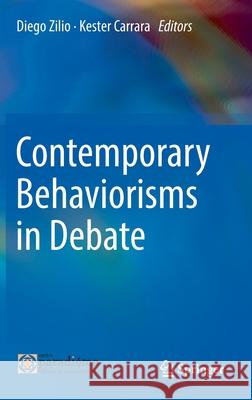
Contemporary Behaviorisms in Debate
ISBN-13: 9783030773946 / Angielski / Twarda / 2021 / 394 str.
(netto: 690,08 VAT: 5%)
Najniższa cena z 30 dni: 655,41
ok. 22 dni roboczych.
Darmowa dostawa!
Part I – Teleological Behaviorism
1. Teleological Behaviorism: Origins and Present Status
2. Purposive Behavior and Psychological Categories: Thoughts on Teleological Behaviorism
3. Response to Comments of LazzeriPart II – Molar Behaviorism
4. Introduction to Molar Behaviorism and Multiscale Behavior Analysis
5. The Molar View of Behavior: A Paradigm Shift in Behavior Analysis?6. Genes, Selection, and Behavior: Response to Laurenti’s Commentary
Part III – Theoretical Behaviorism
7. Theoretical Behaviorism8. What is the Theory of Theoretical Behaviorism?
9. Theory: A Response to Lopes
Part IV – Biological Behaviorism10. Biological Behaviorism
11. Comments on “Biological Behaviorism”
12. Reactions to Commentary on Biological BehaviorismPart V – Intentional Behaviorism
13. Intentional Behaviorism
14. Behavior Analysis and Psychological Concepts: Commentary on Foxall’s Intentional Behaviorism15. Behavior Analysis and Psychological Concepts: Reply to Oliveira-Castro
Part VI – Contextual Behaviorism
16. Contextual Behavioral Science as a Distinct form of Behavioral Research and Practice17. Will the Wing Fly Away from the Body? A Commentary on Steven Hayes' Chapter, Contextual Behavioral Science
18. The Bottom Line is Progress – All the Rest is Commentary
Part VII – Field-Theory Behaviorism
19. A Theory of Behavior or a Theory of Psychology
20. A Critical Appraisal of Ribes’ Theory of Psychology
21. The Definition of Psychological Behavior and the Adequacy of Theorical Concepts are the Fundamental Issues: A Reply to Borges Neves and Oliveira Magalhães
Diego Zilio received his Doctorate Degree (Sc.D.) in Experimental Psychology from the University of São Paulo (USP) at São Paulo in August of 2013. Zilio’s dissertation focused on the synthesis between behavior analysis and neuroscience. During this period he was a visiting scholar at the Georgia Institute of Technology. He also holds a Masters Degree in Philosophy of Mind, Epistemology and Logic from the State University of São Paulo (UNESP) at Marilia. Zilio’s master’s thesis provided a radical behavioristic perspective about the main problems in contemporary Philosophy of Mind. As an undergrad, he has a License in Psychology from the State University of São Paulo at Bauru. He is currently Assistant Professor at the Department of Social and Developmental Psychology and Permanent Professor at the Graduate Program in Psychology, Federal University of Espírito Santo, Brazil. He has been and currently is advisor of several undergraduate and graduate students. Dr. Zilio is the head of the GEPPSAC – Behavior Analytic Social Psychology Research Group. He has published papers in a number of different journals, including The Behavior Analyst (Perspectives on Behavior Science), Behavior and Philosophy, The Psychological Record, Behavior and Social Issues, Review of General Psychology, Acta Comportamentalia, Brazilian Journal of Behavior Analysis, among others. He has published and organized several books in Portuguese, including A Natureza Comportamental da Mente: Behaviorismo Radical e Filosofia da Mente ("The Behavioral Nature of Mind: Radical Behaviorism and Philosophy of Mind") and, with Kester Carrara, the three-volume series Behaviorismos: Reflexões Históricas e Conceituais ("Behaviorisms: Conceptual and Historical Issues"). He is the general editor of Behavior and Philosophy, and associated editor of Acta Comportamentalia, Brazilian Journal of Behavior Analysis and Perspectives on Behavior Analysis. Dr. Zilio develops philosophical, conceptual and historical research concerning behavior analysis, discussing topics such as the nature of mind and behavior, the relation of behavior analysis with neuroscience as well as the relation of behavior analysis with the social sciences. Currently, his main focus of interest is in systematizing a behavior-analytic social psychology.
Kester Carrara received his Doctorate Degree (Sc.D.) in Education from State University of São Paulo (UNESP) at Marilia. He also holds a Masters Degree in Psychology from Pontifícia Universidade Católica (PUC) at São Paulo. As an undergrad, he has a License in Psychology from the State University of São Paulo at Bauru. He is currently Professor Emeritus at the Department of Psychology, State University of São Paulo at Bauru. He has published papers in a number of different journals. He has published and organized several books, including the three-volume series Behaviorismos: Reflexões Históricas e Conceituais ("Behaviorisms: Conceptual and Historical Issues"), with Diego Zilio, and Radical Behaviorism and Cultural Analysis, published by Springer. He is the former general editor of Acta Comportamentalia. Dr. Carrara develops philosophical, conceptual and historical research concerning behavior analysis with a particular interested in how behavior analysis studies cultural practices.
This book presents and discusses seven contemporary theoretical approaches to behavior analysis that build upon the foundations laid by B.F. Skinner’s radical behaviorism and renew its legacy. These contemporary approaches show that behaviorism is not a monolithic or static intellectual tradition, but a dynamic movement, which changes and adapts in face of new questions, issues, and perspectives. The death of behaviorism has been proclaimed since its early days – a “premature” assessment, to say the least – but this volume shows that behaviorism is alive and kicking, even thirty years after its main proponent passed away.
This volume contains seven sections, each one dedicated to a particular variation of contemporary behaviorism: Howard Rachlin’s teleological behaviorism, William Baum’s molar behaviorism and multiscale behavior analysis, John Staddon’s theoretical behaviorism, John Donahoe’s biological behaviorism, Gordon Foxall’s intentional behaviorism, Steven Hayes’ contextual behaviorism or contextual behavioral science, and Emilio Ribes-Iñesta’s field-theory behaviorism. Each section contains three chapters: the first one written by the original proponent of each of these forms of behaviorism, the second one written by a commentator, and the third one written by the proponent, replying to the commentator.
Contemporary Behaviorisms in Debate will be a valuable tool to behavior analysts and psychologists in general by providing an introduction to contemporary forms of behaviorism and promoting debates about the main philosophical issues faced by the field of behavior analysis today— issues that can directly influence future epistemological variations in the selection process of “behaviorisms.” By doing so the book is directed not only to the present, but, more importantly, toward the future of the field.




Czytaj nas na:
1997-2026 DolnySlask.com Agencja Internetowa
KrainaKsiazek.PL - Księgarnia Internetowa


