Chapter 1. Constitutional Resilience and the Covid-19 Pandemic
Derek Powell and Ebenezer Durojaye
Chapter 2. International Human Rights Norms and Standards on Derogation and Limitation of Rights during a Public Emergency
Adetoun Adebanjo and Ebenezer Durojaye
Chapter 3. Addressing Covid-19: A Test of Kenya’s Constitutional and Democratic Resilience
Josephat Muuo Kilonzo and Balla Galma
Chapter 4. Covid-19 and Zambia’s Constitutional Dilemma
Christopher Phiri
Chapter 5. Constitutional Resilience and Limitation of Rights under Covid-19 Response in South Sudan
Joseph Geng Akech
Chapter 6. The Covid-19 Pandemic and Constitutional Resilience in The Gambia
Satang Nabaneh and Basiru Bah
Chapter 7. Walking a Tightrope: Balancing Human Rights and Public Health Measures during the Covid-19 Pandemic in Nigeria
Olubayo Oluduro
Chapter 8. The Constitutionality of Legal Measures Taken by the Government of Mauritius in the Context of the Covid-19 Pandemic
Roopanand Mahadew
Chapter 9. Constitutional and Human Rights Issues Arising from Covid-19: Uganda’s Youth in Context
Robert Doya Nanima
Chapter 10. The (Il)legality of Ghana’s Covid-19 Emergency Response: A Commentary
Bright Nkrumah
Chapter 11. Constitutional and Human Rights Issues Arising from Covid-19 in South Africa
Robert Doya Nanima and Ebenezer Durojaye
Chapter 12. Zimbabwe’s Response to Covid-19 and its Socio-economic Impact
Tinotenda Chidhawu
Ebenezer Durojaye is Professor and Head of the Socio-Economic Rights Project in the Dullah Omar Institute for Constitutional Law, Governance and Human Rights, University of the Western Cape, South Africa.
Derek M. Powell is Associate Professor of Law and Head of the Applied Constitutional Studies Project in the Dullah Omar Institute for Constitutional Law, Governance and Human Rights, University of the Western Cape, South Africa.
‘This volume is a much-needed piece of the global puzzle of legal responses to the COVID-19 pandemic. The regional focus on constitutional law systems in Sub-Saharan Africa and their linkages to international law obligations offer a unique reference point, which will be of utmost importance for fostering an enhanced preparedness against similar future threats. The book is integral for understanding how the legal determinants of health unfold during pandemics.’
–Pedro A. Villarreal, Senior Research Fellow, Max Planck Institute for Comparative Public Law and International Law, Germany.
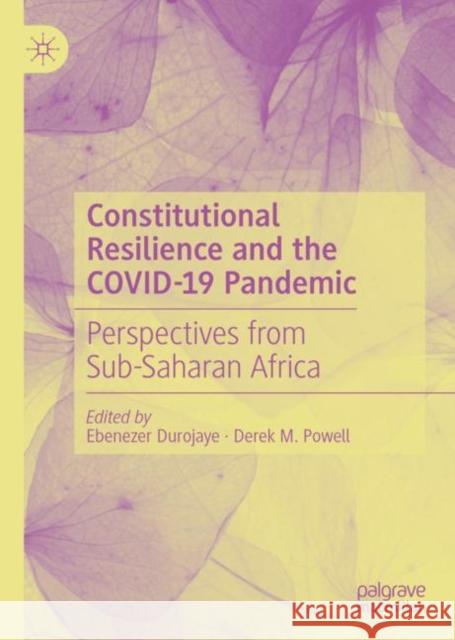
This book explores the resilience of constitutional government in the wake of the COVID-19 pandemic, connecting and comparing perspectives from ten countries in sub-Saharan Africa to global trends.
In emergency situations, such as the COVID-19 pandemic, a state has the right and duty under both international law and domestic constitutional law to take appropriate steps to protect the health and security of its population. Emergency regimes may allow for the suspension or limitation of normal constitutional government and even human rights. Those measures are not a license for authoritarian rule, but they must conform to legal standards of necessity, reasonableness, and proportionality that limit state action in ways appropriate to the maintenance of the rule of law in the context of a public health emergency.
Bringing together established and emerging African scholars from ten countries, this book looks at the impact government emergency responses to the pandemic have on the functions of the executive, the legislature, and the judiciary, as well as the protection of human rights. It also considers whether and to what extent government emergency responses were consistent with international human rights law, in particular with the standards of legality, necessity, proportionality, and non-discrimination in the Siracusa Principles.
Ebenezer Durojaye is Professor and Head of the Socio-Economic Rights Project in the Dullah Omar Institute for Constitutional Law, Governance and Human Rights, University of the Western Cape, South Africa.
Derek M. Powell is Associate Professor of Law and Head of the Applied Constitutional Studies Project in the Dullah Omar Institute for Constitutional Law, Governance and Human Rights, University of the Western Cape, South Africa.