• Wyszukiwanie zaawansowane
  • Kategorie
  • Kategorie BISAC
  • Książki na zamówienie
  • Promocje
  • Granty
  • Książka na prezent
  • Opinie
  • Pomoc
  • Załóż konto
  • Zaloguj się

Connecting the Internet of Things: IoT Connectivity Standards and Solutions » książka


zaloguj się | załóż konto
Logo Krainaksiazek.pl

koszyk

konto

szukaj
topmenu
Księgarnia internetowa
Szukaj
Książki na zamówienie
Promocje
Granty
Książka na prezent
Moje konto
Pomoc
 
 
Wyszukiwanie zaawansowane
Pusty koszyk
Bezpłatna dostawa dla zamówień powyżej 20 złBezpłatna dostawa dla zamówień powyżej 20 zł

Kategorie główne

• Nauka
 [2949965]
• Literatura piękna
 [1857847]

  więcej...
• Turystyka
 [70818]
• Informatyka
 [151303]
• Komiksy
 [35733]
• Encyklopedie
 [23180]
• Dziecięca
 [617748]
• Hobby
 [139972]
• AudioBooki
 [1650]
• Literatura faktu
 [228361]
• Muzyka CD
 [398]
• Słowniki
 [2862]
• Inne
 [444732]
• Kalendarze
 [1620]
• Podręczniki
 [167233]
• Poradniki
 [482388]
• Religia
 [509867]
• Czasopisma
 [533]
• Sport
 [61361]
• Sztuka
 [243125]
• CD, DVD, Video
 [3451]
• Technologie
 [219309]
• Zdrowie
 [101347]
• Książkowe Klimaty
 [123]
• Zabawki
 [2362]
• Puzzle, gry
 [3791]
• Literatura w języku ukraińskim
 [253]
• Art. papiernicze i szkolne
 [7933]
Kategorie szczegółowe BISAC

Connecting the Internet of Things: IoT Connectivity Standards and Solutions

ISBN-13: 9781484288962 / Angielski / Miękka / 2023 / 387 str.
Anil Kumar; Jafer Hussain; Anthony Chun
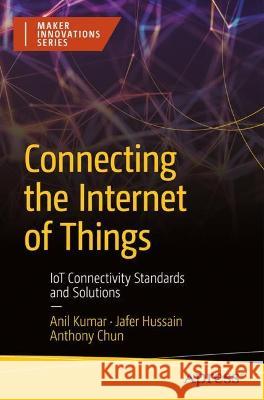
Connecting the Internet of Things: IoT Connectivity Standards and Solutions Anil Kumar Jafer Hussain Anthony Chun 9781484288962 Apress - książkaWidoczna okładka, to zdjęcie poglądowe, a rzeczywista szata graficzna może różnić się od prezentowanej.

Connecting the Internet of Things: IoT Connectivity Standards and Solutions

ISBN-13: 9781484288962 / Angielski / Miękka / 2023 / 387 str.

Anil Kumar; Jafer Hussain; Anthony Chun
cena 242,07 zł
(netto: 230,54 VAT:  5%)

Najniższa cena z 30 dni: 231,29 zł
Termin realizacji zamówienia:
ok. 22 dni roboczych
Bez gwarancji dostawy przed świętami

Darmowa dostawa!

Navigating the fragmented IoT connectivity ecosystem of standards, protocols, and architectures can be a challenge. Not to mention scaling a solution to a viable product. This book guides you through this fractured landscape with real world examples and projects that can be leverage for an IoT product.Backed by an overview of IoT use cases and key connectivity elements of IoT solutions, you'll gain an understanding of the breadth of the IoT landscape and the fragmentation of connectivity standards and solutions and the challenge in navigating the many standards and technologies. You'll also be able to understand the essentials of connectivity including, hardware, software, and business models.​IoT is essential for increasing productivity of many industries and quality of life (making the world smart and autonomous). Both wired and wireless connectivity technologies are essential ingredients in an IoT product. Written by Intel engineers and architects,Connecting the Internet of Thingsunderstands that connectivity is a key topic of IoT and comprehensively covers the topic from a system engineering and practical perspective.What You'll LearnUnderstand the trade offs between different wireless technologies and network topologiesUse wireless technologies in IoT productsExamine connectivity technologies and considerations on selecting it for the IoT use casesAssemble all of the components of a working solutionScale your solution to a productReview emerging connectivity technologies for addressing new use casesAdvance and optimize the performance of existing technologiesWho This Book Is ForResearchers, managers, strategists, technologists, makers, and students in the embedded and Internet of Things (IoT) space trying to understand and implement connectivity in the devices/platforms.

Navigating the fragmented IoT connectivity ecosystem of standards, protocols, and architectures can be a challenge. Not to mention scaling a solution to a viable product. This book guides you through this fractured landscape with real world examples and projects that can be leverage for an IoT product. 

Backed by an overview of IoT use cases and key connectivity elements of IoT solutions, you'll gain an understanding of the breadth of the IoT landscape and the fragmentation of connectivity standards and solutions and the challenge in navigating the many standards and technologies. You'll also be able to understand the essentials of connectivity including, hardware, software, and business models. 

​IoT is essential for increasing productivity of many industries and quality of life (making the world smart and autonomous). Both wired and wireless connectivity technologies are essential ingredients in an IoT product. Written by Intel engineers and architects, Connecting the Internet of Things understands that connectivity is a key topic of IoT and comprehensively covers the topic from a system engineering and practical perspective.

What You'll Learn
  • Understand the trade offs between different wireless technologies and network topologies
  • Use wireless technologies in IoT products
  • Examine connectivity technologies and considerations on selecting it for the IoT use cases
  • Assemble all of the components of a working solution 
  • Scale your solution to a product
  • Review emerging connectivity technologies for addressing new use cases
  • Advance and optimize the performance of existing technologies

Who This Book Is For

Researchers, managers, strategists, technologists, makers, and students in the embedded and Internet of Things (IoT) space trying to understand and implement connectivity in the devices/platforms.

Kategorie:
Informatyka, Internet
Kategorie BISAC:
Computers > Networking - Hardware
Computers > Security - Network Security
Wydawca:
Apress
Język:
Angielski
ISBN-13:
9781484288962
Rok wydania:
2023
Dostępne języki:
Ilość stron:
387
Oprawa:
Miękka
Dodatkowe informacje:
Wydanie ilustrowane

Chapter 1: Introduction to IoT Connectivity

Chapter Goal: This chapter provides an overview of key IoT use cases and key connectivity elements of IoT solutions. The reader will get an understanding of the breadth of the IoT landscape.
• Purpose of this book
• Background and Terminology
• Key IoT use cases
o Smart cities
o Asset tracking
o Smart factories
o Industrial
o Transportation
o Digital surveillance systems
o Retail
o Medical 
o Indoor location
• End-to-end IoT building blocks
o Things/devices/sensors
o Edge/Gateway/Fog
o Cloud
• IoT Stakeholders/Value Chain
o Chip Vendors
o Module Vendors
o System Integrators
o ODMs
o ISVs
o End Customers

Chapter 2: Considerations in choosing a connectivity technology
Chapter Goals: This chapter highlights the fragmentation of connectivity standards and solutions and the challenge in navigating the many standards and technologies and also discusses the tradeoffs between different wireless technologies and network topologies. Also, this chapter provides the motivation for using wireless technologies in IoT products as well as challenges.
• Compute and connect are integral functions that are fully integrated in single SoC-for lower cost and low power solutions
• Benefits of wireless
• Seamless wireless connectivity for mobility applications
• Remote Commissioning, ease of deployment, OTA update, device identification
• Challenges of Wireless Connectivity
• Fragmentation of the IoT Ecosystem
o Discussion of IoT Framework Open Connectivity Foundation etc.
o Interoperability (open standards)
• Coexistence and interference
• Wireless security is vital
• Certification (Industry, regulatory, operator)
o Certified labs
• Antenna design challenges
• Considerations in choosing a connectivity technology
o Energy/power/cost tradeoffs
o Selection of network architectures and topologies
o Wireless standards and alignment to use cases-how to choose the right wireless protocol for the job
o Selection criteria-range, data rate, power, security, latency, capacity, etc.
• Wireless Standard Bodies
Subchapter Goal: Overview of Connectivity standards including 15.4, ZigBee, Thread, 6LoWPAN, wi-fi, BT, LTE, 5G etc. and which is appropriate for each use case; include cost considerations
o WiFi Alliance
o BT SIG
o ZigBee Alliance
o Thread Group
o Dot dot
o Z-Wave
o 3GPP (ITU-T)

Chapter Goals: The following chapters (3 to 10) provide a deep dive on each connectivity technology and considerations on selecting it for the IoT use cases

Chapter 3: Wi-Fi 
• Wi-Fi mesh
• WiFi 802.11a/b/g/n/ac
• WiFi 6

Chapter 4: Bluetooth
• BLE
• BT mesh
• BT direction finding
• BT beacons

Chapter 5: 802.15.4 (unlicensed)
• ZigBee
• Thread

Chapter 6: LPWAN
• Lora
• SigFox
Chapter 7: Cellular Technologies 
• NB IoT
• 3G
• 4G LTE
• CBRS (Private LTE) / OnGo

Chapter 8: 5G
• eMBB
• mMTC
• urLLC
• 5G TSN

Chapter 9: Ethernet
• TSN
• Industrial Ethernet Technologies

Chapter 10: GNSS

Chapter 11: IoT Connectivity Frameworks and Stacks
Chapter Goal: This chapter goes into detail on how to assemble all of the components of a working solution and discusses how to scale your solution to a product
• Software stacks, drivers, operating systems, RTOS
• Gateway architecture including protocols
o IoT protocols
 CoAP
 MQTT
 OPCUA
• RF: antenna, PA, etc.
• Coexistence
• Environmental considerations, reliability, long life etc.
• Security and privacy
• Managing the network
• Certification
• Putting it together
• How to integrate and validate (chip vs pre-certified module)
• Scaling from project to product 
• Putting it together: Sample Projects
• Go through the earlier examples and discuss the complete products

Chapter 12: The Future of IoT Connectivity
Chapter Goal: This chapter discusses emerging connectivity technologies for addressing new use cases as well as advancing and optimizing the performance of existing technologies

• Things/sensors (low power, battery powered, low compute, need wireless connectivity, small memory footprint, small RTOS footprint)
• Software defined radio
• What is coming next?
• Future technologies: Wi-Fi 7, etc.
• Next steps for the reader
• Where to get more information

References
Index

Anil Kumar is a Principal Engineer at Intel Corporation. As a System Architect in the Client Computing Group, he works with Intel’s partners to unlock people’s potential by bringing computing devices to market, allowing them to ​​​​​​​focus, create and connect in ways that matter most to them. Before this role, Anil was responsible for the Connectivity Platform Architecture in the Internet of Things Group (IOTG). In IOTG, he successfully drove platform and chip-level integration of several critical connectivity and communication technologies, resulting in a broad set of IoT applications across different vertical markets. 


Anil joined Intel in 2007 as a design engineer in the Digital Home Group. He served as Platform Architect for several Intel Architecture-based Media Processors for TV and Set Top Box applications. As the chief architect in Intel Media Group, Anil led several designs that resulted in award-winning consumer electronic device designs at CES (Consumer Electronics Show). The world’s first Google TV devices are based on reference designs created by Anil. 


Before joining Intel, Anil held design engineering positions at multinational companies such as Fujitsu & Alcatel. Anil’s passion and purpose is driven by taking designs from concept to production. Anil is a co-author of Demystifying Internet of Things Security (Apress 2019).


Jafer Hussain is a Senior Product Line Manager in the Network and Edge Group (NEX) at Intel Corporation. Jafer is responsible for the product management of Intel’s Core based Smart and Intelligent AI platforms. In his current role, Jafer engages with Intel’s ecosystem partners to drive Intel’s leadership in various IoT markets.

Jafer has previously led the development and integration of wireless connectivity solutions and contributed to the development of wireless connectivity strategy. He also led several customer engagements to drive these solutions to the market.

Jafer is an accomplished inventor with multiple patents on embedded systems, wireless technologies, and IoT. He received B.S. in Electrical Engineering from University of Engineering and Technology Taxila, Pakistan, and M.S. in Management of Technology from the National University of Singapore.


Dr. Anthony (Tony) Chun is head of digital access and an Encore.org/CoGenerate Fellow, at The Bridging Tech Charitable Fund, a nonprofit that is closing the digital divide for K-12 students via computers and connectivity.  He recently retired from Intel Corporation, where he was the Wi-Fi product manager in the Internet of Things Group.

He joined Intel in 2000 and was a research scientist in Intel Labs where he developed architectures for reconfigurable software defined radios and accelerators.

He has co-authored 20 patents in wireless architectures and accelerators. He has co-authored several papers in engineering journals and received best paper awards at the Intel Design Technology and Test Conference 2011 and at the IEEE Computer Society Annual Symposium on VLSI, 2009. He has B.S., M.S. and PhD degrees in Electrical Engineering from Stanford University, Stanford, California.


Navigating the fragmented IoT connectivity ecosystem of standards, protocols, and architectures can be a challenge. Not to mention scaling a solution to a viable product. This book guides you through this fractured landscape with real world examples and projects that can be leverage for an IoT product. 

Backed by an overview of IoT use cases and key connectivity elements of IoT solutions, you'll gain an understanding of the breadth of the IoT landscape and the fragmentation of connectivity standards and solutions and the challenge in navigating the many standards and technologies. You'll also be able to understand the essentials of connectivity including, hardware, software, and business models. 

​IoT is essential for increasing productivity of many industries and quality of life (making the world smart and autonomous). Both wired and wireless connectivity technologies are essential ingredients in an IoT product. Written by Intel engineers and architects, Connecting the Internet of Things understands that connectivity is a key topic of IoT and comprehensively covers the topic from a system engineering and practical perspective.

You will:
  • Understand the trade offs between different wireless technologies and network topologies
  • Use wireless technologies in IoT products
  • Examine connectivity technologies and considerations on selecting it for the IoT use cases
  • Assemble all of the components of a working solution 
  • Scale your solution to a product
  • Review emerging connectivity technologies for addressing new use cases
  • Advance and optimize the performance of existing technologies



Udostępnij

Facebook - konto krainaksiazek.pl


Opinie o Krainaksiazek.pl na Opineo.pl

Partner Mybenefit

Krainaksiazek.pl w programie rzetelna firma Krainaksiaze.pl - płatności przez paypal

Czytaj nas na:

Facebook - krainaksiazek.pl
  • książki na zamówienie
  • granty
  • książka na prezent
  • kontakt
  • pomoc
  • opinie
  • regulamin
  • polityka prywatności

Zobacz:

  • Księgarnia czeska

  • Wydawnictwo Książkowe Klimaty

1997-2025 DolnySlask.com Agencja Internetowa

© 1997-2022 krainaksiazek.pl
     
KONTAKT | REGULAMIN | POLITYKA PRYWATNOŚCI | USTAWIENIA PRYWATNOŚCI
Zobacz: Księgarnia Czeska | Wydawnictwo Książkowe Klimaty | Mapa strony | Lista autorów
KrainaKsiazek.PL - Księgarnia Internetowa

Polityka prywatnosci - link
Krainaksiazek.pl - płatnośc Przelewy24
Przechowalnia Przechowalnia




