• Wyszukiwanie zaawansowane
  • Kategorie
  • Kategorie BISAC
  • Książki na zamówienie
  • Promocje
  • Granty
  • Książka na prezent
  • Opinie
  • Pomoc
  • Załóż konto
  • Zaloguj się

Concepts of Matter in Science Education » książka


zaloguj się | załóż konto
Logo Krainaksiazek.pl

koszyk

konto

szukaj
topmenu
Księgarnia internetowa
Szukaj
Książki na zamówienie
Promocje
Granty
Książka na prezent
Moje konto
Pomoc
 
 
Wyszukiwanie zaawansowane
Pusty koszyk
Bezpłatna dostawa dla zamówień powyżej 20 złBezpłatna dostawa dla zamówień powyżej 20 zł

Kategorie główne

• Nauka
 [2950560]
• Literatura piękna
 [1849509]

  więcej...
• Turystyka
 [71097]
• Informatyka
 [151150]
• Komiksy
 [35848]
• Encyklopedie
 [23178]
• Dziecięca
 [617388]
• Hobby
 [139064]
• AudioBooki
 [1657]
• Literatura faktu
 [228597]
• Muzyka CD
 [383]
• Słowniki
 [2855]
• Inne
 [445295]
• Kalendarze
 [1464]
• Podręczniki
 [167547]
• Poradniki
 [480102]
• Religia
 [510749]
• Czasopisma
 [516]
• Sport
 [61293]
• Sztuka
 [243352]
• CD, DVD, Video
 [3414]
• Technologie
 [219456]
• Zdrowie
 [101002]
• Książkowe Klimaty
 [124]
• Zabawki
 [2311]
• Puzzle, gry
 [3459]
• Literatura w języku ukraińskim
 [254]
• Art. papiernicze i szkolne
 [8079]
Kategorie szczegółowe BISAC

Concepts of Matter in Science Education

ISBN-13: 9789400759138 / Angielski / Twarda / 2013 / 524 str.
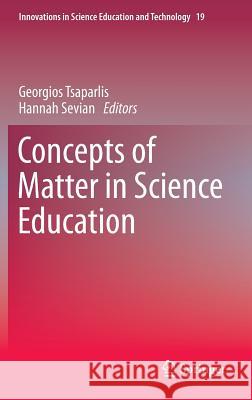
Georgios Tsaparlis; Hannah Sevian
Concepts of Matter in Science Education Georgios Tsaparlis Hannah Sevian 9789400759138 Springer - książkaWidoczna okładka, to zdjęcie poglądowe, a rzeczywista szata graficzna może różnić się od prezentowanej.

Concepts of Matter in Science Education

ISBN-13: 9789400759138 / Angielski / Twarda / 2013 / 524 str.

Georgios Tsaparlis; Hannah Sevian
cena 603,81
(netto: 575,06 VAT:  5%)

Najniższa cena z 30 dni: 578,30
Termin realizacji zamówienia:
ok. 22 dni roboczych
Dostawa w 2026 r.

Darmowa dostawa!

Bringing together a wide collection of ideas, reviews, analyses and new research on particulate and structural concepts of matter, Concepts of Matter in Science Education informs practice from pre-school through graduate school learning and teaching and aims to inspire progress in science education. The expert contributors offer a range of reviews and critical analyses of related literature and in-depth analysis of specific issues, as well as new research. Among the themes covered are learning progressions for teaching a particle model of matter, the mental models of both students and teachers of the particulate nature of matter, educational technology, chemical reactions and chemical phenomena, chemical structure and bonding, quantum chemistry and the history and philosophy of science relating to the particulate nature of matter. The book will benefit a wide audience including classroom practitioners and student teachers at every educational level, teacher educators and researchers in science education."If gaining the precise meaning in particulate terms of what is solid, what is liquid, and that air is a gas, were that simple, we would not be confronted with another book which, while suggesting new approaches to teaching these topics, confirms they are still very difficult for students to learn."Peter Fensham, Emeritus Professor Monash University, Adjunct Professor QUT(from the foreword to this book)"


Kategorie:
Podręczniki
Kategorie BISAC:
Education > Curricula
Education > Educational Psychology
Education > Professional Development
Wydawca:
Springer
Seria wydawnicza:
Innovations in Science Education and Technology
Język:
Angielski
ISBN-13:
9789400759138
Rok wydania:
2013
Wydanie:
2013
Numer serii:
000027007
Ilość stron:
524
Waga:
0.93 kg
Wymiary:
23.39 x 15.6 x 3.02
Oprawa:
Twarda
Wolumenów:
01
Dodatkowe informacje:
Wydanie ilustrowane

From the book reviews:

"It is a comprehensive and well-written book with synergies across the areas of research and curriculum development ... . It therefore holds implications for researchers and practitioners at every grade level. ... A book of this breadth has a place on every researcher's shelf. ... For those considering carrying out research about student conceptions of matter, chemical structure or bonding, the chapters in this book covering these topics are exceedingly well referenced and provide new directions in research." (Marcy H. Towns, Studies in Science Education, July, 2014)

"This substantial book, organised in six sections, offers 21 chapters emerging from a 2010 symposium held in Athens, Greece ... . any chemistry teacher digging into this book will find something of value to help them help their students to more clearly 'see' and understand the concept of matter." (Vanessa Kind, Education in Chemistry, March, 2014)

PETER FENSHAM Foreword.- GEORGIOS TSAPARLIS AND HANNAH SEVIAN Introduction: Concepts of matter – Complex to teach and difficult to learn - PART I: LEARNING PROGRESSIONS FOR TEACHING A PARTICLE MODEL OF MATTER.- JOI MERRITT AND JOSEPH KRAJCIK Learning progression developed to support students in building a particle model of matter.- PHILIP JOHNSON How students’ understanding of particle theory develops: A learning progression.- HANNAH SEVIAN AND MARILYNE STAINS Implicit assumptions and progress variables in a learning progression about structure and motion of matter.- MARIANNE WISER, KATHRYN E. FRAZIER AND VICTORIA FOX At the beginning was amount of material: A learning progression for matter for early elementary grades.- PART II: STUDENTS’ AND TEACHERS’ MENTAL MODELS OF THE PARTICULATE NATURE OF MATTER.- DAVID F. TREAGUST, A. L. CHANDRASEGARAN, LILIA HALIM, ENG TEK ONG, AHMAD NURULAZAM MD ZAIN AND MAGESWARY KARPUDEWAN Understanding of basic particle nature of matter concepts by secondary school students following an intervention program.- MEI-HUNG CHIU AND SHIAO-LAN CHUNG The use of multiple perspectives of conceptual change to investigate students' mental models of gas particles.- CANAN NAKIBOĞLU AND KEITH S. TABER The atom as a tiny solar system: Turkish high school students' understanding of the atom in relation to a common teaching analogy.- ELENI PETRIDOU, DIMITRIS PSILLOS, EURIPIDES HATZIKRANIOTIS AND MARIA KALLERY A study on the exploratory use of microscopic models as investigative tools: The case of electrostatic polarization.- INGO EILKS Teacher pathways through the particulate nature of matter in lower secondary school chemistry: Continuous switching between different models or a coherent conceptual structure?.- FAIK Ö. KARATAŞ, SUAT ÜNAL, GREGORY DURLAND AND GEORGE BODNER What do we know about students' beliefs? Changes in students' conceptions of the particulate nature of matter from pre-instruction to college.- AJDA KAHVECI Diagnostic assessment of student understanding of the particular nature of matter: Decades of research.- PART III: EDUCATIONAL TECHNOLOGY.- SEVIL AKAYGUN AND LORETTA L. JONES Dynamic visualizations: Tools for understanding the particulate nature of matter.- GEORGE KALKANIS From the scientific to the educational: Using Monte Carlo simulations of the microKosmos for science education by inquiry.-PART IV: CHEMICAL REACTIONS, CHEMICAL PHENOMENA.- GEORGE PAPAGEORGIOU Can simple particle models support satisfying explanations of chemical changes for young students?.- VICENTE TALANQUER How do students reason about chemical substances and reactions?.- KEITH S. TABER AND KARINA ADBO Developing chemical understanding in the explanatory vacuum: Swedish high school students' use of an anthropomorphic conceptual framework to make sense of chemical phenomena.- PART V: CHEMICAL STRUCTURE AND BONDING.- TAMI LEVY NAHUM, RACHEL MAMLOK-NAAMAN AND AVI HOFSTEIN Teaching and learning of the chemical bonding concept: Problems and some pedagogical issues and recommendations.- KEITH S. TABER A common core to chemical conceptions: Learners' conceptions of chemical stability, change and bonding.- MARIJN R. MEIJER, ASTRID M. W. BULTE AND ALBERT PILOT Macro-Micro thinking with structure-property relations: Integrating ‘meso levels’ in secondary education.- GEORGIOS TSAPARLIS Learning and teaching the basic quantum chemical concepts.- PART VI: HISTORY AND PHILOSOPHY OF SCIENCE.- CONSTANTINE D. SKORDOULIS AND VANGELIS KOUTALIS Investigating the historical development of the concept of matter: Controversies about/in ancient atomism.- GEORGIOS TSAPARLIS AND HANNAH SEVIAN Toward a scientifically sound understanding of concepts of matter.                                       

Bringing together a wide collection of ideas, reviews, analyses and new research on particulate and structural concepts of matter, Concepts of Matter in Science Education informs practice from pre-school through graduate school learning and teaching and aims to inspire progress in science education. The expert contributors offer a range of reviews and critical analyses of related literature and in-depth analysis of specific issues, as well as new research. Among the themes covered are learning progressions for teaching a particle model of matter, the mental models of both students and teachers of the particulate nature of matter, educational technology, chemical reactions and chemical phenomena, chemical structure and bonding, quantum chemistry and the history and philosophy of science relating to the particulate nature of matter. The book will benefit a wide audience including classroom practitioners and student teachers at every educational level, teacher educators and researchers in science education.

"If gaining the precise meaning in particulate terms of what is solid, what is liquid, and that air is a gas, were that simple, we would not be confronted with another book which, while suggesting new approaches to teaching these topics, confirms they are still very difficult for students to learn".

Peter Fensham, Emeritus Professor Monash University, Adjunct Professor QUT (from the foreword to this book)


Udostępnij

Facebook - konto krainaksiazek.pl


Opinie o Krainaksiazek.pl na Opineo.pl

Partner Mybenefit

Krainaksiazek.pl w programie rzetelna firma Krainaksiaze.pl - płatności przez paypal

Czytaj nas na:

Facebook - krainaksiazek.pl
  • książki na zamówienie
  • granty
  • książka na prezent
  • kontakt
  • pomoc
  • opinie
  • regulamin
  • polityka prywatności

Zobacz:

  • Księgarnia czeska

  • Wydawnictwo Książkowe Klimaty

1997-2025 DolnySlask.com Agencja Internetowa

© 1997-2022 krainaksiazek.pl
     
KONTAKT | REGULAMIN | POLITYKA PRYWATNOŚCI | USTAWIENIA PRYWATNOŚCI
Zobacz: Księgarnia Czeska | Wydawnictwo Książkowe Klimaty | Mapa strony | Lista autorów
KrainaKsiazek.PL - Księgarnia Internetowa

Polityka prywatnosci - link
Krainaksiazek.pl - płatnośc Przelewy24
Przechowalnia Przechowalnia





