• Wyszukiwanie zaawansowane
  • Kategorie
  • Kategorie BISAC
  • Książki na zamówienie
  • Promocje
  • Granty
  • Książka na prezent
  • Opinie
  • Pomoc
  • Załóż konto
  • Zaloguj się

Computers Helping People with Special Needs, Part I: 12th International Conference, Icchp 2010, Vienna, Austria, July 14-16, 2010. Proceedings » książka


zaloguj się | załóż konto
Logo Krainaksiazek.pl

koszyk

konto

szukaj
topmenu
Księgarnia internetowa
Szukaj
Książki na zamówienie
Promocje
Granty
Książka na prezent
Moje konto
Pomoc
 
 
Wyszukiwanie zaawansowane
Pusty koszyk
Bezpłatna dostawa dla zamówień powyżej 20 złBezpłatna dostawa dla zamówień powyżej 20 zł

Kategorie główne

• Nauka
 [2946600]
• Literatura piękna
 [1856966]

  więcej...
• Turystyka
 [72221]
• Informatyka
 [151456]
• Komiksy
 [35826]
• Encyklopedie
 [23190]
• Dziecięca
 [619653]
• Hobby
 [140543]
• AudioBooki
 [1577]
• Literatura faktu
 [228355]
• Muzyka CD
 [410]
• Słowniki
 [2874]
• Inne
 [445822]
• Kalendarze
 [1744]
• Podręczniki
 [167141]
• Poradniki
 [482898]
• Religia
 [510455]
• Czasopisma
 [526]
• Sport
 [61590]
• Sztuka
 [243598]
• CD, DVD, Video
 [3423]
• Technologie
 [219201]
• Zdrowie
 [101638]
• Książkowe Klimaty
 [124]
• Zabawki
 [2473]
• Puzzle, gry
 [3898]
• Literatura w języku ukraińskim
 [254]
• Art. papiernicze i szkolne
 [8170]
Kategorie szczegółowe BISAC

Computers Helping People with Special Needs, Part I: 12th International Conference, Icchp 2010, Vienna, Austria, July 14-16, 2010. Proceedings

ISBN-13: 9783642140969 / Angielski / Miękka / 2010 / 727 str.
Klaus Miesenberger; Joachim Klaus; Wolfgang Zagler
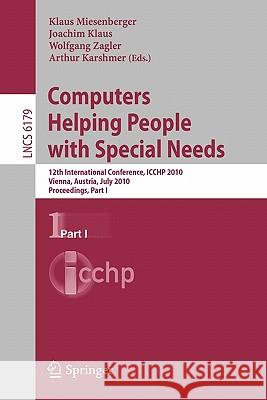
Computers Helping People with Special Needs, Part I: 12th International Conference, Icchp 2010, Vienna, Austria, July 14-16, 2010. Proceedings Miesenberger, Klaus 9783642140969 Not Avail - książkaWidoczna okładka, to zdjęcie poglądowe, a rzeczywista szata graficzna może różnić się od prezentowanej.

Computers Helping People with Special Needs, Part I: 12th International Conference, Icchp 2010, Vienna, Austria, July 14-16, 2010. Proceedings

ISBN-13: 9783642140969 / Angielski / Miękka / 2010 / 727 str.

Klaus Miesenberger; Joachim Klaus; Wolfgang Zagler
cena 403,47 zł
(netto: 384,26 VAT:  5%)

Najniższa cena z 30 dni: 385,52 zł
Termin realizacji zamówienia:
ok. 22 dni roboczych
Bez gwarancji dostawy przed świętami

Darmowa dostawa!

Welcome to the Proceedings of ICCHP 2010 We were proud to welcome participants from more than 40 countries from all over the world to this year's ICCHP. Since the late 1980s, it has been ICCHP's mission to support and reflect development in the field of "Assistive Technologies," eAccessibility and eInclusion. With a focus on scientific quality, ICCHP has become an important reference in our field. The 2010 conference and this collection of papers once again fulfilled this mission. The International Programme Committee, comprising 106 experts from all over the world, selected 147 full and 44 short papers out of 328 abstracts submitted to ICCHP. This acceptance ratio of about half of the submissions demonstrates our strict pursuit of scientific quality both of the programme and in particular of the proceedings in your hands. An impressive number of experts agreed to organize "Special Thematic Sessions" (STS) for ICCHP 2010. These STS help to bring the meeting into sharper focus in several key areas. In turn, this deeper level of focus helps to collate a state of the art and mainstream technical, social, cultural and political developments.


Kategorie:
Informatyka
Kategorie BISAC:
Computers > Data Science - General
Computers > System Administration - Storage & Retrieval
Computers > User Interfaces
Wydawca:
Not Avail
Seria wydawnicza:
Lecture Notes in Computer Science / Information Systems and
Język:
Angielski
ISBN-13:
9783642140969
Rok wydania:
2010
Wydanie:
2010
Numer serii:
000379988
Ilość stron:
727
Waga:
1.07 kg
Wymiary:
23.5 x 15.5
Oprawa:
Miękka
Wolumenów:
01

Design for Adaptive Content Processing.- Design for Adaptive Content Processing: Introduction to the Special Thematic Session.- Generating DAISY Books from OpenOffice.org.- Combining Web Services and DAISY for the Production and Delivery of Audio Tactile Diagrams.- Wiki, a New Way to Produce Accessible Documents.- Guided Generation and Evaluation of Accessible Scalable Vector Graphics.- Improving the Re-digitisation Process by Using Software with Automatic Metadata Detection.- New Production and Delivery System for Pupils with Disabilities in Austria as Chance for Higher Quality Output.- A Flexible Software Architecture Concept for the Creation of Accessible PDF Documents.- Digital Access to Documents for People with Print Disabilities.- DAISY Kindergarten Books and Rocket Science Journals.- Exploiting the Daisy Format for Automated, Single-Source Braille Publishing.- Rapid Listening of DAISY Digital Talking Books by Speech-Rate Conversion Technology for People with Visual Impairments.- E-Books and Audiobooks: What about Their Accessibility?.- E-Books and Inclusion: Dream Come True or Nightmare Unending?.- Collaboratively Generated Content on the Audio-Tactile Map.- Generating Braille from OpenOffice.org.- Sonification of ASCII Circuit Diagrams.- Accessing Google Docs via Screen Reader.- Making Digital Maps Accessible Using Vibrations.- Non-visual Navigation of Spreadsheet Tables.- New Testing Method for the Dyslexic and the Newly Blind with a Digital Audio Player and Document Structure Diagrams.- Annotating and Describing Pictures – Applications in E-Learning and Accessibility of Graphics.- New Concepts of PC Interaction for Blind Users Based on Braille Displays with ATC Technology (Active Tactile Control).- HCI and Non Classical Interfaces.- Inclusive E-Services for All: Identifying Accessibility Requirements for Upcoming Interaction Technologies.- HAIL: Hierarchical Adaptive Interface Layout.- Customizable Software Interface for Monitoring Applications.- Towards to Real–Time System with Optimization Based Approach for EOG and Blinking Signals Separation for Human Computer Interaction.- Towards Accessible Interactions with Pervasive Interfaces, Based on Human Capabilities.- Accelerometer & Spatial Audio Technology: Making Touch-Screen Mobile Devices Accessible.- HCI: Software Accessibility and Social Interaction.- An Open Source / Freeware Assistive Technology Software Inventory.- Designing and Developing Accessible Java Swing Applications.- Effects of Visual Stimuli on a Communication Assistive Method Using Sympathetic Skin Response.- Computerized Assessing the Mouse Proficiency through Multiple Indicators.- PUIR: Parallel User Interface Rendering.- Transient Cooperation in Social Applications for Accessibility Mapping.- A Social Approach to Accessible Social Networking Using the CAT Model.- Entertainment Software Accessibility.- Entertainment Software Accessibility: Introduction to the Special Thematic Session.- User Interface Evaluation of Serious Games for Students with Intellectual Disability.- Making Mainstreaming Videogames More Accessible: A Pilot Study Applied to Buzz!TM Junior Monster Rumble for PlayStation.- Accessibility of a Social Network Game.- Using Placement and Name for Speaker Identification in Captioning.- A Real-Time Network Board Game System Using Tactile and Auditory Senses for the Visually Impaired.- Accessible Tourism.- Realizing Accessible Tourism by Matching Stakeholders: Introduction to the Special Thematic Session.- Planning of Inclusive and Accessible Events.- User Feed-Back in the Development of an Information System for Public Transport.- User-Specific Web-Based Route Planning.- Smart and Assistive Environments.- Results of a Workshop Series on Ambient Assisted Living.- Challenges for Norwegian PC-Users with Parkinson’s Disease – A Survey.- Usability and Usefulness of GPS Based Localization Technology Used in Dementia Care.- Development of Universal Communication Aid for Emergency Using Motion Pictogram.- Friendly Human-Machine Interaction in an Adapted Robotized Kitchen.- Audio Classification Techniques in Home Environments for Elderly/Dependant People.- Autonomamente: Using Goal Attainment Scales to Evaluate the Impact of a Multimodal Domotic System to Support Autonomous Life of People with Cognitive Impairment.- PMD: Designing a Portable Medicine Dispenser for Persons Suffering from Alzheimer’s Disease.- Usable Web Accessibility: Editing.- Merging Web Accessibility and Usability by Patterns.- Towards the Convergence of Web 2.0 and Semantic Web for E-Inclusion.- Beyond a Visuocentric Way of a Visual Web Search Clustering Engine: The Sonification of WhatsOnWeb.- Editing Web Presentations by Means of Dialogue.- Fast Access to Web Pages with Finger Reading.- The Evaluations of Deletion-Based Method and Mixing-Based Method for Audio CAPTCHAs.- Integrating Semantic Web and Folksonomies to Improve E-Learning Accessibility.- Simple Browser Construction Toolkit.- Usable Web Accessibility: Education and Motivation.- Organizational Motivations for Web Accessibility Implementation – A Case Study.- Using Collaborative Learning to Teach WCAG 2.0.- Web_Access: Education on Accessible Web Design.- Usable Web Accessibility: Evaluation.- Assessing WCAG 2.0 Conformance in Practice.- Is the Accessibility Audit Dead?.- Evaluating Conformance to WCAG 2.0: Open Challenges.- Automatic Checking of Alternative Texts on Web Pages.- OASES: Online Accessibility Self Evaluation Service – A Web-Based Tool for Education Institutions to Self-Assess the Accessibility of Their Practice.- Analysis and Evaluation of the Accessibility to Visual Information in Web Pages.- User Testing of Google Reader and RIA Complexity – A Warning.- Analyzing Effects of Web Accessibility – A Framework to Determine Changes in Website Traffic and Success.- eGovernment Accessibility.- Implementation Concept for an Accessible Web CMS.- Requirements of the Vision Impairments for E-Government Services in Taiwan from Accessibility to Efficiency.- Accessibility of eGovernment Web Sites: Towards a Collaborative Retrofitting Approach.- Improving the Accessibility of Fabasoft Folio by Means of WAI-ARIA.- Accessibility of Blended and E-Learning for Mature Age and Disabled Students and Staff.- Accessibility of Blended and E-Learning for Mature Age and Disabled Students and Staff: Introduction to the Special Thematic Session.- Understanding and Supporting the Needs of Educational Professionals Working with Students with Disabilities and Mature Age Students.- Institutional Conditions for the Implementation of Accessible Lifelong Learning (ALL) Based on the EU4ALL Approach.- Design Guidelines for Developing Curriculum-Focused ICT Materials for Diverse Students.- A Framework to Support Development of Learning Applications for Disabled Children.- Using Robots in Education and Therapy Sessions for Children with Disabilities: Guidelines for Teachers and Rehabilitation Professionals.- Virtual Learning Environments: Another Barrier to Blended and E-Learning.- Successful Service Provision.- ICT for Persons with Disabilities: Bridging the Digital Divide in Bangladesh.- Success through Exchange: The Higher Education Accessibility Guide (HEAG).- Linking Instruments and Documenting Decisions in Service Delivery Guided by an ICF-Based Tool for Assistive Technology Selection.- Easy-to-Use Social Network Service.- Standards: A Driver for Accessibility and Usability.- Standards Are Drivers for Accessibility and Usability: Introduction to the Special Thematic Session.- International AT and DfA Standardisation: What Is in the Pipeline?.- Redefining Assumptions: Accessibility and Its Stakeholders.- Stand4All: Promoting More Accessible Standards through Training of Stakeholders.- Standards-Based Content Resources: A Prerequisite for Content Integration and Content Interoperability.- Standardization and Sustainability of Open Source Products - Barriers and Conflicts Demonstrated with the Linux Screenreader SUE -.- The Challenge of Mainstreaming ICT Design for All.- Evaluating the Users’ Satisfaction Using Inclusive Initiatives in Two Different Environments: The University and a Research Conference.- People with Speech Impairment: “Weak and Silent Speech”: Tools to Support People with Speech Impairment.- ICCHP Keynote: Recognizing Silent and Weak Speech Based on Electromyography.- CanSpeak: A Customizable Speech Interface for People with Dysarthric Speech.- Adding Voice to Whisper Using a Simple Heuristic Algorithm Inferred from Empirical Observation.- LIPPS – A Virtual Teacher for Speechreading Based on a Dialog-Controlled Talking-Head.- People with Speech Learning and Cognitive Problems: Easy-to-Web.- Easy-to-Web: Introduction to the Special Thematic Session.- The Need for Easy-to-Read Information on Web Sites.- EasyWeb – A Study How People with Specific Learning Difficulties Can Be Supported on Using the Internet.- Supporting the Web Experience of Young People with Learning Disabilities.- Easy-to-Web Search for People with Learning Disabilities as Part of an Integrated Concept of Cognitive Web Accessibility.- Adaptive Reading: A Design of Reading Browser with Dynamic Alternative Text Multimedia Dictionaries for the Text Reading Difficulty Readers.- In-Folio: An Open Source Portfolio for Students with Learning Disabilities.


Udostępnij

Facebook - konto krainaksiazek.pl


Opinie o Krainaksiazek.pl na Opineo.pl

Partner Mybenefit

Krainaksiazek.pl w programie rzetelna firma Krainaksiaze.pl - płatności przez paypal

Czytaj nas na:

Facebook - krainaksiazek.pl
  • książki na zamówienie
  • granty
  • książka na prezent
  • kontakt
  • pomoc
  • opinie
  • regulamin
  • polityka prywatności

Zobacz:

  • Księgarnia czeska

  • Wydawnictwo Książkowe Klimaty

1997-2025 DolnySlask.com Agencja Internetowa

© 1997-2022 krainaksiazek.pl
     
KONTAKT | REGULAMIN | POLITYKA PRYWATNOŚCI | USTAWIENIA PRYWATNOŚCI
Zobacz: Księgarnia Czeska | Wydawnictwo Książkowe Klimaty | Mapa strony | Lista autorów
KrainaKsiazek.PL - Księgarnia Internetowa

Polityka prywatnosci - link
Krainaksiazek.pl - płatnośc Przelewy24
Przechowalnia Przechowalnia






