• Wyszukiwanie zaawansowane
  • Kategorie
  • Kategorie BISAC
  • Książki na zamówienie
  • Promocje
  • Granty
  • Książka na prezent
  • Opinie
  • Pomoc
  • Załóż konto
  • Zaloguj się

Computational Photonics » książka


zaloguj się | załóż konto
Logo Krainaksiazek.pl

koszyk

konto

szukaj
topmenu
Księgarnia internetowa
Szukaj
Książki na zamówienie
Promocje
Granty
Książka na prezent
Moje konto
Pomoc
 
 
Wyszukiwanie zaawansowane
Pusty koszyk
Bezpłatna dostawa dla zamówień powyżej 20 złBezpłatna dostawa dla zamówień powyżej 20 zł

Kategorie główne

• Nauka
 [2948695]
• Literatura piękna
 [1824038]

  więcej...
• Turystyka
 [70868]
• Informatyka
 [151073]
• Komiksy
 [35227]
• Encyklopedie
 [23181]
• Dziecięca
 [621575]
• Hobby
 [138961]
• AudioBooki
 [1642]
• Literatura faktu
 [228651]
• Muzyka CD
 [371]
• Słowniki
 [2933]
• Inne
 [445341]
• Kalendarze
 [1243]
• Podręczniki
 [164416]
• Poradniki
 [479493]
• Religia
 [510449]
• Czasopisma
 [502]
• Sport
 [61384]
• Sztuka
 [243086]
• CD, DVD, Video
 [3417]
• Technologie
 [219673]
• Zdrowie
 [100865]
• Książkowe Klimaty
 [124]
• Zabawki
 [2168]
• Puzzle, gry
 [3372]
• Literatura w języku ukraińskim
 [260]
• Art. papiernicze i szkolne
 [7838]
Kategorie szczegółowe BISAC

Computational Photonics

ISBN-13: 9780470688939 / Angielski / Twarda / 2010 / 328 str.
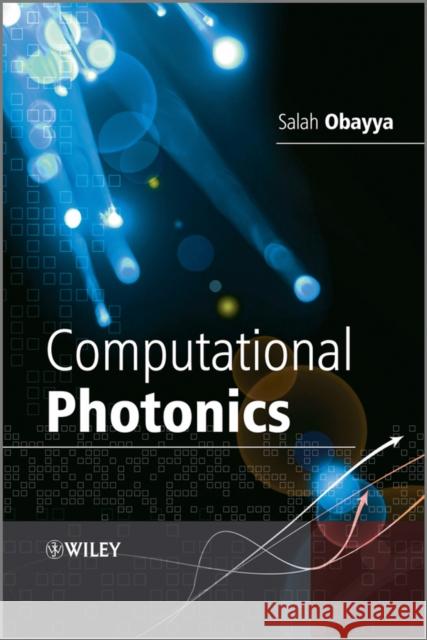
Professor Salah Obayya;¬Abar;¬Abar
Computational Photonics Professor Salah Obayya   9780470688939  - książkaWidoczna okładka, to zdjęcie poglądowe, a rzeczywista szata graficzna może różnić się od prezentowanej.

Computational Photonics

ISBN-13: 9780470688939 / Angielski / Twarda / 2010 / 328 str.

Professor Salah Obayya;¬Abar;¬Abar
cena 503,96
(netto: 479,96 VAT:  5%)

Najniższa cena z 30 dni: 497,78
Termin realizacji zamówienia:
ok. 30 dni roboczych.

Darmowa dostawa!

This book explores the state-of-the art in computational modelling techniques for photonic devices In this book, the author provides a comprehensive coverage of modern numerical modelling techniques for designing photonic devices for use in modern optical telecommunications systems. In addition the book presents the state-of-the-art in computational photonics techniques, covering methods such as full-vectorial finite-element beam propagation, bidirectional beam propagation, complex-envelope alternative direction implicit finite difference time domain, multiresolution time domain, and finite volume time domain. The book guides the reader through the concepts of modelling, analysing, designing and optimising the performance of a wide range of photonic devices by building their own numerical code using these methods. Key Features:

  • Provides a thorough presentation of the state-of-the art in computational modelling techniques for photonics
  • Contains broad coverage of both frequency- and time-domain techniques to suit a wide range of photonic devices
  • Reviews existing commercial software packages for photonics
  • Presents the advantages and disadvantages of the different modelling techniques as well as their suitability for various photonic devices
  • Shows the reader how to model, analyse, design and optimise the performance of a wide range of photonic devices by building their own numerical code using these methods
  • Accompanying website contains the numerical examples representing the numerical techniques in this book, as well as several design examples (http: //www.wiley.com/go/obayya_computational)
This book will serve as an invaluable reference for researchers, optical telecommunications engineers, engineers in the photonics industry. PhD and MSc students undertaking courses in the areas of photonics and optical telecommunications will also find this book of interest.


This book explores the state–of–the art in computational modelling techniques for photonic devicesIn this book, the author provides a comprehensive coverage of modern numerical modelling techniques for designing photonic devices for use in modern optical telecommunications systems. In addition the book presents the state–of–the–art in computational photonics techniques, covering methods such as full–vectorial finite–element beam propagation, bidirectional beam propagation, complex–envelope alternative direction implicit finite difference time domain, multiresolution time domain, and finite volume time domain. The book guides the reader through the concepts of modelling, analysing, designing and optimising the performance of a wide range of photonic devices by building their own numerical code using these methods.Key Features:•Provides a thorough presentation of the state–of–the art in computational modelling techniques for photonics•Contains broad coverage of both frequency– and time–domain techniques to suit a wide range of photonic devices•Reviews existing commercial software packages for photonics•Presents the advantages and disadvantages of the different modelling techniques as well as their suitability for various photonic devices•Shows the reader how to model, analyse, design and optimise the performance of a wide range of photonic devices by building their own numerical code using these methods•Accompanying website contains the numerical examples representing the numerical techniques in this book, as well as several design examples (http://www.wiley.com/go/obayya—computational)This book will serve as an invaluable reference for researchers, optical telecommunications engineers, engineers in the photonics industry. PhD and MSc students undertaking courses in the areas of photonics and optical telecommunications will also find this book of interest.

Kategorie:
Technologie
Kategorie BISAC:
Technology & Engineering > Lasers & Photonics
Język:
Angielski
ISBN-13:
9780470688939
Rok wydania:
2010
Ilość stron:
328
Waga:
0.72 kg
Wymiary:
24.89 x 17.27 x 2.29
Oprawa:
Twarda
Wolumenów:
01
Dodatkowe informacje:
Bibliografia
Wydanie ilustrowane

"Provides a thorough presentation of the state–of–the art in computational modelling techniques for photonics Contains broad coverage of both frequency– and time–domain techniques to suit a wide range of photonic devices Reviews existing commercial software packages for photonics". (MyCFO, 20 January 2011)

"In this book, the author provides a comprehensive coverage of modern numerical modelling techniques for designing photonic devices for use in modern optical telecommunication". (VentureBeat Profiles, 21 January 2011)

1 Introduction 1.1 Photonics: the countless possibilities of light propagation 1.2 Modelling photonics 2 Full–vectorial Beam Propagation Method 2.1 Introduction 2.2 Overview of the beam propagation methods 2.3 Maxwell s Equations 2.4 Magnetic field formulation of the wave equation 2.5 Electric field formulation of the wave equation 2.6 Perfectly–Matched Layer 2.7 Finite Element Analysis 2.8 Derivation of BPM Equations 2.9 Imaginary–Distance BPM: Mode Solver 3 Assessment of Full–Vectorial Beam Propagation Method 3.1 Introduction 3.2 Analysis of Rectangular waveguide 3.3 Photonic Crystal Fibre 3.4 Liquid Crystal Based Photonic Crystal Fibre 3.5 Electro–optical Modulators 3.6 Switches 4 Bidirectional Beam Propagation Method 4.1 Introduction 4.2 Optical Waveguide Discontinuity Problem 4.3 Finite element analysis of discontinuity problems 4.4 Derivation of Finite Element Matrices 4.5 Application of Taylor s Series Expansion 4.6 Computation of Reflected, Transmitted and Radiation Waves 4.7 Optical fiber–facet problem 4.8 Finite element analysis of optical fiber facets 4.9 Iterative analysis of multiple–discontinuities 4.10 Numerical assessment 5 Complex –Envelope Alternating –Direction –Implicit Finite Difference Time Domain Method with Assessment 5.1 Introduction 5.2 Maxwell′s equations 5.3 Brief history of Finite Difference Time Domain (FDTD) Method 5.4 Finite Difference Time Domain (FDTD) Method 5.5 –Direction–Implicit FDTD (ADI–FDTD): Beyond the Courant Limit 5.6 Complex–Envelope ADI–FDTD (CE–ADI– 5.7 Perfectly Matched Layer (PML) Boundary Conditions 5.8 Uniaxal Perfectly Matched Layer (UPML) Absorbing Boundary Condition 5.9 PML Parameters 5.10 PML Boundary Conditions for CE–ADI–FDTD 5.11 PhC Resonant Cavities 5.12 5x5 Rectangular Lattice PhC Cavity 5.13 Triangular Lattice PhC Cavity 5.14 Wavelength Division Multiplexing 5.15 Conclusions 6. Finite Volume time Domain (FVTD) Method 6.1 Introduction 6.2 Numerical analysis 6.3 UPWIND Scheme for the Calculation 6.4 NON–DIFFUSIVE Scheme for the Flux Calculation 6.5 2D Formulation of the FVTD Method 6.6 Boundary Conditions 6.7 Nonlinear Optics 6.8 Nonlinear Optical Interactions 6.9 Extension of the FDTD Method to Nonlinear Problems 6.10 Extension of the FVTD Method to Nonlinear Problems 6.11 Conclusions 7 Numerical Analysis of Linear and Nonlinear PhC Based Devices 7.1 Introduction 7.2 FVTD Method Assessment: PhC Cavity 7.3 FVTD Method Assessment: PhC Waveguide 7.4 FVTD Method Assessment: PBG T–Branch 7.5 PhC Multimode Resonant Cavity 7.6 FDTD Analysis of Nonlinear Devices 7.7 FVTD Analysis of Nonlinear Photonic Crystal Wires 7.8 Conclusions 8 Multiresolution Time Domain 8.1 Introduction 8.2 MRTD basics 8.3 MRTD update scheme 8.4 Scaling–MRTD 8.5 Conclusions 9 MRTD Analysis of PhC–Devices 9.1 Introduction 9.2 UPML–MRTD: test and code validation 9.3 MRTD vs FDTD for the analysis of linear photonic crystals 9.4 Conclusions 10 MRTD Analysis of SHG PhC–Devices 10.1 Introduction 10.2 Second harmonic generation in optics 10.3 Extended S–MRTD for SHG analysis 10.4 SHG in PhC–waveguide 10.5 Selective SHG in compound PhC–based structures 10.6 New design for selective SHG: PhC–microcavities coupling 10.7 Conclusions 11 Dispersive Nonlinear MRTD for SHG Applications 11.1 Introduction 11.2 Dispersion analysis 11.3 SHG–MRTD scheme for dispersive materials 11.4 Simulation results 11.5 Conclusions

This book explores the state–of–the art in computational modelling techniques for photonic devices

In this book, the author provides a comprehensive coverage of modern numerical modelling techniques for designing photonic devices for use in modern optical telecommunications systems. In addition the book presents the state–of–the–art in computational photonics techniques, covering methods such as full–vectorial finite–element beam propagation, bidirectional beam propagation, complex–envelope alternative direction implicit finite difference time domain, multiresolution time domain, and finite volume time domain. The book guides the reader through the concepts of modelling, analysing, designing and optimising the performance of a wide range of photonic devices by building their own numerical code using these methods.

Key Features:

Provides a thorough presentation of the state–of–the art in computational modelling techniques for photonics

Contains broad coverage of both frequency– and time–domain techniques to suit a wide range of photonic devices

Reviews existing commercial software packages for photonics

Presents the advantages and disadvantages of the different modelling techniques as well as their suitability for various photonic devices

Shows the reader how to model, analyse, design and optimise the performance of a wide range of photonic devices by building their own numerical code using these methods

Accompanying website contains the numerical examples representing the numerical techniques in this book, as well as several design examples (http://www.wiley.com/go/obayya—computational)

This book will serve as an invaluable reference for researchers, optical telecommunications engineers, engineers in the photonics industry. PhD and MSc students undertaking courses in the areas of photonics and optical telecommunications will also find this book of interest.




Udostępnij

Facebook - konto krainaksiazek.pl


Opinie o Krainaksiazek.pl na Opineo.pl

Partner Mybenefit

Krainaksiazek.pl w programie rzetelna firma Krainaksiaze.pl - płatności przez paypal

Czytaj nas na:

Facebook - krainaksiazek.pl
  • książki na zamówienie
  • granty
  • książka na prezent
  • kontakt
  • pomoc
  • opinie
  • regulamin
  • polityka prywatności

Zobacz:

  • Księgarnia czeska

  • Wydawnictwo Książkowe Klimaty

1997-2026 DolnySlask.com Agencja Internetowa

© 1997-2022 krainaksiazek.pl
     
KONTAKT | REGULAMIN | POLITYKA PRYWATNOŚCI | USTAWIENIA PRYWATNOŚCI
Zobacz: Księgarnia Czeska | Wydawnictwo Książkowe Klimaty | Mapa strony | Lista autorów
KrainaKsiazek.PL - Księgarnia Internetowa

Polityka prywatnosci - link
Krainaksiazek.pl - płatnośc Przelewy24
Przechowalnia Przechowalnia



