• Wyszukiwanie zaawansowane
  • Kategorie
  • Kategorie BISAC
  • Książki na zamówienie
  • Promocje
  • Granty
  • Książka na prezent
  • Opinie
  • Pomoc
  • Załóż konto
  • Zaloguj się

Computational Nuclear Physics 2: Nuclear Reactions » książka


zaloguj się | załóż konto
Logo Krainaksiazek.pl

koszyk

konto

szukaj
topmenu
Księgarnia internetowa
Szukaj
Książki na zamówienie
Promocje
Granty
Książka na prezent
Moje konto
Pomoc
 
 
Wyszukiwanie zaawansowane
Pusty koszyk
Bezpłatna dostawa dla zamówień powyżej 20 złBezpłatna dostawa dla zamówień powyżej 20 zł

Kategorie główne

• Nauka
 [2950560]
• Literatura piękna
 [1849509]

  więcej...
• Turystyka
 [71097]
• Informatyka
 [151150]
• Komiksy
 [35848]
• Encyklopedie
 [23178]
• Dziecięca
 [617388]
• Hobby
 [139064]
• AudioBooki
 [1657]
• Literatura faktu
 [228597]
• Muzyka CD
 [383]
• Słowniki
 [2855]
• Inne
 [445295]
• Kalendarze
 [1464]
• Podręczniki
 [167547]
• Poradniki
 [480102]
• Religia
 [510749]
• Czasopisma
 [516]
• Sport
 [61293]
• Sztuka
 [243352]
• CD, DVD, Video
 [3414]
• Technologie
 [219456]
• Zdrowie
 [101002]
• Książkowe Klimaty
 [124]
• Zabawki
 [2311]
• Puzzle, gry
 [3459]
• Literatura w języku ukraińskim
 [254]
• Art. papiernicze i szkolne
 [8079]
Kategorie szczegółowe BISAC

Computational Nuclear Physics 2: Nuclear Reactions

ISBN-13: 9781461393375 / Angielski / Miękka / 2011 / 203 str.
K. Langanke; J. a. Maruhn; S. E. Koonin
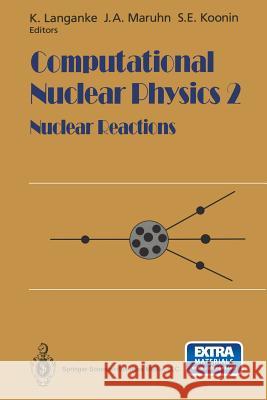
Computational Nuclear Physics 2: Nuclear Reactions K. Langanke J. a. Maruhn S. E. Koonin 9781461393375 Springer - książkaWidoczna okładka, to zdjęcie poglądowe, a rzeczywista szata graficzna może różnić się od prezentowanej.

Computational Nuclear Physics 2: Nuclear Reactions

ISBN-13: 9781461393375 / Angielski / Miękka / 2011 / 203 str.

K. Langanke; J. a. Maruhn; S. E. Koonin
cena 483,04
(netto: 460,04 VAT:  5%)

Najniższa cena z 30 dni: 462,63
Termin realizacji zamówienia:
ok. 22 dni roboczych
Dostawa w 2026 r.

Darmowa dostawa!

Computation is essential to our modern understanding of nuclear systems. Although simple analytical models might guide our intuition, the complex- ity of the nuclear many-body problem and the ever-increasing precision of experimental results require large-scale numerical studies for a quantitative understanding. Despite their importance, many nuclear physics computations remain something of a black art. A practicing nuclear physicist might be familiar with one or another type of computation, but there is no way to systemati- cally acquire broad experience. Although computational methods and results are often presented in the literature, it is often difficult to obtain the working codes. More often than not, particular numerical expertise resides in one or a few individuals, who must be contacted informally to generate results; this option becomes unavailable when these individuals leave the field. And while the teaching of modern nuclear physics can benefit enormously from realistic computer simulations, there has been no source for much of the important material. The present volume, the second of two, is an experiment aimed at address- ing some of these problems. We have asked recognized experts in various aspects of computational nuclear physics to codify their expertise in indi- vidual chapters. Each chapter takes the form of a brief description of the relevant physics (with appropriate references to the literature), followed by a discussion of the numerical methods used and their embodiment in a FOR- TRAN code. The chapters also contain sample input and test runs, as well as suggestions for further exploration.


Kategorie:
Nauka, Fizyka
Kategorie BISAC:
Mathematics > Systemy liczbowe
Science > Fizyka matematyczna
Science > Fizyka jądrowa
Wydawca:
Springer
Język:
Angielski
ISBN-13:
9781461393375
Rok wydania:
2011
Wydanie:
Softcover Repri
Ilość stron:
203
Waga:
0.31 kg
Wymiary:
23.39 x 15.6 x 1.17
Oprawa:
Miękka
Wolumenów:
01

1. One-Boson-Exchange Potentials and Nucleon-Nucleon Scattering.- 1.1 The Meson Theory of Nuclear Forces.- 1.2 Relativistic Two-Nucleon Scattering.- 1.2.1 Covariant Equations.- 1.2.2 The R-Matrix Equation and Helicity State Basis.- 1.2.3 The On-Shell R-Matrix and Phase Shifts.- 1.2.4 Effective Range Parameters.- 1.2.5 Using Thompson’s Equation.- 1.3 One-Boson-Exchange Potentials.- 1.3.1 Interaction Lagrangians and OBE Amplitudes.- 1.3.2 Partial-Wave Decomposition.- 1.3.3 Meson Parameters and Two-Nucleon Predictions.- 1.4 Numerics and Codes.- 1.4.1 Momentum-Space OBEP.- 1.4.2 $$\hat R$$-Matrix and Phase Shifts.- 1.5 Using the Codes.- 1.5.1 OBEP Code BONN.- 1.5.2 Code PHASES.- 1.6 What Else?.- Acknowledgments.- References.- 2. The G-Matrix in Finite Nuclei.- 2.1 Introduction.- 2.2 The G-Matrix, a First Step Towards an Effective NN Interaction.- 2.3 The Solution of the Bethe-Goldstone Equation.- 2.4 Details of the Numerical Calculation.- 2.5 Some Examples for Tests and Studies.- 2.6 Technical Note.- References.- 3. The Nuclear-Matter Effective Interaction.- 3.1 Background.- 3.2 The Bethe-Goldstone Equation in Uniform Matter.- 3.3 The Reference Spectrum Method.- 3.4 The Legindgaard Representation.- 3.5 Numerical Methods.- 3.5.1 The Off-Shell Reference Effective Interaction for a Local Potential.- 3.5.2 The Nuclear Matter Reaction Matrix.- 3.6 Remarks on the Code.- 3.6.1 Input to TREF.- 3.6.2 Output from TREF.- 3.6.3 Input to TNM.- 3.6.4 Output from TNM.- 3.7 Performance.- 3.8 Things to Do.- References.- 4. Microscopic Description of Nuclear Collisions.- 4.1 Introduction.- 4.2 Theoretical Background to the Resonating Group Method.- 4.3 A Short Description of the Numerical Methods Used and the Program Structure.- 4.4 Installation and Use of the Codes.- 4.5 Physical Applications.- 4.6 Technical Note.- References.- 5. The Distorted-Wave Born Approximation.- 5.1 General Description of DWUCK4.- 5.2 Specific Cases of Reactions.- 5.2.1 Inelastic Excitation Using a Collective Nuclear Model.- 5.2.2 The (d,p) Stripping Reaction.- 5.2.3 The (p,d) Pickup Reaction.- 5.2.4 The Microscopic Interaction Model for Inelastic Scattering.- 5.3 Description of the Input for DWUCK4.- 5.4 Sample Cases-Input and Output.- 5.5 Things to Do.- 5.6 Technical Note.- References.- 6. Statistical-Model Calculations with Angular-Momentum Coupling.- 6.1 Background.- 6.2 Basic Features of the Code.- 6.3 Level-Density Tables.- 6.4 Transmission Coefficients.- 6.5 Fission Barrier and Probability.- 6.6 Angular Distribution.- 6.7 Special Programming Features.- 6.8 Input and Output Files.- 6.9 Summary.- 6.10 Technical Note.- References.- 7. The Time-Dependent Hartree-Fock Approximation for Nuclear Slabs.- 7.1 Background.- 7.2 Interaction.- 7.3 Reduction to One Dimension.- 7.4 Numerical Methods.- 7.4.1 The Static Problem.- 7.4.2 The Dynamic Problem.- 7.5 Remarks on the Code.- 7.5.1 Input.- 7.5.2 Output.- 7.6 Running the Code.- 7.7 Things to Do.- References.- 8. The Vlasov-Uehling-Uhlenbeck Model.- 8.1 Introduction.- 8.2 Theoretical Description of Heavy-Ion Collisions.- 8.3 The VUU Equation.- 8.4 The Nuclear Equation of State.- 8.5 Numerical Realization.- 8.6 The Basic Structure of the Program.- 8.7 Running the Program.- 8.7.1 Compilation and Linking.- 8.7.2 Input.- 8.8 Input Examples.- 8.9 Interpretation of the Output.- 8.10 Output Analysis with VUUANL.- 8.11 Final Comments on Using the Program.- 8.12 Test Output.- References.- 9. The Friction Model for Deep-Inelastic and Fusion Reactions.- 9.1 Introduction.- 9.2 Description of the Program.- 9.2.1 FOLDING.- 9.2.2 FIT.- 9.2.3 FRICTION.- 9.3 The Structure of the Final Printout File.- 9.4 Running the Code with the Sample Input.- References.- 10. The Quark Model and the Nucleon-Nucleon Interaction.- 10.1 Introduction.- 10.2 The Resonating Group Method.- 10.3 The Hamiltonian of the Six-Quark System.- 10.4 Remarks on the Code.- 10.4.1 General Structure of the Program.- 10.4.2 Input Parameters.- 10.4.3 Output of the Code.- 10.4.4 Library Routines.- 10.4.5 Performance.- 10.4.6 Sample Parameters and Exercises.- 10.5 Technical Note.- References.- 11. Hadron-Hadron and Hadron-Nucleus Scattering.- 11.1 Introduction.- 11.2 Multiple Scattering Off Nuclei.- 11.2.1 General Formalism.- 11.2.2 Numerical Methods.- 11.2.3 Program Description MUSH (Multiple Scattering of Hadrons) and Performance.- 11.2.4 Discussion of the Results.- 11.3 Hadronic Interactions in the Quark Model.- 11.3.1 Definition of the Model.- 11.3.2 Solution of the 4-Quark Problem.- 11.3.3 Calculational Methods.- 11.3.4 Numerical Methods.- 11.3.5 Program Description QUASH (Quarks and Hadron Scattering) and Performance.- 11.3.6 Discussion of the Results.- 11.4 Conclusion.- 11.5 Technical Note.- References.


Udostępnij

Facebook - konto krainaksiazek.pl


Opinie o Krainaksiazek.pl na Opineo.pl

Partner Mybenefit

Krainaksiazek.pl w programie rzetelna firma Krainaksiaze.pl - płatności przez paypal

Czytaj nas na:

Facebook - krainaksiazek.pl
  • książki na zamówienie
  • granty
  • książka na prezent
  • kontakt
  • pomoc
  • opinie
  • regulamin
  • polityka prywatności

Zobacz:

  • Księgarnia czeska

  • Wydawnictwo Książkowe Klimaty

1997-2025 DolnySlask.com Agencja Internetowa

© 1997-2022 krainaksiazek.pl
     
KONTAKT | REGULAMIN | POLITYKA PRYWATNOŚCI | USTAWIENIA PRYWATNOŚCI
Zobacz: Księgarnia Czeska | Wydawnictwo Książkowe Klimaty | Mapa strony | Lista autorów
KrainaKsiazek.PL - Księgarnia Internetowa

Polityka prywatnosci - link
Krainaksiazek.pl - płatnośc Przelewy24
Przechowalnia Przechowalnia





