• Wyszukiwanie zaawansowane
  • Kategorie
  • Kategorie BISAC
  • Książki na zamówienie
  • Promocje
  • Granty
  • Książka na prezent
  • Opinie
  • Pomoc
  • Załóż konto
  • Zaloguj się

Computational Neuroscience: Theoretical Insights Into Brain Function: Volume 165 » książka


zaloguj się | załóż konto
Logo Krainaksiazek.pl

koszyk

konto

szukaj
topmenu
Księgarnia internetowa
Szukaj
Książki na zamówienie
Promocje
Granty
Książka na prezent
Moje konto
Pomoc
 
 
Wyszukiwanie zaawansowane
Pusty koszyk
Bezpłatna dostawa dla zamówień powyżej 20 złBezpłatna dostawa dla zamówień powyżej 20 zł

Kategorie główne

• Nauka
 [2946912]
• Literatura piękna
 [1852311]

  więcej...
• Turystyka
 [71421]
• Informatyka
 [150889]
• Komiksy
 [35717]
• Encyklopedie
 [23177]
• Dziecięca
 [617324]
• Hobby
 [138808]
• AudioBooki
 [1671]
• Literatura faktu
 [228371]
• Muzyka CD
 [400]
• Słowniki
 [2841]
• Inne
 [445428]
• Kalendarze
 [1545]
• Podręczniki
 [166819]
• Poradniki
 [480180]
• Religia
 [510412]
• Czasopisma
 [525]
• Sport
 [61271]
• Sztuka
 [242929]
• CD, DVD, Video
 [3371]
• Technologie
 [219258]
• Zdrowie
 [100961]
• Książkowe Klimaty
 [124]
• Zabawki
 [2341]
• Puzzle, gry
 [3766]
• Literatura w języku ukraińskim
 [255]
• Art. papiernicze i szkolne
 [7810]
Kategorie szczegółowe BISAC

Computational Neuroscience: Theoretical Insights Into Brain Function: Volume 165

ISBN-13: 9780444528230 / Angielski / Twarda / 2007 / 570 str.
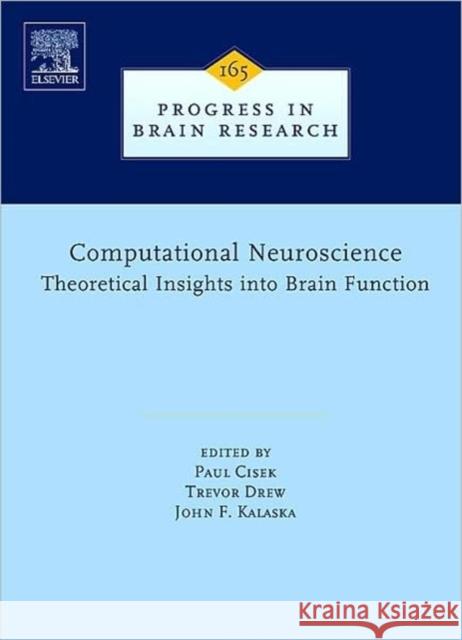
Trevor Drew; John Kalaska; Paul Cisek
Computational Neuroscience: Theoretical Insights Into Brain Function: Volume 165 Cisek, Paul 9780444528230 Elsevier Science - książkaWidoczna okładka, to zdjęcie poglądowe, a rzeczywista szata graficzna może różnić się od prezentowanej.

Computational Neuroscience: Theoretical Insights Into Brain Function: Volume 165

ISBN-13: 9780444528230 / Angielski / Twarda / 2007 / 570 str.

Trevor Drew; John Kalaska; Paul Cisek
cena 965,58
(netto: 919,60 VAT:  5%)

Najniższa cena z 30 dni: 965,58
Termin realizacji zamówienia:
ok. 30 dni roboczych
Dostawa w 2026 r.

Darmowa dostawa!

Computational neuroscience is a relatively new but rapidly expanding area of research which is becoming increasingly influential in shaping the way scientists think about the brain. Computational approaches have been applied at all levels of analysis, from detailed models of single-channel function, transmembrane currents, single-cell electrical activity, and neural signaling to broad theories of sensory perception, memory, and cognition. This book provides a snapshot of this exciting new field by bringing together chapters on a diversity of topics from some of its most important contributors. This includes chapters on neural coding in single cells, in small networks, and across the entire cerebral cortex, visual processing from the retina to object recognition, neural processing of auditory, vestibular, and electromagnetic stimuli, pattern generation, voluntary movement and posture, motor learning, decision-making and cognition, and algorithms for pattern recognition. Each chapter provides a bridge between a body of data on neural function and a mathematical approach used to interpret and explain that data. These contributions demonstrate how computational approaches have become an essential tool which is integral in many aspects of brain science, from the interpretation of data to the design of new experiments, and to the growth of our understanding of neural function.

- Includes contributions by some of the most influential people in the field of computational neuroscience
- Demonstrates how computational approaches are being used today to interpret experimental data
- Covers a wide range of topics from single neurons, to neural systems, to abstract models of learning


Kategorie:
Nauka, Medycyna
Kategorie BISAC:
Medical > Neuroscience
Wydawca:
Elsevier Science
Seria wydawnicza:
Progress in Brain Research
Język:
Angielski
ISBN-13:
9780444528230
Rok wydania:
2007
Numer serii:
000061059
Ilość stron:
570
Oprawa:
Twarda
Wolumenów:
01

The neuronal transfer function: contributions from voltage and time-dependent mechanisms
E.P. Cook, A.C. Wilhelm, J.A. Guest, Y. Liang, N.Y. Masse and C.M. Colbert (Montreal QC, Canada and Houston, TX, USA).
A simple growth model constructs critical avalanche networks
L.F. Abbott and R. Rohrkemper (New York, NY, USA and Zurich, Switzerland).
The dynamics of visual responses in the primary visual cortex
R. Shapley, M. Hawken and D. Xing (New York, NY, USA).
A quantitative theory of immediate visual recognition
T. Serre, G. Kreiman, M. Kouh, C. Cadieu, U. Knoblich and T. Poggio (Boston, MA, USA).
Attention in hierarchical models of object recognition
D.B. Walther and C. Koch (Urbana, IL, and Pasadena,CA, USA).
Towards a unified theory of neocortex: laminar cortical circuits for vision and cognition
S. Grossberg (Boston, MA, USA).
Real-time neural coding of memory
J.Z. Tsien (Boston, MA, USA).
Beyond timing in the auditory brainstem: intensity in the avian cochlear nucleus angularis
K.M. MacLeod and C.E. Carr (College Park, MD, USA).
Neural strategies for optimal processing of sensory signals
L. Maler (Ottawa, ON, Canada).
Coordinate transformations and sensory integration in the detection of spatial orientation and self-motion: from models to experiments
A.M. Green and D.E. Angelaki (Montreal, QC, Canada and St. Louis, MO, USA).
Sensorimotor optimization in higher dimensions
. Tweed (Toronto, ON,USA).
How tightly tuned are network parameters? Insight from computational and experimental studies in small rhythmic motor networks
E. Marder, A.-E. Tobin and R. Grashow (Waltham, MA, USA).
Spatial organization and state-dependent mechanisms for respiratory rhythm and pattern generation
I.A. Rybak, A.P.L. Abdala, S.N. Markin, J.F.R. Paton and J.C. Smith (Philadelphia, PA and Bethesda, MD, USA and Bristol, UK).
Modeling a vertebrate motor system - pattern generation, steering and control of body orientation
S. Grillner, A. Kozlov, P. Dario, C. Stefanini, A. Menciassi, A. Lansner, J. Hellgren Kotaleski (Stockholm, Sweden and Pontedera, Italy).
Modeling the mammalian locomotor CPG: insights from mistakes and perturbations
D.A. McCrea and I.A. Rybak (Winnipeg, MB, Canada and Philadelphia, PA, USA).
The neuromechanical tuning hypothesis
A. Prochazka and S. Yakovenko (Edmonton, AB and Montreal, QC, Canada).
Threshold position control and the principle of minimal interaction in motor actions
A.G. Feldman, V. Goussev, A. Sangole and M.F. Levin (Montreal and Laval, QC, Canada).
Modelling sensorimotor control of human upright stance
T. Mergner (Freiburg, Germany).
Dimensional reduction in sensorimotor systems: a framework for understanding muscle coordination of posture
L.H. Ting (Atlanta, GA, USA).
Primitives, premotor drives and pattern generation: a combined computational and neuroethological perspective
S. Giszter, V. Patil and C. Hart (Philadelphia, PA, USA).
A multi-level approach to understanding upper limb function
I. Kurtzer and S.H. Scott (Kingston, ON, Canada).
How is somatosensory information used to adapt to changes in the mechanical environment?
T.E. Milner, M.R. Hinder and D.W. Franklin (Burnaby, BC, Queensland, Australia and Kyoto, Japan).
Trial-by-trial motor adaptation: a window into elemental neural computation
K.A. Thoroughman, M.S. Fine and J.A. Taylor (Saint Louis, MO, USA).
Towards a computational neuropsychology of action
J.W. Krakauer and R. Shadmehr (New York, NY and Baltimore, MD, USA).
Motor control in a meta-network with attractor dynamics
N.I. Krouvhev and J.F. Kalaska (Montreal, WC, Canada).
Computing movement geometry - a step in sensory-motor transformations
D. Zipser and E. Torres (Pasadena, CA, USA).
Dynamics systems versus optimal control - a unifying view
S. Schaal, P. Mohajerian and A. Ijspeert (Los Angeles, CA, USA, Kyoto, Japan and Lausanne, Switzerland).
The place of 'codes' in nonlinear neurodynamics
W.J. Freeman (Berkeley, CA, USA).
From a representation of behaviour to the concept of cognitive syntax: a theoretical framework
T. Gisiger and M. Kerszberg (Paris, France).
A parallel framework for interactive behaviour
P. Cisek (Montreal, QC, Canada).
Statistical models for neural encoding, decoding, and optimal stimulus design
L. Paninski, J. Pillow and J. Lewi (New York, NY, USA and London, UK).
Probabilistic population codes and the exponential family of distributions
J. Beck, W. Ma, P.E. Latham and A. Pouget (Rochester, NY, USA and London, UK).
On the challenge of learning complex functions
Y. Bengio (Montreal, QC, Canada).
To recognize shapes, first learn to generate images
G.E. Hinton (Toronto, Canada).


Udostępnij

Facebook - konto krainaksiazek.pl


Opinie o Krainaksiazek.pl na Opineo.pl

Partner Mybenefit

Krainaksiazek.pl w programie rzetelna firma Krainaksiaze.pl - płatności przez paypal

Czytaj nas na:

Facebook - krainaksiazek.pl
  • książki na zamówienie
  • granty
  • książka na prezent
  • kontakt
  • pomoc
  • opinie
  • regulamin
  • polityka prywatności

Zobacz:

  • Księgarnia czeska

  • Wydawnictwo Książkowe Klimaty

1997-2025 DolnySlask.com Agencja Internetowa

© 1997-2022 krainaksiazek.pl
     
KONTAKT | REGULAMIN | POLITYKA PRYWATNOŚCI | USTAWIENIA PRYWATNOŚCI
Zobacz: Księgarnia Czeska | Wydawnictwo Książkowe Klimaty | Mapa strony | Lista autorów
KrainaKsiazek.PL - Księgarnia Internetowa

Polityka prywatnosci - link
Krainaksiazek.pl - płatnośc Przelewy24
Przechowalnia Przechowalnia






