• Wyszukiwanie zaawansowane
  • Kategorie
  • Kategorie BISAC
  • Książki na zamówienie
  • Promocje
  • Granty
  • Książka na prezent
  • Opinie
  • Pomoc
  • Załóż konto
  • Zaloguj się

Computational Models for Neuroscience: Human Cortical Information Processing » książka


zaloguj się | załóż konto
Logo Krainaksiazek.pl

koszyk

konto

szukaj
topmenu
Księgarnia internetowa
Szukaj
Książki na zamówienie
Promocje
Granty
Książka na prezent
Moje konto
Pomoc
 
 
Wyszukiwanie zaawansowane
Pusty koszyk
Bezpłatna dostawa dla zamówień powyżej 20 złBezpłatna dostawa dla zamówień powyżej 20 zł

Kategorie główne

• Nauka
 [2948695]
• Literatura piękna
 [1824038]

  więcej...
• Turystyka
 [70868]
• Informatyka
 [151073]
• Komiksy
 [35227]
• Encyklopedie
 [23181]
• Dziecięca
 [621575]
• Hobby
 [138961]
• AudioBooki
 [1642]
• Literatura faktu
 [228651]
• Muzyka CD
 [371]
• Słowniki
 [2933]
• Inne
 [445341]
• Kalendarze
 [1243]
• Podręczniki
 [164416]
• Poradniki
 [479493]
• Religia
 [510449]
• Czasopisma
 [502]
• Sport
 [61384]
• Sztuka
 [243086]
• CD, DVD, Video
 [3417]
• Technologie
 [219673]
• Zdrowie
 [100865]
• Książkowe Klimaty
 [124]
• Zabawki
 [2168]
• Puzzle, gry
 [3372]
• Literatura w języku ukraińskim
 [260]
• Art. papiernicze i szkolne
 [7838]
Kategorie szczegółowe BISAC

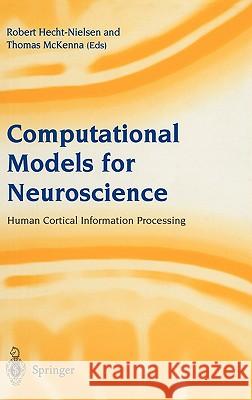
Computational Models for Neuroscience: Human Cortical Information Processing

ISBN-13: 9781852335939 / Angielski / Twarda / 2002 / 299 str.
Robert Hecht-Nielsen; Thomas McKenna; R. Hect- Nielsen
Computational Models for Neuroscience: Human Cortical Information Processing Hecht-Nielsen, Robert 9781852335939 Springer - książkaWidoczna okładka, to zdjęcie poglądowe, a rzeczywista szata graficzna może różnić się od prezentowanej.

Computational Models for Neuroscience: Human Cortical Information Processing

ISBN-13: 9781852335939 / Angielski / Twarda / 2002 / 299 str.

Robert Hecht-Nielsen; Thomas McKenna; R. Hect- Nielsen
cena 602,40
(netto: 573,71 VAT:  5%)

Najniższa cena z 30 dni: 578,30
Termin realizacji zamówienia:
ok. 22 dni roboczych.

Darmowa dostawa!

Formal study of neuroscience (broadly defined) has been underway for millennia. For example, writing 2,350 years ago, Aristotle asserted that association - of which he defined three specific varieties - lies at the center of human cognition. Over the past two centuries, the simultaneous rapid advancements of technology and (conse- quently) per capita economic output have fueled an exponentially increasing effort in neuroscience research. Today, thanks to the accumulated efforts of hundreds of thousands of scientists, we possess an enormous body of knowledge about the mind and brain. Unfortunately, much of this knowledge is in the form of isolated factoids. In terms of "big picture" understanding, surprisingly little progress has been made since Aristotle. In some arenas we have probably suffered negative progress because certain neuroscience and neurophilosophy precepts have clouded our self-knowledge; causing us to become largely oblivious to some of the most profound and fundamental aspects of our nature (such as the highly distinctive propensity of all higher mammals to automatically seg- ment all aspects of the world into distinct holistic objects and the massive reorganiza- tion of large portions of our brains that ensues when we encounter completely new environments and life situations). At this epoch, neuroscience is like a huge collection of small, jagged, jigsaw puz- zle pieces piled in a mound in a large warehouse (with neuroscientists going in and tossing more pieces onto the mound every month).


Kategorie:
Nauka, Medycyna
Kategorie BISAC:
Medical > Neuroscience
Computers > Artificial Intelligence - General
Medical > Neurologia i neurofizjologia kliniczna
Wydawca:
Springer
Język:
Angielski
ISBN-13:
9781852335939
Rok wydania:
2002
Wydanie:
2003
Ilość stron:
299
Waga:
0.63 kg
Oprawa:
Twarda
Wolumenów:
01
Dodatkowe informacje:
Bibliografia
Wydanie ilustrowane

1 The Neurointeractive Paradigm: Dynamical Mechanics and the Emergence of Higher Cortical Function.- 1.1 Abstract.- 1.2 Introduction.- 1.3 Principles of Cortical Neurointeractivity.- 1.4 Dynamical Mechanics.- 1.5 The Neurointeractive Cycle.- 1.6 Developmental Emergence.- 1.7 Explaining Emergence.- 1.8 References.- 2 The Cortical Pyramidal Cell as a Set of Interacting Error Backpropagating Dendrites: Mechanism for Discovering Nature ’s Order.- 2.1 Abstract.- 2.2 Introduction.- 2.2.1 Defining the Problem.- 2.2.2 How Does the Brain Discover Orderly Relations?.- 2.3 Implementation of the Proposal.- 2.3.1 How Might Error Backpropagation Learning Be Implemented in Dendrites?.- 2.3.2 How Can Dendrites Be Set Up to Teach Each Other?.- 2.3.3 How to Divide Connections Among the Dendrites?.- 2.4 Cortical Minicolumnar Organization and SINBAD Neurons.- 2.5 Associationism.- 2.5.1 SINBAD as an Associationist Theory.- 2.5.2 Countering Nativist Arguments.- 2.6 Acknowledgements.- References.- 3 Performance of Intelligent Systems Governed by Internally Generated Goals.- 3.1 Abstract.- 3.2 Introduction.- 3.3 Perception as an Active Process.- 3.4 Nonlinear Dynamics of the Olfactory System.- 3.5 Chaotic Oscillations During Learning Novel Stimuli.- 3.6 Generalization and Consolidation of New Perceptions with Context.- 3.7 The Central Role of the Limbic System.- 3.8 Conclusions.- 3.9 Acknowledgements.- References.- 4 A Theory of Thalamocortex.- 4.1 Abstract.- 4.2 Active Neurons.- 4.3 Neuronal Connections within Thalamocortex.- 4.4 Cortical Regions.- 4.5 Feature Artractor Associative Memory Neural Network.- 4.6 Antecedent Support Associative Memory Neural Network.- 4.7 Hierarchical Abstractor Associative Memory Neural Network.- 4.8 Consensus Building.- 4.9 Brain Command Loop.- 4.10 Testing this Theory.- 4.11 Acknowledgements.- Appendix A: Sketch of an Analysis of the Simplified Feature Artractor Associative Memory Neural Network.- Appendix B: Experiments with a Simplified Antecedent Support Associative Memory Neural Network.- Appendix C: An Experiment with Consensus Building.- References.- 5 Elementary Principles of Nonlinear Synaptic Transmission.- 5.1 Abstract.- 5.2 Introduction.- 5.3 Frequency-dependent Synaptic Transmission.- 5.4 Nonlinear Synapses Enable Temporal Integration.- 5.5 Temporal Information.- 5.6 Packaging Temporal Information.- 5.7 Size of Temporal Information Packages.- 5.8 Classes of Temporal Information Packages.- 5.9 Emergence of the Population Signal.- 5.10 Recurrent Neural Networks.- 5.11 Combining Temporal Information in Recurrent Networks.- 5.12 Organization of Synaptic Parameters.- 5.13 Learning Dynamics, Learning to Predict.- 5.14 Redistribution of Synaptic Efficacy.- 5.15 Optimizing Synaptic Prediction.- 5.16 A Nested Learning Algorithm.- 5.17 Retrieving Memories from Nonlinear Synapses.- 5.18 Conclusion.- 5.19 Acknowledgements.- Appendix A: Sherrington ’s Leap.- Appendix B: Functional Significance.- Appendix C: Visual Patch Recordings.- Appendix D: Biophysical Basis of Parameters.- Appendix E: Single Connection, Many Synapses.- Appendix F: The Model.- Appendix G: Synaptic Classes.- Appendix H: Paired Pulses.- Appendix I: Digitization of Synaptic Parameters.- Appendix J: Steady State.- Appendix K: Inhibitory Synapses.- Appendix L: Lack of Boundaries.- Appendix M: Speed of RI Accumulation.- Appendix N: Network Efficiency.- Appendix O: The Binding Problem of the Binding Problem.- References.- 6 The Development of Cortical Models to Enable Neural-based Cognitive Architectures.- 6.1 Introduction.- 6.1.1 Computational Neuroscience Paradigms and Predictions.- 6.2 The Challenge of Cognitive Architectures.- 6.2.1 General Cognitive Skills.- 6.2.2 A Survey of Current Cognitive Architectures.- 6.2.3 Assumptions and Limitations of Current Cognitive Architectures.- 6.3 The Prospects for a Neural-based Cognitive Architecture.- 6.3.1 Limitations of Artificial Neural Networks.- 6.3.2 Biological Networks Emerging from Computational Neuroscience: Sensory and Motor Modules.- 6.3.3 Forebrain Systems Supporting Cortical Function.- 6.4 Elements of a General Cortical Model.- 6.4.1 Single Neuron Models or Processor Elements.- 6.4.2 Microcircuitry.- 6.4.3 Dynamic Synaptic Connectivity.- 6.4.4 Ensemble Dynamics and Coding.- 6.4.5 Transient Coherent Structures and Cognitive Dynamics.- 6.5 Promising Models and their Capabilities.- 6.5.1 Biologically Based Cortical Systems.- 6.5.2 A Cortical System Based on Neurobiology, Biological Principles and Mathematical Analysis: Cortronics.- 6.5.3 Connectionist Architectures with Biological Principles: The Convergence of Cognitive Science and Computational Neuroscience.- 6.6 The Challenges of Demonstrating Cognitive Ability.- 6.6.1 Robotics and Autonomous Systems.- 6.7 Co-development Strategies for Automated Systems and Human Performers.- 6.8 Acknowledgements.- References.- 7 The Behaving Human Neocortex as a Dynamic Network of Networks.- 7.1 Abstract.- 7.2 Neural Organization Across Scales.- 7.3 Network of Networks (NoN) Model.- 7.3.1 Architecture.- 7.3.2 Model Formulation.- 7.3.3 NoN Properties.- 7.3.4 NoN Contributions.- 7.4 Neurobiological Predicatability and Falsifiability.- 7.5 Implications for Neuroengineering.- 7.6 Concluding Remarks.- 7.7 Acknowledgements.- References.- 8 Towards Global Principles of Brain Processing.- 8.1 Abstract.- 8.2 Introduction.- 8.3 What Could Brain Principles Look Like?.- 8.4 Structural Modeling.- 8.5 Static Activation Study Results.- 8.6 The Motion After-Effect (MAE).- 8.7 The Three-Stage Model of Consciousness.- 8.8 The CODAM Model of Consciousness.- 8.9 Principles of the Global Brain.- 8.10 The Thinking Brain.- 8.11 Discussion.- 8.12 Acknowledgement.- References.- 9 The Neural Networks for Language in the Brain: Creating LAD.- 9.1 Abstract.- 9.2 Introduction.- 9.3 The ACTION Net Model of TSSG.- 9.4 Phrase Structure Analyzers.- 9.5 Generativity of the Adjectival Phrase Analyzer.- 9.6 Complexity of Phrase Structure Analysis.- 9.7 Future Directions in the Construction of LAD.- 9.8 Conclusions.- References.- 10 Cortical Belief Networks.- 10.1 Abstract.- 10.1 Introduction.- 10.1 An Example.- 10.1 Representing Distributions in Populations.- 10.1 Basis Function Representations.- 10.1 Generative Representations.- 10.1 Standard Bayesian Approach.- 10.1 Distributional Population Coding.- 10.1 Applying Distributional Population Coding.- 10.1.1 Population Analysis.- 10.1.1 Decoding Transparent Motion.- 10.1.1 Decision Noise.- 10.1.1 Lateral Interactions.- 10.1 Cortical Belief Network.- 10.1 Discussion.- 10.1 Acknowledgements.- 10.1 References.

Hecht-Nielsen, Robert Robert Hecht-Nielsen was made a Fellow of the IEEE... więcej >


Udostępnij

Facebook - konto krainaksiazek.pl


Opinie o Krainaksiazek.pl na Opineo.pl

Partner Mybenefit

Krainaksiazek.pl w programie rzetelna firma Krainaksiaze.pl - płatności przez paypal

Czytaj nas na:

Facebook - krainaksiazek.pl
  • książki na zamówienie
  • granty
  • książka na prezent
  • kontakt
  • pomoc
  • opinie
  • regulamin
  • polityka prywatności

Zobacz:

  • Księgarnia czeska

  • Wydawnictwo Książkowe Klimaty

1997-2026 DolnySlask.com Agencja Internetowa

© 1997-2022 krainaksiazek.pl
     
KONTAKT | REGULAMIN | POLITYKA PRYWATNOŚCI | USTAWIENIA PRYWATNOŚCI
Zobacz: Księgarnia Czeska | Wydawnictwo Książkowe Klimaty | Mapa strony | Lista autorów
KrainaKsiazek.PL - Księgarnia Internetowa

Polityka prywatnosci - link
Krainaksiazek.pl - płatnośc Przelewy24
Przechowalnia Przechowalnia






