• Wyszukiwanie zaawansowane
  • Kategorie
  • Kategorie BISAC
  • Książki na zamówienie
  • Promocje
  • Granty
  • Książka na prezent
  • Opinie
  • Pomoc
  • Załóż konto
  • Zaloguj się

Computational Methods to Examine Team Communication: When and How to Change the Conversation » książka

zaloguj się | załóż konto
Logo Krainaksiazek.pl

koszyk

konto

szukaj
topmenu
Księgarnia internetowa
Szukaj
Książki na zamówienie
Promocje
Granty
Książka na prezent
Moje konto
Pomoc
 
 
Wyszukiwanie zaawansowane
Pusty koszyk
Bezpłatna dostawa dla zamówień powyżej 20 złBezpłatna dostawa dla zamówień powyżej 20 zł

Kategorie główne

• Nauka
 [2946600]
• Literatura piękna
 [1856966]

  więcej...
• Turystyka
 [72221]
• Informatyka
 [151456]
• Komiksy
 [35826]
• Encyklopedie
 [23190]
• Dziecięca
 [619653]
• Hobby
 [140543]
• AudioBooki
 [1577]
• Literatura faktu
 [228355]
• Muzyka CD
 [410]
• Słowniki
 [2874]
• Inne
 [445822]
• Kalendarze
 [1744]
• Podręczniki
 [167141]
• Poradniki
 [482898]
• Religia
 [510455]
• Czasopisma
 [526]
• Sport
 [61590]
• Sztuka
 [243598]
• CD, DVD, Video
 [3423]
• Technologie
 [219201]
• Zdrowie
 [101638]
• Książkowe Klimaty
 [124]
• Zabawki
 [2473]
• Puzzle, gry
 [3898]
• Literatura w języku ukraińskim
 [254]
• Art. papiernicze i szkolne
 [8170]
Kategorie szczegółowe BISAC

Computational Methods to Examine Team Communication: When and How to Change the Conversation

ISBN-13: 9783030361587 / Angielski / Twarda / 2020 / 196 str.
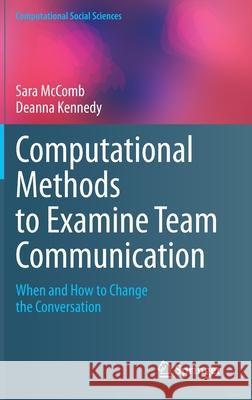
Sara McComb; Deanna Kennedy
Computational Methods to Examine Team Communication: When and How to Change the Conversation McComb, Sara 9783030361587 Springer - książkaWidoczna okładka, to zdjęcie poglądowe, a rzeczywista szata graficzna może różnić się od prezentowanej.

Computational Methods to Examine Team Communication: When and How to Change the Conversation

ISBN-13: 9783030361587 / Angielski / Twarda / 2020 / 196 str.

Sara McComb; Deanna Kennedy
cena 443,82 zł
(netto: 422,69 VAT:  5%)

Najniższa cena z 30 dni: 424,07 zł
Termin realizacji zamówienia:
ok. 22 dni roboczych
Bez gwarancji dostawy przed świętami

Darmowa dostawa!
inne wydania
Kategorie:
Nauka, Matematyka
Kategorie BISAC:
Social Science > Socjologia
Business & Economics > Zarządzenie i techniki zarządzania
Business & Economics > Strategia biznesowa
Wydawca:
Springer
Seria wydawnicza:
Computational Social Sciences
Język:
Angielski
ISBN-13:
9783030361587
Rok wydania:
2020
Wydanie:
2020
Numer serii:
000471981
Ilość stron:
196
Waga:
0.48 kg
Wymiary:
23.39 x 15.6 x 1.42
Oprawa:
Twarda
Wolumenów:
01
Dodatkowe informacje:
Wydanie ilustrowane


Outline

1.      Team Communication in Theory and Practice

1.1.   Why is this book important?

1.1.1.      Motivation (teams are increasingly used in organizations, communication is the mode via which work is accomplished)

1.1.2.      Longitudinal and Dynamic Team Research

1.1.3.      Team Communication Research

1.1.4.      Gap in the literature (granular view over time)

1.2.   What are the theoretical underpinnings of this book?

1.2.1.      Marks et al – Team Phases

1.2.2.      Bartunek & Woodman - Organization Change Framework

1.2.3.      Integration of Marks et al and Bartunek & Woodman

1.3.   What is the focus of this book

1.3.1.      In Person versus Networked (Shannon & Weaver – channels)

1.3.2.      Baseline (i.e., no restrictions/requirements) versus Time Pressure

1.4.   What is included in this book?

1.4.1.      Chapter Previews

1.4.2.      Managerial Minutes

1.4.3.      Methodological Appendices

1.5.   So, why should you read this book?

1.5.1.      Researchers

1.5.1.1.            Enhance the longitudinal and dynamic literatures

1.5.1.2.            Tutorials stepping through the methodological approaches

1.5.2.      Practitioners

1.5.2.1.            Managerial minutes offering concrete suggestions for managing team communication under varying working conditions

2.      The Study

2.1.   The Sample

2.2.   The Study Design

2.2.1.      Task Description and Procedures - experiment documents in Appendix A

2.2.2.      Performance Episodes

2.2.3.      Communication Media

2.2.4.      Time Availability

2.3.   The Data

2.3.1.      Performance Measures

2.3.2.      Communication Strings

2.3.2.1.            Coding Framework

2.3.2.2.            Coding Process

2.3.2.3.            Data Operationalizations

3.      Pacing and Timing

3.1.   Introduce Pacing and Timing of Team Communication

3.2.   RQ:  Do teams communicate differently across quartiles in the four study conditions (pacing)?  Does a right time exist for discussing topics (timing)?

3.3.   Data Specification – aggregated topic communication by quartiles x team performance x conditions

3.4.   Methodological Approach

3.4.1.      Network pictographs

3.4.2.      Why is it appropriate?  How has it been used in previous team and/or behavioral research?

3.4.3.      Specific description of what was done in this study with reference to Appendix B

3.5.   Results

3.6.   Theoretical Implications

3.7.   Managerial Minute

3.8.   Suggestions for Future Research

4.      Sequence

4.1.   Introduce Sequence of Team Communication

4.2.   RQ:  Does the way in which team conversations unfold differ across quartiles?  Do differences exist across conditions?

4.3.   Data Specification – topic and exchange-type communication strings across quartiles x conditions

4.4.   Methodological Approach

4.4.1.      Hierarchical clustering analysis and dendrograms

4.4.2.      Why is it appropriate?  How has it been used in previous team and/or behavioral research?

4.4.3.      Specific description of what was done in this study with reference to Appendix C

4.5.   Results

4.6.   Theoretical Implications

4.7.   Managerial Minute

4.8.   Suggestions for Future Research

5.      Rhythm

5.1.   Introduce Rhythm of Team Communication

5.2.   RQ:  Do teams engage in cyclical conversations?  What are the intensity, frequency, and length of these cycles?  Do cycles relate to team performance?  Are these cycles and relationships different across conditions?

5.3.   Data Specification – T1 and T2 topic communication strings x conditions

5.4.   Methodological Approach

5.4.1.      General Recurrence Analysis description w/metrics

5.4.2.      Why is it appropriate?  How has it been used in previous team and/or behavioral research?

5.4.3.      Specific description of what was done in this study with reference to Appendix D

5.5.   Results

5.6.   Theoretical Implications

5.7.   Managerial Minute

5.8.   Suggestions for Future Research

6.      Polyphony

6.1.   Introduce Polyphony in Team Communication

6.2.   RQ:  Do teams engage in repetitive communication cycles?  Is the frequency influenced by the cycle frequency of and/or initial conversations about other topics?  How are the initial conversations about each topic interrelated?  Do cycles relate to team performance?  Are these cycles and relationships different across conditions?

6.3.   Methodological Approach

6.3.1.      Anderson-Gill Intensity Model (structural polyphony)

6.3.2.      Event History Analysis (influence polyphony)

6.3.3.      Why are these methods appropriate?  How has it been used in previous team and/or behavioral research?

6.3.4.      Specific description of what was done in this study with reference to Appendix E

6.4.   Data Specification – T1 and T2 topic communication patterns x team performance x conditions

6.5.   Results (include any observations from previous chapters that relate to polyphony)

6.6.   Theoretical Implications

6.7.   Managerial Minute

6.8.   Suggestions for Future Research

7.      What does it all mean?

7.1.   Comparisons across conditions

7.1.1.      In person versus networked

7.1.2.      Baseline versus time pressure

7.1.3.      Time 1 versus Time 2

7.2.   Theoretical Contributions and Suggested Future Research – focus on transition versus action process from Marks and different temporal dimensions of change from B&W

7.3.   Practical Contributions and Recommendations – summarize the Managerial Minutes, including suggested interventions and best practices

7.4.   Embed Contributions in broader team dynamics literature

8.      Appendices

8.1.   Appendix A – Experiment Documents

8.2.   Appendix B – Network Pictographs

8.3.   Appendix C – Hierarchical Cluster Analysis and Dendrograms

8.4.   Appendix D – Recurrence Analysis

8.5.   Appendix E – Anderson-Gill Intensity Model and Event History Analysis

Sara McComb is a Professor at Purdue University with a joint appointment in Nursing and Industrial Engineering.  She has over 20 years experience studying team communication and cognition; has garnered over $2.7M in external funding from agencies including the National Science Foundation and Office of Naval Research; and published in top journals including the Journal of Applied Psychology, Human Factors and the Journal of Advanced Nursing. Her research focuses on understanding how communication and cognition impact team processes and performance.

Deanna M. Kennedy is an Associate Professor at the University of Washington Bothell in the School of Business. Her research addresses the application of project management through the study of team interactions and showcases a variety of methodological approaches in the team researcher toolkit. Her work has been funded by the Army Research Office and NASA and published in such journals as Journal of Applied Psychology, European Journal of Operational Research, and Decision Sciences.

The primary focus of this book is an examination of longitudinal team communication and its impact on team performance.  This theoretically-grounded, holistic examination of team communication includes cross-condition comparisons of team (i.e., distributed/in person, unrestricted/time pressured, two performance episodes) and employs multiple quantitative methodological approaches to examine the phenomena of interest.

This book simultaneously provides practical content for researchers and practitioners in the social sciences and humanities. Included are step-by-step instructions for the methodologies employed, and distillations of findings via Managerial Minutes that highlight best practices and/or examples to help enhance team communication in practice.


Udostępnij

Facebook - konto krainaksiazek.pl


Opinie o Krainaksiazek.pl na Opineo.pl

Partner Mybenefit

Krainaksiazek.pl w programie rzetelna firma Krainaksiaze.pl - płatności przez paypal

Czytaj nas na:

Facebook - krainaksiazek.pl
  • książki na zamówienie
  • granty
  • książka na prezent
  • kontakt
  • pomoc
  • opinie
  • regulamin
  • polityka prywatności

Zobacz:

  • Księgarnia czeska

  • Wydawnictwo Książkowe Klimaty

1997-2025 DolnySlask.com Agencja Internetowa

© 1997-2022 krainaksiazek.pl
     
KONTAKT | REGULAMIN | POLITYKA PRYWATNOŚCI | USTAWIENIA PRYWATNOŚCI
Zobacz: Księgarnia Czeska | Wydawnictwo Książkowe Klimaty | Mapa strony | Lista autorów
KrainaKsiazek.PL - Księgarnia Internetowa

Polityka prywatnosci - link
Krainaksiazek.pl - płatnośc Przelewy24
Przechowalnia Przechowalnia







