• Wyszukiwanie zaawansowane
  • Kategorie
  • Kategorie BISAC
  • Książki na zamówienie
  • Promocje
  • Granty
  • Książka na prezent
  • Opinie
  • Pomoc
  • Załóż konto
  • Zaloguj się

Computational Methods for Corpus Annotation and Analysis » książka


zaloguj się | załóż konto
Logo Krainaksiazek.pl

koszyk

konto

szukaj
topmenu
Księgarnia internetowa
Szukaj
Książki na zamówienie
Promocje
Granty
Książka na prezent
Moje konto
Pomoc
 
 
Wyszukiwanie zaawansowane
Pusty koszyk
Bezpłatna dostawa dla zamówień powyżej 20 złBezpłatna dostawa dla zamówień powyżej 20 zł

Kategorie główne

• Nauka
 [2946600]
• Literatura piękna
 [1856966]

  więcej...
• Turystyka
 [72221]
• Informatyka
 [151456]
• Komiksy
 [35826]
• Encyklopedie
 [23190]
• Dziecięca
 [619653]
• Hobby
 [140543]
• AudioBooki
 [1577]
• Literatura faktu
 [228355]
• Muzyka CD
 [410]
• Słowniki
 [2874]
• Inne
 [445822]
• Kalendarze
 [1744]
• Podręczniki
 [167141]
• Poradniki
 [482898]
• Religia
 [510455]
• Czasopisma
 [526]
• Sport
 [61590]
• Sztuka
 [243598]
• CD, DVD, Video
 [3423]
• Technologie
 [219201]
• Zdrowie
 [101638]
• Książkowe Klimaty
 [124]
• Zabawki
 [2473]
• Puzzle, gry
 [3898]
• Literatura w języku ukraińskim
 [254]
• Art. papiernicze i szkolne
 [8170]
Kategorie szczegółowe BISAC

Computational Methods for Corpus Annotation and Analysis

ISBN-13: 9789402407808 / Angielski / Miękka / 2016 / 186 str.
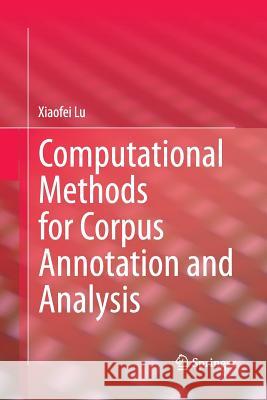
Xiaofei Lu
Computational Methods for Corpus Annotation and Analysis Xiaofei Lu 9789402407808 Springer - książkaWidoczna okładka, to zdjęcie poglądowe, a rzeczywista szata graficzna może różnić się od prezentowanej.

Computational Methods for Corpus Annotation and Analysis

ISBN-13: 9789402407808 / Angielski / Miękka / 2016 / 186 str.

Xiaofei Lu
cena 512,35 zł
(netto: 487,95 VAT:  5%)

Najniższa cena z 30 dni: 508,15 zł
Termin realizacji zamówienia:
ok. 30 dni roboczych
Bez gwarancji dostawy przed świętami

Darmowa dostawa!

In the past few decades the use of increasingly large text corpora has grown rapidly in language and linguistics research. This was enabled by remarkable strides in natural language processing (NLP) technology, technology that enables computers to automatically and efficiently process, annotate and analyze large amounts of spoken and written text in linguistically and/or pragmatically meaningful ways. It has become more desirable than ever before for language and linguistics researchers who use corpora in their research to gain an adequate understanding of the relevant NLP technology to take full advantage of its capabilities.
This volume provides language and linguistics researchers with an accessible introduction to the state-of-the-art NLP technology that facilitates automatic annotation and analysis of large text corpora at both shallow and deep linguistic levels. The book covers a wide range of computational tools for lexical, syntactic, semantic, pragmatic and discourse analysis, together with detailed instructions on how to obtain, install and use each tool in different operating systems and platforms. The book illustrates how NLP technology has been applied in recent corpus-based language studies and suggests effective ways to better integrate such technology in future corpus linguistics research.
This book provides language and linguistics researchers with a valuable reference for corpus annotation and analysis.


Kategorie:
Informatyka
Kategorie BISAC:
Language Arts & Disciplines > Linguistics - General
Computers > Artificial Intelligence - Natural Language Processing
Computers > Speech & Audio Processing
Wydawca:
Springer
Język:
Angielski
ISBN-13:
9789402407808
Rok wydania:
2016
Wydanie:
Softcover Repri
Ilość stron:
186
Waga:
0.28 kg
Wymiary:
23.39 x 15.6 x 1.07
Oprawa:
Miękka
Wolumenów:
01
Dodatkowe informacje:
Wydanie ilustrowane

From the book reviews:

"'Computational Methods for Corpus Annotation and Analysis' is an excellent book for corpus linguists who are interested in using advanced corpus queries. It presents the latest computational tools for corpus annotation and analysis in a very accessible manner. The advice and resources in the book are also very practical and useful. It is highly recommended to researchers and students of corpus linguistics." (Phoebe M. S. Lin, The Linguist List, March, 2015)

Preface.- Chapter 1   Introduction. 1.1 Objectives and Rationale of the Book. 1.2 Why Do We Need to Go Beyond Raw Corpora. 1.3 What is Corpus Annotation. 1.4 Organization of the Book.- Chapter 2 Text Processing with the Command Line Interface. 2.1 The Command Line Interface. 2.2 Basic Commands. 2.2.1 Notational Conventions. 2.2.2 Printing the Current Working Directory. 2.2.3 Listing Files and Subdirectories. 2.2.4 Making New Directories. 2.2.5 Changing Directory Locations. 2.2.6            Creating and Editing Text Files with UTF-8 Encoding. 2.2.7 Viewing, Renaming, Moving, Copying, and Removing Files. 2.2.8 Copying, Moving, and Removing Directories. 2.2.9 Using Shell Meta-Characters for File Matching. 2.2.10 Manual Pages, Command History, and Command Line Completion. 2.3 Tools for Text Processing. 2.3.1 Searching for a String with egrep. 2.3.2 Regular Expressions. 2.3.3 Character Translation with tr. 2.3.4 Editing Files from the Command Line with sed. 2.3.5 Data Filtering and Manipulation Using awk. 2.3.6 Task Decomposition and Pipes. 2.4 Summary.- Chapter 3 Lexical Annotation. 3.1 Part-of-Speech Tagging.  3.1.1 What is Part-of-Speech Tagging. 3.1.2 Understanding Part-of-Speech Tagsets. 3.1.3 The Stanford Part-of-Speech Tagger. 3.2 Lemmatization. 3.2.1 What is Lemmatization and Why is it Useful. 3.2.2 The TreeTagger. 3.3 Additional Tools. 3.3.1 The Stanford Tokenizer. 3.3.2 The Stanford Word Segmenter for Arabic and Chinese. 3.3.3 The CLAWS Tagger for English. 3.3.4 The Morpha Lemmatizer for English. 3.4 Summary.- Chapter 4 Lexical Analysis. 4.1 Frequency Lists. 4.1.1 Working with Output Files from the TreeTagger. 4.1.2 Working with Output Files from the Stanford POS Tagger and Morpha. 4.1.3   Analyzing Frequency Lists with Text Processing Tools. 4.2 N-grams. 4.3 Lexical Richness. 4.3.1 Lexical Density. 4.3.2 Lexical Variation. 4.3.3 Lexical Sophistication. 4.3.4 Tools for Lexical Richness Analysis. 4.4 Summary.- Chapter 5 Syntactic Annotation. 5.1 Syntactic Parsing Overview. 5.1.1 What is Syntactic Parsing and Why is it Useful. 5.1.2 Phrase Structure Grammars. 5.1.3 Dependency Grammars. 5.2 Syntactic Parsers. 5.2.1 The Stanford Parser. 5.2.2 Collins’ Parser. 5.3 Summary.- Chapter 6 Syntactic Analysis. 6.1 Querying Syntactically Parsed Corpora. 6.1.1 Tree Relationships. 6.1.2 Tregex. 6.2 Syntactic Complexity Analysis.      6.2.1 Measures of Syntactic Complexity. 6.2.2 Syntactic Complexity Analyzers. 6.3 Summary.- Chapter 7 Semantic, Pragmatic and Discourse Analysis.- 7.1 Semantic Field Analysis. 7.1.1 The UCREL Semantic Analysis System. 7.1.2 Profile in Semantics-Lexical in Computerized Profiling. 7.2 Analysis of Propositions. 7.2.1 Computerized Propositional Idea Density Rater. 7.2.2 Analysis of Propositions in Computerized Profiling. 7.3 Conversational Act Analysis in Computerized Profiling. 7.4   Coherence and Cohesion Analysis in Coh-Metrix. 7.5 Text Structure Analysis. 7.6 Summary.- Chapter 8 Summary and Outlook. 8.1 Summary of the Book. 8.2 Future Directions in Computational Corpus Analysis. 8.2.1 Computational Analysis of Language Meaning and Use. 8.2.2 Computational Analysis of Learner Language. 8.2.3 Computational Analysis Based on Specific Language Theories.- Appendix

In the past few decades the use of increasingly large text corpora has grown rapidly in language and linguistics research. This was enabled by remarkable strides in natural language processing (NLP) technology, technology that enables computers to automatically and efficiently process, annotate and analyze large amounts of spoken and written text in linguistically and/or pragmatically meaningful ways. It has become more desirable than ever before for language and linguistics researchers who use corpora in their research to gain an adequate understanding of the relevant NLP technology to take full advantage of its capabilities.

This volume provides language and linguistics researchers with an accessible introduction to the state-of-the-art NLP technology that facilitates automatic annotation and analysis of large text corpora at both shallow and deep linguistic levels. The book covers a wide range of computational tools for lexical, syntactic, semantic, pragmatic and discourse analysis, together with detailed instructions on how to obtain, install and use each tool in different operating systems and platforms. The book illustrates how NLP technology has been applied in recent corpus-based language studies and suggests effective ways to better integrate such technology in future corpus linguistics research.

This book provides language and linguistics researchers with a valuable reference for corpus annotation and analysis.



Udostępnij

Facebook - konto krainaksiazek.pl


Opinie o Krainaksiazek.pl na Opineo.pl

Partner Mybenefit

Krainaksiazek.pl w programie rzetelna firma Krainaksiaze.pl - płatności przez paypal

Czytaj nas na:

Facebook - krainaksiazek.pl
  • książki na zamówienie
  • granty
  • książka na prezent
  • kontakt
  • pomoc
  • opinie
  • regulamin
  • polityka prywatności

Zobacz:

  • Księgarnia czeska

  • Wydawnictwo Książkowe Klimaty

1997-2025 DolnySlask.com Agencja Internetowa

© 1997-2022 krainaksiazek.pl
     
KONTAKT | REGULAMIN | POLITYKA PRYWATNOŚCI | USTAWIENIA PRYWATNOŚCI
Zobacz: Księgarnia Czeska | Wydawnictwo Książkowe Klimaty | Mapa strony | Lista autorów
KrainaKsiazek.PL - Księgarnia Internetowa

Polityka prywatnosci - link
Krainaksiazek.pl - płatnośc Przelewy24
Przechowalnia Przechowalnia




