• Wyszukiwanie zaawansowane
  • Kategorie
  • Kategorie BISAC
  • Książki na zamówienie
  • Promocje
  • Granty
  • Książka na prezent
  • Opinie
  • Pomoc
  • Załóż konto
  • Zaloguj się

Computational Materials Science: From Ab Initio to Monte Carlo Methods » książka


zaloguj się | załóż konto
Logo Krainaksiazek.pl

koszyk

konto

szukaj
topmenu
Księgarnia internetowa
Szukaj
Książki na zamówienie
Promocje
Granty
Książka na prezent
Moje konto
Pomoc
 
 
Wyszukiwanie zaawansowane
Pusty koszyk
Bezpłatna dostawa dla zamówień powyżej 20 złBezpłatna dostawa dla zamówień powyżej 20 zł

Kategorie główne

• Nauka
 [2949965]
• Literatura piękna
 [1857847]

  więcej...
• Turystyka
 [70818]
• Informatyka
 [151303]
• Komiksy
 [35733]
• Encyklopedie
 [23180]
• Dziecięca
 [617748]
• Hobby
 [139972]
• AudioBooki
 [1650]
• Literatura faktu
 [228361]
• Muzyka CD
 [398]
• Słowniki
 [2862]
• Inne
 [444732]
• Kalendarze
 [1620]
• Podręczniki
 [167233]
• Poradniki
 [482388]
• Religia
 [509867]
• Czasopisma
 [533]
• Sport
 [61361]
• Sztuka
 [243125]
• CD, DVD, Video
 [3451]
• Technologie
 [219309]
• Zdrowie
 [101347]
• Książkowe Klimaty
 [123]
• Zabawki
 [2362]
• Puzzle, gry
 [3791]
• Literatura w języku ukraińskim
 [253]
• Art. papiernicze i szkolne
 [7933]
Kategorie szczegółowe BISAC

Computational Materials Science: From Ab Initio to Monte Carlo Methods

ISBN-13: 9783642641558 / Angielski / Miękka / 2011 / 329 str.
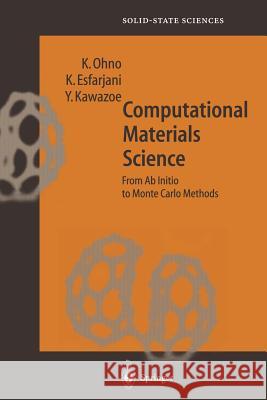
Kaoru Ohno;Keivan Esfarjani;Yoshiyuki Kawazoe
Computational Materials Science: From Ab Initio to Monte Carlo Methods Kaoru Ohno, Keivan Esfarjani, Yoshiyuki Kawazoe 9783642641558 Springer-Verlag Berlin and Heidelberg GmbH &  - książkaWidoczna okładka, to zdjęcie poglądowe, a rzeczywista szata graficzna może różnić się od prezentowanej.

Computational Materials Science: From Ab Initio to Monte Carlo Methods

ISBN-13: 9783642641558 / Angielski / Miękka / 2011 / 329 str.

Kaoru Ohno;Keivan Esfarjani;Yoshiyuki Kawazoe
cena 403,47 zł
(netto: 384,26 VAT:  5%)

Najniższa cena z 30 dni: 385,52 zł
Termin realizacji zamówienia:
ok. 22 dni roboczych
Bez gwarancji dostawy przed świętami

Darmowa dostawa!

There has been much progress in the computational approaches in the field of materials science during the past two decades. In particular, computer simula tion has become a very important tool in this field since it is a bridge between theory, which is often limited by its oversimplified models, and experiment, which is limited by the physical parameters. Computer simulation, on the other hand, can partially fulfill both of these paradigms, since it is based on theories and is in fact performing experiment but under any arbitrary, even unphysical, conditions. This progress is indebted to advances in computational physics and chem istry. Ab initio methods are being used widely and frequently in order to determine the electronic and/or atomic structures of different materials. The ultimate goal is to be able to predict various properties of a material just from its atomic coordinates, and also, in some cases, to even predict the sta ble atomic positions of a given material. However, at present, the applications of ab initio methods are severely limited with respect to the number of par ticles and the time scale of dynamical simulation. This is one extreme of the methodology based on very accurate electronic-level calculations."


Kategorie:
Nauka, Fizyka
Kategorie BISAC:
Computers > Computer Simulation
Science > Physics - Condensed Matter
Science > Fizyka matematyczna
Wydawca:
Springer-Verlag Berlin and Heidelberg GmbH &
Seria wydawnicza:
Springer Series in Solid-State Sciences
Język:
Angielski
ISBN-13:
9783642641558
Rok wydania:
2011
Dostępne języki:
Angielski
Wydanie:
Softcover Repri
Numer serii:
000022128
Ilość stron:
329
Waga:
0.52 kg
Wymiary:
23.523.5 x 15.5
Oprawa:
Miękka
Wolumenów:
01

1. Introduction.- 1.1 Computer Simulation as a Tool for Materials Science.- 1.2 Modeling of Natural Phenomena.- 2. Ab Initio Methods.- 2.1 Introduction.- 2.2 Electronic States of Many-Particle Systems.- 2.2.1 Quantum Mechanics of Identical Particles.- 2.2.2 The Hartree-Fock Approximation.- 2.2.3 Density Functional Theory.- 2.2.4 Periodic Systems.- 2.2.5 Group Theory.- 2.2.6 LCAO, OPW and Mixed-Basis Approaches.- 2.2.7 Pseudopotential Approach.- 2.2.8 APW Method.- 2.2.9 KKR, LMTO and ASW Methods.- 2.2.10 Some General Remarks.- 2.2.11 Ab Initio O(N) and Related Methods.- 2.3 Perturbation and Linear Response.- 2.3.1 Effective-Mass Tensor.- 2.3.2 Dielectric Response.- 2.3.3 Magnetic Susceptibility.- 2.3.4 Chemical Shift.- 2.3.5 Phonon Spectrum.- 2.3.6 Electrical Conductivity.- 2.4 Ab Initio Molecular Dynamics.- 2.4.1 Car-Parrinello Method.- 2.4.2 Steepest Descent and Conjugate Gradient Methods.- 2.4.3 Formulation with Plane Wave Basis.- 2.4.4 Formulation with Other Bases.- 2.5 Applications.- 2.5.1 Application to Fullerene Systems.- 2.5.2 Application to Point Defects in Crystals.- 2.5.3 Application to Other Systems.- 2.5.4 Coherent Potential Approximation.- 2.6 Beyond the Born-Oppenheimer Approximation.- 2.7 Electron Correlations Beyond the LDA.- 2.7.1 Generalized Gradient Approximation.- 2.7.2 Self-Interaction Correction.- 2.7.3 GW Approximation.- 2.7.4 Exchange and Coulomb Holes.- 2.7.5 Optimized Effective Potential Method.- 2.7.6 Time-Dependent Density Functional Theory.- 2.7.7 Inclusion of Ladder Diagrams.- 2.7.8 Further Remarks: Cusp Condition, etc.- References.- 3. Tight-Binding Methods.- 3.1 Introduction.- 3.2 Tight-Binding Formalism.- 3.2.1 Tight-Binding Parametrization.- 3.2.2 Calculation of the Matrix Elements.- 3.2.3 Total Energy.- 3.2.4 Forces.- 3.3 Methods to Solve the Schrödinger Equation for Large Systems.- 3.3.1 The Density Matrix O(N) Method.- 3.3.2 The Recursion Method.- 3.4 Self-Consistent Tight-Binding Formalism.- 3.4.1 Parametrization of the Coulomb Integral U.- 3.5 Applications to Fullerenes, Silicon and Transition-Metal Clusters.- 3.5.1 Fullerene Collisions.- 3.5.2 C240 Doughnuts and Their Vibrational Properties.- 3.5.3 IR Spectra of C60 and C60 Dimers.- 3.5.4 Simulated Annealing of Small Silicon Clusters.- 3.5.5 Titanium and Copper Clusters.- 3.6 Conclusions.- References.- 4. Empirical Methods and Coarse-Graining.- 4.1 Introduction.- 4.2 Reduction to Classical Potentials.- 4.2.1 Polar Systems.- 4.2.2 Van der Waals Potential.- 4.2.3 Potential for Covalent Bonds.- 4.2.4 Embedded-Atom Potential.- 4.3 The Connolly-Williams Approximation.- 4.3.1 Lattice Gas Model.- 4.3.2 The Connolly-Williams Approximation.- 4.4 Potential Renormalization.- 4.4.1 Basic Idea: Two-Step Renormalization Scheme.- 4.4.2 The First Step.- 4.4.3 The Second Step.- 4.4.4 Application to Si.- References.- 5. Monte Carlo Methods.- 5.1 Introduction.- 5.2 Basis of the Monte Carlo Method.- 5.2.1 Stochastic Processes.- 5.2.2 Markov Process.- 5.2.3 Ergodicity.- 5.3 Algorithms for Monte Carlo Simulation.- 5.3.1 Random Numbers.- 5.3.2 Simple Sampling Technique.- 5.3.3 Importance Sampling Technique.- 5.3.4 General Comments on Dynamic Models.- 5.4 Applications.- 5.4.1 Systems of Classical Particles.- 5.4.2 Modified Monte Carlo Techniques.- 5.4.3 Percolation.- 5.4.4 Polymer Systems.- 5.4.5 Classical Spin Systems.- 5.4.6 Nucleation.- 5.4.7 Crystal Growth.- 5.4.8 Fractal Systems.- References.- 6. Quantum Monte Carlo (QMC) Methods.- 6.1 Introduction.- 6.2 Variational Monte Carlo (VMC) Method.- 6.3 Diffusion Monte Carlo (DMC) Method.- 6.4 Path-Integral Monte Carlo (PIMC) Method.- 6.5 Quantum Spin Models.- 6.6 Other Quantum Monte Carlo Methods.- References.- A. Molecular Dynamics and Mechanical Properties.- A.l Time Evolution of Atomic Positions.- A.2 Acceleration of Force Calculations.- A.2.1 Particle-Mesh Method.- A.2.2 The Greengard-Rockhlin Method.- References.- B. Vibrational Properties.- References.- C. Calculation of the Ewald Sum.- References.- D. Optimization Methods Used in Materials Science.- D.l Conjugate-Gradient Minimization.- D.2 Broyden’s Method.- D.3 SA and GA as Global Optimization Methods.- D.3.1 Simulated Annealing (SA).- D.3.2 Genetic Algorithm (GA).- References.

This book introduces modern techniques based on computer simulation to study materials science. It starts from first principles calculations that enable the physical and chemical properties to be revealed by solving a many-body Schroedinger equation with Coulomb forces. For the exchange-correlation term, the local density approximation is usually applied. After the introduction of the first principles treatment, tight-binding and classical potential methods are briefly introduced to indicate how one can increase the number of atoms in the system. In the second half of the book, Monte Carlo simulation is discussed in detail. Readers can gain sufficient knowledge to begin theoretical studies in modern materials research.


Udostępnij

Facebook - konto krainaksiazek.pl


Opinie o Krainaksiazek.pl na Opineo.pl

Partner Mybenefit

Krainaksiazek.pl w programie rzetelna firma Krainaksiaze.pl - płatności przez paypal

Czytaj nas na:

Facebook - krainaksiazek.pl
  • książki na zamówienie
  • granty
  • książka na prezent
  • kontakt
  • pomoc
  • opinie
  • regulamin
  • polityka prywatności

Zobacz:

  • Księgarnia czeska

  • Wydawnictwo Książkowe Klimaty

1997-2025 DolnySlask.com Agencja Internetowa

© 1997-2022 krainaksiazek.pl
     
KONTAKT | REGULAMIN | POLITYKA PRYWATNOŚCI | USTAWIENIA PRYWATNOŚCI
Zobacz: Księgarnia Czeska | Wydawnictwo Książkowe Klimaty | Mapa strony | Lista autorów
KrainaKsiazek.PL - Księgarnia Internetowa

Polityka prywatnosci - link
Krainaksiazek.pl - płatnośc Przelewy24
Przechowalnia Przechowalnia





