• Wyszukiwanie zaawansowane
  • Kategorie
  • Kategorie BISAC
  • Książki na zamówienie
  • Promocje
  • Granty
  • Książka na prezent
  • Opinie
  • Pomoc
  • Załóż konto
  • Zaloguj się

Computational Linguistics and Talking Robots: Processing Content in Database Semantics » książka


zaloguj się | załóż konto
Logo Krainaksiazek.pl

koszyk

konto

szukaj
topmenu
Księgarnia internetowa
Szukaj
Książki na zamówienie
Promocje
Granty
Książka na prezent
Moje konto
Pomoc
 
 
Wyszukiwanie zaawansowane
Pusty koszyk
Bezpłatna dostawa dla zamówień powyżej 20 złBezpłatna dostawa dla zamówień powyżej 20 zł

Kategorie główne

• Nauka
 [2949524]
• Literatura piękna
 [1817948]

  więcej...
• Turystyka
 [70715]
• Informatyka
 [151291]
• Komiksy
 [35671]
• Encyklopedie
 [23176]
• Dziecięca
 [612440]
• Hobby
 [136066]
• AudioBooki
 [1740]
• Literatura faktu
 [226030]
• Muzyka CD
 [378]
• Słowniki
 [2918]
• Inne
 [445441]
• Kalendarze
 [1181]
• Podręczniki
 [166545]
• Poradniki
 [469898]
• Religia
 [508035]
• Czasopisma
 [502]
• Sport
 [61392]
• Sztuka
 [242759]
• CD, DVD, Video
 [3348]
• Technologie
 [219537]
• Zdrowie
 [98738]
• Książkowe Klimaty
 [124]
• Zabawki
 [2382]
• Puzzle, gry
 [3543]
• Literatura w języku ukraińskim
 [259]
• Art. papiernicze i szkolne
 [7107]
Kategorie szczegółowe BISAC

Computational Linguistics and Talking Robots: Processing Content in Database Semantics

ISBN-13: 9783642224317 / Angielski / Twarda / 2011 / 286 str.
Roland Hausser
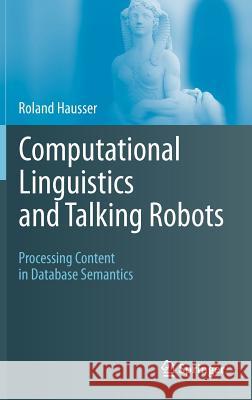
Computational Linguistics and Talking Robots: Processing Content in Database Semantics Roland Hausser 9783642224317 Springer-Verlag Berlin and Heidelberg GmbH &  - książkaWidoczna okładka, to zdjęcie poglądowe, a rzeczywista szata graficzna może różnić się od prezentowanej.

Computational Linguistics and Talking Robots: Processing Content in Database Semantics

ISBN-13: 9783642224317 / Angielski / Twarda / 2011 / 286 str.

Roland Hausser
cena 366,61
(netto: 349,15 VAT:  5%)

Najniższa cena z 30 dni: 364,33
Termin realizacji zamówienia:
ok. 10-14 dni roboczych.

Darmowa dostawa!
inne wydania

The practical task of building a talking robot requires a theory of how natural language communication works. Conversely, the best way to computationally verify a theory of natural language communication is to demonstrate its functioning concretely in the form of a talking robot, the epitome of human-machine communication. To build an actual robot requires hardware that provides appropriate recognition and action interfaces, and because such hardware is hard to develop the approach in this book is theoretical: the author presents an artificial cognitive agent with language as a software system called database semantics (DBS). Because a theoretical approach does not have to deal with the technical difficulties of hardware engineering there is no reason to simplify the system - instead the software components of DBS aim at completeness of function and of data coverage in word form recognition, syntactic-semantic interpretation and inferencing, leaving the procedural implementation of elementary concepts for later.

In this book the author first examines the universals of natural language and explains the Database Semantics approach. Then in Part I he examines the following natural language communication issues: using external surfaces; the cycle of natural language communication; memory structure; autonomous control; and learning. In Part II he analyzes the coding of content according to the aspects: semantic relations of structure; simultaneous amalgamation of content; graph-theoretical considerations; computing perspective in dialogue; and computing perspective in text. The book ends with a concluding chapter, a bibliography and an index.

The book will be of value to researchers, graduate students and engineers in the areas of artificial intelligence and robotics, in particular those who deal with natural language processing.


Kategorie:
Informatyka, Bazy danych
Kategorie BISAC:
Computers > Artificial Intelligence - General
Language Arts & Disciplines > Linguistics - General
Computers > User Interfaces
Wydawca:
Springer-Verlag Berlin and Heidelberg GmbH &
Język:
Angielski
ISBN-13:
9783642224317
Rok wydania:
2011
Dostępne języki:
Angielski
Wydanie:
2011
Ilość stron:
286
Waga:
0.62 kg
Wymiary:
23.523.5 x 15.5
Oprawa:
Twarda
Wolumenów:
01
Dodatkowe informacje:
Bibliografia

Chap. 1.- Introduction: How to Build a Talking Robot.- Part I.- Five Mysteries of Natural Language Communication.- Chap. 2.-  Mystery Number One: Using External Surfaces.-  Chap. 3.- Mystery Number Two: Cycle of Natural Language Communication.- Chap. 4.- Mystery Number Three: Memory Structure.- Chap. 5.- Mystery Number Four: Autonomous Control.- Chap. 6.- Mystery Number Five: Learning.- Part II.- The Coding of Content.- Chap. 7.- Semantic Relations of Structure.- Chap. 8.- Simultaneous Amalgamation of Content.- Chap. 9.- Graph-Theoretical Considerations.- Chap. 10.- Computing Perspective in Dialogue.- Chap. 11.- Computing Perspective in Text.- Chap. 12.- Conclusion.- Bibliography.

Prof. Dr. Hausser has been Professor for Linguistische Informatik at the University Erlangen-Nürnberg since 1989; he is also director of the Laboratory of Computational Linguistics Uni Erlangen (CLUE). Among his publications are the books "Foundations of Computational Linguistics -- Human–Computer Communication in Natural Language", 2001, ISBN 978-3-540-42417-8 and "A Computational Model of Natural Language Communication", 2006, ISBN 978-3-540-35476-5.

The practical task of building a talking robot requires a theory of how natural language communication works. Conversely, the best way to computationally verify a theory of natural language communication is to demonstrate its functioning concretely in the form of a talking robot, the epitome of human–machine communication. To build an actual robot requires hardware that provides appropriate recognition and action interfaces, and because such hardware is hard to develop the approach in this book is theoretical: the author presents an artificial cognitive agent with language as a software system called database semantics (DBS). Because a theoretical approach does not have to deal with the technical difficulties of hardware engineering there is no reason to simplify the system – instead the software components of DBS aim at completeness of function and of data coverage in word form recognition, syntactic–semantic interpretation and inferencing, leaving the procedural implementation of elementary concepts for later.

In this book the author first examines the universals of natural language and explains the Database Semantics approach. Then in Part I he examines the following natural language communication issues: using external surfaces; the cycle of natural language communication; memory structure; autonomous control; and learning. In Part II he analyzes the coding of content according to the aspects: semantic relations of structure; simultaneous amalgamation of content; graph-theoretical considerations; computing perspective in dialogue; and computing perspective in text. The book ends with a concluding chapter, a bibliography and an index.

The book will be of value to researchers, graduate students and engineers in the areas of artificial intelligence and robotics, in particular those who deal with natural language processing.




Udostępnij

Facebook - konto krainaksiazek.pl


Opinie o Krainaksiazek.pl na Opineo.pl

Partner Mybenefit

Krainaksiazek.pl w programie rzetelna firma Krainaksiaze.pl - płatności przez paypal

Czytaj nas na:

Facebook - krainaksiazek.pl
  • książki na zamówienie
  • granty
  • książka na prezent
  • kontakt
  • pomoc
  • opinie
  • regulamin
  • polityka prywatności

Zobacz:

  • Księgarnia czeska

  • Wydawnictwo Książkowe Klimaty

1997-2026 DolnySlask.com Agencja Internetowa

© 1997-2022 krainaksiazek.pl
     
KONTAKT | REGULAMIN | POLITYKA PRYWATNOŚCI | USTAWIENIA PRYWATNOŚCI
Zobacz: Księgarnia Czeska | Wydawnictwo Książkowe Klimaty | Mapa strony | Lista autorów
KrainaKsiazek.PL - Księgarnia Internetowa

Polityka prywatnosci - link
Krainaksiazek.pl - płatnośc Przelewy24
Przechowalnia Przechowalnia



