• Wyszukiwanie zaawansowane
  • Kategorie
  • Kategorie BISAC
  • Książki na zamówienie
  • Promocje
  • Granty
  • Książka na prezent
  • Opinie
  • Pomoc
  • Załóż konto
  • Zaloguj się

Complexity Theory Retrospective II » książka


zaloguj się | załóż konto
Logo Krainaksiazek.pl

koszyk

konto

szukaj
topmenu
Księgarnia internetowa
Szukaj
Książki na zamówienie
Promocje
Granty
Książka na prezent
Moje konto
Pomoc
 
 
Wyszukiwanie zaawansowane
Pusty koszyk
Bezpłatna dostawa dla zamówień powyżej 20 złBezpłatna dostawa dla zamówień powyżej 20 zł

Kategorie główne

• Nauka
 [2946600]
• Literatura piękna
 [1856966]

  więcej...
• Turystyka
 [72221]
• Informatyka
 [151456]
• Komiksy
 [35826]
• Encyklopedie
 [23190]
• Dziecięca
 [619653]
• Hobby
 [140543]
• AudioBooki
 [1577]
• Literatura faktu
 [228355]
• Muzyka CD
 [410]
• Słowniki
 [2874]
• Inne
 [445822]
• Kalendarze
 [1744]
• Podręczniki
 [167141]
• Poradniki
 [482898]
• Religia
 [510455]
• Czasopisma
 [526]
• Sport
 [61590]
• Sztuka
 [243598]
• CD, DVD, Video
 [3423]
• Technologie
 [219201]
• Zdrowie
 [101638]
• Książkowe Klimaty
 [124]
• Zabawki
 [2473]
• Puzzle, gry
 [3898]
• Literatura w języku ukraińskim
 [254]
• Art. papiernicze i szkolne
 [8170]
Kategorie szczegółowe BISAC

Complexity Theory Retrospective II

ISBN-13: 9780387949734 / Angielski / Twarda / 1997 / 339 str.
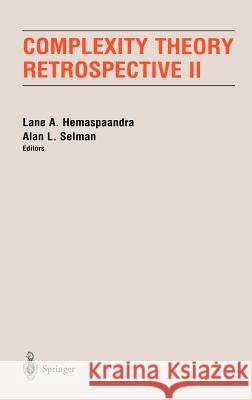
Lane A. Hemaspaandra; Alan L. Selman
Complexity Theory Retrospective II Lane A. Hemaspaandra Alan L. Selman 9780387949734 Springer - książkaWidoczna okładka, to zdjęcie poglądowe, a rzeczywista szata graficzna może różnić się od prezentowanej.

Complexity Theory Retrospective II

ISBN-13: 9780387949734 / Angielski / Twarda / 1997 / 339 str.

Lane A. Hemaspaandra; Alan L. Selman
cena 201,72 zł
(netto: 192,11 VAT:  5%)

Najniższa cena z 30 dni: 192,74 zł
Termin realizacji zamówienia:
ok. 22 dni roboczych
Bez gwarancji dostawy przed świętami

Darmowa dostawa!

Readers of Complexity Theory Retrospective (published by Springer-Verlag in 1990) will remember that the collection consisted primarily of articles that first ap- peared in preliminary form at one of the meetings of the Annual IEEE Conference on Structure in Complexity Theory. In particular, Complexity Theory Retrospective contained final versions of high-quality technical expository presentations, includ- ing talks that honored Juris Hartmanis on the occasion of his sixtieth birthday. We began planning for the current collection some months before the scheduled meeting in 1994 of the Tenth Annual IEEE Conference on Structure in Complexity Theory. As with the original volume, several of the papers in this book originated as presentations at one of the meetings of the Structure in Complexity Theory con- ference. We are pleased to provide this forum for final, polished versions of these papers. As it turns out, 1994 was a watershed year for the Structures conference, for at this meeting the conference attendees voted to change the conference name to its current name, the Annual IEEE Conference on Computational Complex- ity. In voting to remove the expression "Structure in," the conferees recognized the recent explosion of techniques and results in computational complexity, and expressed concern that the original conference name might not accurately reflect the current status. We approached this volume in the same spirit.


Kategorie:
Informatyka, Bazy danych
Kategorie BISAC:
Computers > Computer Science
Computers > Programming - Algorithms
Wydawca:
Springer
Język:
Angielski
ISBN-13:
9780387949734
Rok wydania:
1997
Wydanie:
1997
Ilość stron:
339
Waga:
1.49 kg
Wymiary:
23.5 x 15.5
Oprawa:
Twarda
Wolumenów:
01
Dodatkowe informacje:
Bibliografia
Wydanie ilustrowane

1 Time, Hardware, and Uniformity.- 1 Introduction.- 2 Background: Descriptive Complexity.- 3 First Uniformity Theorem.- 4 Variables That Are Longer Than log nBits.- 5 Uniformity: The Third Dimension.- 6 Variables That Are Shorter Than log nBits.- 7 Conclusions.- 2 Quantum Computation.- 1 The Need for Quantum Mechanics.- 2 Basic Principles of Quantum Mechanics.- 2.1 Probability Amplitudes.- 2.2 Qubits and How to Observe Them.- 2.3 Digression on Quantum Cryptography.- 2.4 Evolution of a Quantum System.- 2.5 Quantum Registers.- 3 Computing with Quantum Registers.- 4 Separating Two Classes of Functions.- 5 Shor’s Factoring Algorithm.- 6 Building a Quantum Computer.- 3 Sparse Sets versus Complexity Classes.- 1 Introduction.- 2 Earlier Results for Turing Reductions.- 2.1 Sparse Sets and Polynomial Size Circuits.- 2.2 The Karp-Lipton Theorem.- 2.3 Long’s Extension.- 3 Earlier Results for Many-One Reductions.- 3.1 The Isomorphism Conjecture for NP.- 3.2 Mahaney’s Theorem.- 4 Bounded Truth Table Reduction of NP.- 4.1 Extensions.- 5 The Hartmanis Conjecture for P.- 5.1 Ogihara’s Language and Randomized NC2.- 5.2 Deterministic Construction.- 5.3 The Finale: NC1 Simulation.- 6 Conclusions.- 4 Counting Complexity.- 1 Introduction.- 2 Preliminaries.- 3 Counting Functions.- 3.1 Algebraic Properties of Counting Functions.- 3.2 A Randomized sign Function.- 3.3 Counting Functions and the Polynomial-Time Hierarchy.- 4 Counting Classes.- 4.1 Classifying Counting Classes.- 4.2 Counting Operators.- 4.3 The Polynomial-Time Hierarchy.- 4.4 Closure Properties of PP.- 5 Relativization.- 6 Other Work.- 6.1 Circuits.- 6.2 Lowness.- 6.3 Characterizing Specific Problems.- 6.4 Interactive Proof Systems.- 6.5 Counting in Space Classes.- 6.6 Other Research.- 5 A Taxonomy of Proof Systems.- 1 Introduction.- 2 A Technical Exposition.- 2.1 Interactive Proof Systems.- 2.2 MIP and PCP.- 2.3 Computationally Sound Proof Systems.- 2.4 Other Types of Proof Systems.- 2.5 Comparison.- 3 The Story.- 3.1 The Evolution of Proof Systems.- 3.2 PCP and Approximation.- 3.3 Interactive Proofs and Program Checking.- 3.4 Zero-Knowledge Proofs.- 6 Structural Properties of Complete Problems for Exponential Time.- 1 Introduction.- 2 Strong Reductions to Complete Sets.- 3 Immunity for Complete Problems.- 4 Differences between Complete Sets.- 5 Other Properties and Open Problems.- 5.1 Properties of “Weak” Complete Sets.- 5.2 Polynomial-Time Complete Recursively Enumerable Sets.- 5.3 A Short List of Open Problems.- 7 The Complexity of Obtaining Solutions for Problems in NP and NL.- 1 Introduction.- 2 Computing Optimal Solutions: The Class FPNP.- 3 Bounded Queries to NP.- 4 Computing Solutions Uniquely: The Class NPSV.- 5 Nonadaptive Queries to NP: The Class FPNPtt.- 6 A Look inside Nondeterministic Logspace.- 7 Conclusions.- 8 Biological Computing.- 1 Introduction.- 2 The One-Molecule Processor.- 3 A Brief Introduction to Biochemistry.- 3.1 DNA, RNA, and Proteins.- 3.2 Protein Synthesis.- 4 Computational Molecules.- 4.1 CNA.- 4.2 tCNA.- 4.3 The Synthesis of tCNA.- 5 The Microarchitecture of CNA Computers.- 6 A Brief Discussion of Adleman’s Model Versus Our Model.- 7 Conclusions.- 9 Computing with Sublogarithmic Space.- 1 Are Sublogarithmic Space Classes of Any Interest?.- 2 The Alternating Sublogarithmic Space World.- 3 Adding Randomness.- 4 Special Limitations of Machines with a Sublogarithmic Space Bound.- 4.1 Technical Preliminaries.- 4.2 Inputs with a Periodic Structure.- 4.3 Fooling ATMs.- 5 A Survey of Lower Space Bound Proofs.- 5.1 Languages for Separating the Levels of the Alternation Hierarchy.- 5.2 ATMs with a Constant Number of Alternations.- 5.3 Unbounded Alternation.- 5.4 Closure Properties.- 5.5 Lower Bounds for Context-Free Languages.- 6 Conclusions and Open Problems.- 10 The Quantitative Structure of Exponential Time.- 1 Introduction.- 2 Preliminaries.- 3 Resource-Bounded Measure.- 4 Incompressibility and Bi-Immunity.- 5 Complexity Cores.- 6 Small Span Theorems.- 7 Weakly Hard Problems.- 8 Upper Bounds for Hard Problems.- 9 Nonuniform Complexity, Natural Proofs, and Pseudorandom Generators.- 10 Weak Stochasticity.- 11 Density of Hard Languages.- 12 Strong Hypotheses.- 13 Conclusions and Open Directions.- 11 Polynomials and Combinatorial Definitions of Languages.- 1 Introduction.- 2 Polynomials.- 3 Representation Schemes and Language Classes.- 4 Strong versus Weak Representation.- 5 Known Upper and Lower Bounds on Degree.- 6 Polynomials for Closure Properties.- 7 Probabilistic Polynomials.- 8 Other Combinatorial Structures.- 12 Average-Case Computational Complexity Theory.- 1 Introduction.- 2 Average Polynomial Time.- 3 Average-Case Completeness.- 3.1 Polynomial-Time Reductions.- 3.2 Polynomial-Time Computable Distributions.- 3.3 Uniform Distributions.- 3.4 Distribution Controlling Lemma.- 3.5 Distributional NP-Completeness.- 3.6 Average Polynomial-Time Reductions.- 3.7 Distributional Search Problems.- 4 Randomization.- 4.1 Flat Distributions and Incompleteness.- 4.2 Randomized Average Polynomial Time.- 4.3 Randomizing Reductions and Completeness.- 4.4 Polynomial-Time Sampling.- 4.5 Randomized Turing Reductions.- 5 Hierarchies of Average-Case Complexity.- 5.1 Average-Time Hierarchies.- 5.2 Fast Convergence of Average Time.- 5.3 Averaging on Ranking of Distributions.- 6 A Brief Survey of Other Results.


Udostępnij

Facebook - konto krainaksiazek.pl


Opinie o Krainaksiazek.pl na Opineo.pl

Partner Mybenefit

Krainaksiazek.pl w programie rzetelna firma Krainaksiaze.pl - płatności przez paypal

Czytaj nas na:

Facebook - krainaksiazek.pl
  • książki na zamówienie
  • granty
  • książka na prezent
  • kontakt
  • pomoc
  • opinie
  • regulamin
  • polityka prywatności

Zobacz:

  • Księgarnia czeska

  • Wydawnictwo Książkowe Klimaty

1997-2025 DolnySlask.com Agencja Internetowa

© 1997-2022 krainaksiazek.pl
     
KONTAKT | REGULAMIN | POLITYKA PRYWATNOŚCI | USTAWIENIA PRYWATNOŚCI
Zobacz: Księgarnia Czeska | Wydawnictwo Książkowe Klimaty | Mapa strony | Lista autorów
KrainaKsiazek.PL - Księgarnia Internetowa

Polityka prywatnosci - link
Krainaksiazek.pl - płatnośc Przelewy24
Przechowalnia Przechowalnia





