• Wyszukiwanie zaawansowane
  • Kategorie
  • Kategorie BISAC
  • Książki na zamówienie
  • Promocje
  • Granty
  • Książka na prezent
  • Opinie
  • Pomoc
  • Załóż konto
  • Zaloguj się

Comparing Transitions to Democracy. Law and Justice in South America and Europe » książka


zaloguj się | załóż konto
Logo Krainaksiazek.pl

koszyk

konto

szukaj
topmenu
Księgarnia internetowa
Szukaj
Książki na zamówienie
Promocje
Granty
Książka na prezent
Moje konto
Pomoc
 
 
Wyszukiwanie zaawansowane
Pusty koszyk
Bezpłatna dostawa dla zamówień powyżej 20 złBezpłatna dostawa dla zamówień powyżej 20 zł

Kategorie główne

• Nauka
 [2946912]
• Literatura piękna
 [1852311]

  więcej...
• Turystyka
 [71421]
• Informatyka
 [150889]
• Komiksy
 [35717]
• Encyklopedie
 [23177]
• Dziecięca
 [617324]
• Hobby
 [138808]
• AudioBooki
 [1671]
• Literatura faktu
 [228371]
• Muzyka CD
 [400]
• Słowniki
 [2841]
• Inne
 [445428]
• Kalendarze
 [1545]
• Podręczniki
 [166819]
• Poradniki
 [480180]
• Religia
 [510412]
• Czasopisma
 [525]
• Sport
 [61271]
• Sztuka
 [242929]
• CD, DVD, Video
 [3371]
• Technologie
 [219258]
• Zdrowie
 [100961]
• Książkowe Klimaty
 [124]
• Zabawki
 [2341]
• Puzzle, gry
 [3766]
• Literatura w języku ukraińskim
 [255]
• Art. papiernicze i szkolne
 [7810]
Kategorie szczegółowe BISAC

Comparing Transitions to Democracy. Law and Justice in South America and Europe

ISBN-13: 9783030675042 / Angielski / Miękka / 2022
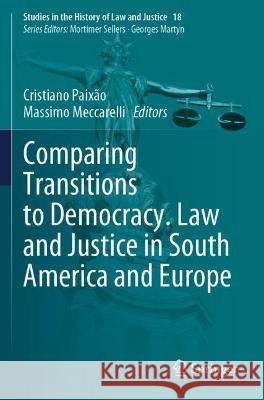
Comparing Transitions to Democracy. Law and Justice in South America and Europe  9783030675042 Springer International Publishing - książkaWidoczna okładka, to zdjęcie poglądowe, a rzeczywista szata graficzna może różnić się od prezentowanej.

Comparing Transitions to Democracy. Law and Justice in South America and Europe

ISBN-13: 9783030675042 / Angielski / Miękka / 2022

cena 645,58
(netto: 614,84 VAT:  5%)

Najniższa cena z 30 dni: 616,85
Termin realizacji zamówienia:
ok. 22 dni roboczych
Bez gwarancji dostawy przed świętami

Darmowa dostawa!

This present book examines some of the key features of the interplay between legal history, authoritarian rule and political transitions in Brazil and other countries from the end of 20th Century until today. This book casts light on these aspects of the role of law and legal actors/institutions. In the context of transition from authoritarian rule to democratic state, Brazil has produced a significant literature on the challenges and shortcomings of the transition, but little attention has been given to the role of law and legal actors/institutions. Different approaches focus on the legal mechanisms, discourses and practices used by the military regime and by the players involved in the political transition process in Brazil. A comparative perspective that takes into account different political transitions – and their legal consequences – in Europe and Latin America complements the analysis. Part 1 (4 essays) discusses some of the central issues of political transition and legal history in contemporary Brazil, focusing on the time of the transition (and its effects on transitional justice) with different perspectives, from racial and gender issues to constitutional reform and police repression. Part 2 (3 essays) brings the comparative studies on South American experiences. Part 3 (4 essays) analyses different cases of transition to democracy in Chile, Portugal, Spain and Italy. Part 4 (3 essays) proposes a historiographical and methodological approach, considering the politics of time involved in the interplay between political transitions and legal history.


Kategorie:
Nauka, Prawo i administracja
Kategorie BISAC:
Law > Reference
Law > Legal History
Law > International
Wydawca:
Springer International Publishing
Seria wydawnicza:
Studies in the History of Law and Justice
Język:
Angielski
ISBN-13:
9783030675042
Rok wydania:
2022
Waga:
0.51 kg
Wymiary:
23.5 x 15.5
Oprawa:
Miękka
Dodatkowe informacje:
Wydanie ilustrowane

Part 1: Brazil.- Chapter 1 Constitutional History and Transitional Justice in Contemporary Brazil: Towards a Politics of Time; Cristiano Paixão.- Chapter 2 Constitutional Politics during the Brazilian Civil-military Dictatorship and the Transition: the Constitution as a Tool for Political Reform; Leonardo Barbosa.- Chapter 3 Social Conflict and the Brazilian Transacted Transition: the Criminal Case n. 453/8; Maria Pia Guerra.- Chapter 4 Transitional Justice and Violation of the Indian Rights during the Brazilian Dictatorship (1964-1985); Juliana Neuenschwander Magalhães.- Part 2: Comparative Perspectives.- Chapter 5 Claudia Paiva Carvalho.- Chapter 6 Domestic Rule of Law Gaps and the Uses of International Human Rights in Post-Atrocity Prosecutions: Argentina, Brazil, and Chile Transitional Justice Experiences; Marcelo Torelly.- Chapter 7 Accountability for Operation Condor Atrocities: the Enduring Search for Truth and Justice in the Southern Cone and Brazil; Francesca Lessa.- Part 3: Comparative Case Studies.- Chapter 8 Lawyers and Transition in Chile; Cath Collins.- Chapter 9 The Protagonism of Judicial System in the Argentinian Transition; Valeria Barbuto.- Chapter 10 Truth and Justice or Legal Oblivion? Transitional Justice and Remembrance of Francoism in Spain; Alfons Aragoneses.- Chapter 11 The Failed Reconciliation. The "Togliatti Amnesty" and the role of the Judiciary in the Post-fascist Italy; Antonella Meniconi.- Chapter 12 Revolutionary and Democratic Legitimacy during Portugal's Transitional Justice Process; António Costa Pinto, Filipa Raimundo.- Part 4: Transitional Time: Theoretical Approaches.- Chapter 13 A verdade é filha do tempo" and "O costume é como que uma outra natureza". The Creative Nature of the Legal Tradition; Antonio Manuel Hespanha.- Chapter 14 Ascriptive Times in the Legal Experience: Transition, Crisis, Emergenc; Massimo Meccarelli.- Chapter 15 Action Times and Time Actions: Between Justice and History; José Otávio Guimarães.

Cristiano Paixão in Professor of legal history at the University of Brasília Law School. Doctor in Law degree from Federal University of Minas Gerais, with post-doctoral studies in historiography at Ecole des Hautes Etudes en Sciences Sociales de Paris and in modern history at Scuola Normale Superiore di Pisa. He was a visiting professor at Macerata University School of Law and at the Master’s Program in Constitutional Law at Seville University, and has published extensively about constitutional history. He was a member of the Brazilian Amnesty Committee (Ministry of Justice), was one of the coordinators of the Anísio Teixeira Memory and Truth Commission (University of Brasília). His main research interests are constitutional history, law and literature, and interdisciplinary studies in law.

Massimo Meccarelli is Professor of Legal History at the University of Macerata (Italy), and affiliate researcher of the Max Planck Institute for European Legal History (Frankfurt am Main). He was visiting professor at: Universidad Autónoma de Madrid, Johann Wolfgang Goethe-Universität in Frankfurt am Main, Universität Wien, Universität Luzern. He is author of several works on history of legal thought, history of justice, historiography and methodology of legal history. Most recently research interests: law and diversity, legal pluralism, constitution making process, time and law, law and humanities.

This present book examines some of the key features of the interplay between legal history, authoritarian rule and political transitions in Brazil and other countries from the end of 20th Century until today. This book casts light on these aspects of the role of law and legal actors/institutions. In the context of transition from authoritarian rule to democratic state, Brazil has produced a significant literature on the challenges and shortcomings of the transition, but little attention has been given to the role of law and legal actors/institutions. Different approaches focus on the legal mechanisms, discourses and practices used by the military regime and by the players involved in the political transition process in Brazil. A comparative perspective that takes into account different political transitions – and their legal consequences – in Europe and Latin America complements the analysis.

Part 1 (4 essays) discusses some of the central issues of political transition and legal history in contemporary Brazil, focusing on the time of the transition (and its effects on transitional justice) with different perspectives, from racial and gender issues to constitutional reform and police repression. Part 2 (3 essays) brings the comparative studies on South American experiences. Part 3 (4 essays) analyses different cases of transition to democracy in Chile, Portugal, Spain and Italy. Part 4 (3 essays) proposes a historiographical and methodological approach, considering the politics of time involved in the interplay between political transitions and legal history.




Udostępnij

Facebook - konto krainaksiazek.pl


Opinie o Krainaksiazek.pl na Opineo.pl

Partner Mybenefit

Krainaksiazek.pl w programie rzetelna firma Krainaksiaze.pl - płatności przez paypal

Czytaj nas na:

Facebook - krainaksiazek.pl
  • książki na zamówienie
  • granty
  • książka na prezent
  • kontakt
  • pomoc
  • opinie
  • regulamin
  • polityka prywatności

Zobacz:

  • Księgarnia czeska

  • Wydawnictwo Książkowe Klimaty

1997-2025 DolnySlask.com Agencja Internetowa

© 1997-2022 krainaksiazek.pl
     
KONTAKT | REGULAMIN | POLITYKA PRYWATNOŚCI | USTAWIENIA PRYWATNOŚCI
Zobacz: Księgarnia Czeska | Wydawnictwo Książkowe Klimaty | Mapa strony | Lista autorów
KrainaKsiazek.PL - Księgarnia Internetowa

Polityka prywatnosci - link
Krainaksiazek.pl - płatnośc Przelewy24
Przechowalnia Przechowalnia




