• Wyszukiwanie zaawansowane
  • Kategorie
  • Kategorie BISAC
  • Książki na zamówienie
  • Promocje
  • Granty
  • Książka na prezent
  • Opinie
  • Pomoc
  • Załóż konto
  • Zaloguj się

Command and Control: The Sociotechnical Perspective » książka


zaloguj się | załóż konto
Logo Krainaksiazek.pl

koszyk

konto

szukaj
topmenu
Księgarnia internetowa
Szukaj
Książki na zamówienie
Promocje
Granty
Książka na prezent
Moje konto
Pomoc
 
 
Wyszukiwanie zaawansowane
Pusty koszyk
Bezpłatna dostawa dla zamówień powyżej 20 złBezpłatna dostawa dla zamówień powyżej 20 zł

Kategorie główne

• Nauka
 [2949965]
• Literatura piękna
 [1857847]

  więcej...
• Turystyka
 [70818]
• Informatyka
 [151303]
• Komiksy
 [35733]
• Encyklopedie
 [23180]
• Dziecięca
 [617748]
• Hobby
 [139972]
• AudioBooki
 [1650]
• Literatura faktu
 [228361]
• Muzyka CD
 [398]
• Słowniki
 [2862]
• Inne
 [444732]
• Kalendarze
 [1620]
• Podręczniki
 [167233]
• Poradniki
 [482388]
• Religia
 [509867]
• Czasopisma
 [533]
• Sport
 [61361]
• Sztuka
 [243125]
• CD, DVD, Video
 [3451]
• Technologie
 [219309]
• Zdrowie
 [101347]
• Książkowe Klimaty
 [123]
• Zabawki
 [2362]
• Puzzle, gry
 [3791]
• Literatura w języku ukraińskim
 [253]
• Art. papiernicze i szkolne
 [7933]
Kategorie szczegółowe BISAC

Command and Control: The Sociotechnical Perspective

ISBN-13: 9781138076860 / Angielski / Miękka / 2017 / 216 str.
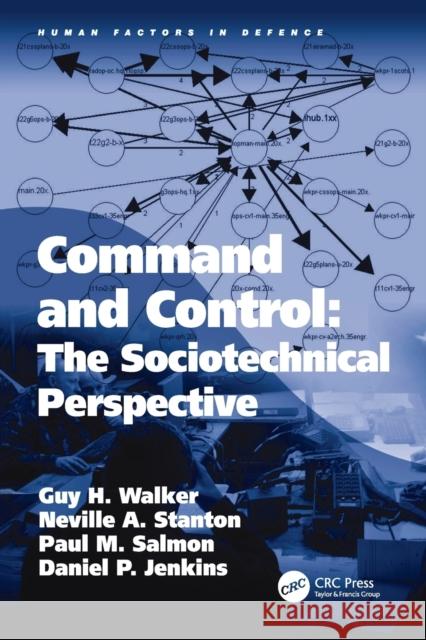
Guy H Walker;Neville A. Stanton;Daniel P. Jenkins
Command and Control: The Sociotechnical Perspective Guy H Walker, Neville A. Stanton, Daniel P. Jenkins 9781138076860 Taylor and Francis - książkaWidoczna okładka, to zdjęcie poglądowe, a rzeczywista szata graficzna może różnić się od prezentowanej.

Command and Control: The Sociotechnical Perspective

ISBN-13: 9781138076860 / Angielski / Miękka / 2017 / 216 str.

Guy H Walker;Neville A. Stanton;Daniel P. Jenkins
cena 282,86 zł
(netto: 269,39 VAT:  5%)

Najniższa cena z 30 dni: 266,93 zł
Termin realizacji zamówienia:
ok. 22 dni roboczych
Bez gwarancji dostawy przed świętami

Darmowa dostawa!
inne wydania

Military command and control is not merely evolving, it is co-evolving. Technology is creating new opportunities for different types of command and control, and new types of command and control are creating new aspirations for technology. The question is how to manage this process, how to achieve a jointly optimised blend of socio and technical and create the kind of agility and self-synchronisation that modern forms of command and control promise. The answer put forward in this book is to re-visit sociotechnical systems theory. In doing so, the problems of 21st century command and control can be approached from an alternative, multi-disciplinary and above all human-centred perspective. Human factors (HF) is also co-evolving. The traditional conception of the field is to serve as a conduit for knowledge between engineering and psychology yet 21st century command and control presents an altogether different challenge. Viewing military command and control through the lens of sociotechnical theory forces us to confront difficult questions about the non-linear nature of people and technology: technology is changing, from platform centric to network centric; the interaction with that technology is changing, from prescribed to exploratory; and complexity is increasing, from behaviour that is linear to that which is emergent. The various chapters look at this transition and draw out ways in which sociotechnical systems theory can help to understand it. The sociotechnical perspective reveals itself as part of a conceptual toolkit through which military command and control can be transitioned, from notions of bureaucratic, hierarchical ways of operating to the devolved, agile, self-synchronising behaviour promised by modern forms of command and control like Network Enabled Capability (NEC). Sociotechnical system theory brings with it a sixty year legacy of practical application and this real-world grounding in business process re-engineering underlies the entire book. An attempt has been made to bring a set of sometimes abstract (but no less useful) principles down to the level of easy examples, design principles, evaluation criteria and actionable models. All of these are based on an extensive review of the current state of the art, new sociotechnical/NEC studies conducted by the authors, and insights derived from field studies of real-life command and control. Time and again, what emerges is a realisation that the most agile, self-synchronising component of all in command and control settings is the human.


Kategorie:
Technologie
Kategorie BISAC:
Technology & Engineering > Industrial Health & Safety
Political Science > Security (National & International)
Technology & Engineering > Industrial Engineering
Wydawca:
Taylor and Francis
Seria wydawnicza:
Human Factors in Defence
Język:
Angielski
ISBN-13:
9781138076860
Rok wydania:
2017
Ilość stron:
216
Oprawa:
Miękka
Wolumenów:
01
Dodatkowe informacje:
Bibliografia

'Walker, Stanton, Salmon and Jenkins have written a highly relevant book that describes what information technology can offer to command and control, acknowledging the importance of keeping the decision maker in charge. The sociotechnical perspective is broadened to reflect the challenges of complex environments, and the requirements for human factors integration. In short, the book presents a comprehensive framework.' Gary Klein, Applied Research Associates, USA 'This book aims to apply socio-technical theory to the design and practice of Network Enabled Capability. It succeeds and in so doing contributes substantially to our understanding of both domains. Especially interesting are the authors' propositions on the design and use of military equipment, and the presentation of some new guiding sociotechnical principles for design. The authors argue persuasively for the need to put humans at the centre of complex networked systems - Amen to that!' Chris W. Clegg, Leeds University Business School, UK 'In writing this book, the authors set themselves the ambitious goal of using HFI research to identify linkages between the various disciplines involved in NCW, then using those linkages to build conceptual bridges that ’reach out across various interdisciplinary boundaries’. This interdisciplinary approach, focused on understanding how the human operates in the NCW environment, offers a unique and valuable insight into modern command and control arrangements. The book’s extensive and thorough review of literature relating to organisational design will see many readers drawn out of their conceptual comfort-zone to alternative views that will nonetheless enhance their understanding of command and control in the informationage. Although some readers may at times find the data analysis impenetrable, the unique insights that this analysis provides makes the additional effort worthwhile. This book is a ’must read’ for all involved or interested in the develop

Contents: Introduction; Reconsidering the network in NEC; Some effects of certain communications patterns on group performance; Complexity and human factors; Dimensions of live-NEC; The human in complex dynamic systems; Beyond NEC; The design of everyday networked interoperable things; Conclusions; References; Bibliography; Index.

Guy H Walker read for a BSc Honours degree in Psychology at Southampton University specialising in engineering psychology, statistics and psychophysics. During his undergraduate studies he also undertook work in auditory perception laboratories at Essex University and the Applied Psychology Unit at Cambridge University. After graduating in 1999 he moved to Brunel University, gaining a PhD in Human Factors in 2002. His research focused on driver performance, situational awareness and the role of feedback in vehicles. Since this time Guy has worked for a human factors consultancy on a project funded by the Rail Safety and Standards Board, examining driver behaviour in relation to warning systems and alarms fitted in train cabs. Currently Guy is a Senior Research Fellow within the HFI DTC at the University of Southampton, engaged primarily in work on future C4i systems. He is also author of numerous journal articles and book contributions. Professor Stanton holds a Chair in Human Factors in the School of Civil Engineering and the Environment at the University of Southampton. He has published over 140 peer-reviewed journal papers and 14 books on Human Factors and Ergonomics. In 1998 he was awarded the Institution of Electrical Engineers Divisional Premium Award for a co-authored paper on Engineering Psychology and System Safety. The Ergonomics Society awarded him the Otto Edholm medal in 2001 and The President's Medal in 2008 for his contribution to basic and applied ergonomics research. In 2007 The Royal Aeronautical Society awarded him the Hodgson Medal and Bronze Award with colleagues for their work on flight deck safety. Professor Stanton is an editor of the journal Ergonomics and on the editorial boards of Theoretical Issues in Ergonomics Science and the International Journal of Human Computer Interaction. Professor Stanton is a Fellow and Chartered Occupational Psychologist registered with The British Psychological Society, and a Fellow of The Ergonomics Society. He has a BSc (Hons) in Occupational Psychology from the University of Hull, an MPhil in Applied Psychology and a PhD in Human Factors from Aston University in Birmingham. Paul Salmon is a Senior Research Fellow in the Human Factors Group at Monash University and holds a BSc in Sports Science and an MSc in Applied Ergonomics, (both from the University of Sunderland). Paul has over six years experience in applied human factors research in a number of domains, including the military, civil and general aviation, rail and road transport and has previously worked on a variety of research projects in these areas. This has led to Paul gaining expertise in a broad range of areas, including human error, situation awareness, and the application of human factors methods, including human error identification, situation awareness measurement, teamwork assessment, task analysis and cognitive task analysis methods. Paul's current research interests include the areas of situation awareness in command and control, human error and the application of human factors methods in sport. Paul has authored and co-authored various scientific journal articles, conference articles, book chapters and books and was recently awarded the Royal Aeronautical Society Hodgson Prize for a co-authored paper in the society's Aeronautical journal. Dan Jenkins graduated in 2004, from Brunel University, with an M.Eng (Hons) in Mechanical Engineering and Design, receiving the 'University Prize' for the highest academic achievement in the school. As a sponsored student, Dan finished University with over two years experience as a Design Engineer in the Automotive Industry. Upon graduation, Dan went to work in Japan for a major car manufacturer, facilitating the necessary design changes to launch a new model in Europe. In 2005, Dan returned to Brunel University taking up the full-time role of Research Fellow in the Ergonomics Research Group, working primarily on the Human Factors Integration Defence Technology Centre (HFI-DTC) project. Dan studied part-time on his PhD in human factors and interaction design - graduating in 2008, receiving the 'Hamilton Prize' for the Best Viva in the School of Engineering and Design. In March 2009, Dan founded Sociotechnic Solutions Limited, a company specialising in the design and optimisation of complex sociotechnical systems. Dan has authored and co-authored numerous journal paper, conference articles, book chapters and books. Dan and his colleagues on the HFI DTC project were awarded the Ergonomics Society's President's Medal in 2008.


Udostępnij

Facebook - konto krainaksiazek.pl


Opinie o Krainaksiazek.pl na Opineo.pl

Partner Mybenefit

Krainaksiazek.pl w programie rzetelna firma Krainaksiaze.pl - płatności przez paypal

Czytaj nas na:

Facebook - krainaksiazek.pl
  • książki na zamówienie
  • granty
  • książka na prezent
  • kontakt
  • pomoc
  • opinie
  • regulamin
  • polityka prywatności

Zobacz:

  • Księgarnia czeska

  • Wydawnictwo Książkowe Klimaty

1997-2025 DolnySlask.com Agencja Internetowa

© 1997-2022 krainaksiazek.pl
     
KONTAKT | REGULAMIN | POLITYKA PRYWATNOŚCI | USTAWIENIA PRYWATNOŚCI
Zobacz: Księgarnia Czeska | Wydawnictwo Książkowe Klimaty | Mapa strony | Lista autorów
KrainaKsiazek.PL - Księgarnia Internetowa

Polityka prywatnosci - link
Krainaksiazek.pl - płatnośc Przelewy24
Przechowalnia Przechowalnia





