• Wyszukiwanie zaawansowane
  • Kategorie
  • Kategorie BISAC
  • Książki na zamówienie
  • Promocje
  • Granty
  • Książka na prezent
  • Opinie
  • Pomoc
  • Załóż konto
  • Zaloguj się

Combinatorial Methods in Density Estimation » książka


zaloguj się | załóż konto
Logo Krainaksiazek.pl

koszyk

konto

szukaj
topmenu
Księgarnia internetowa
Szukaj
Książki na zamówienie
Promocje
Granty
Książka na prezent
Moje konto
Pomoc
 
 
Wyszukiwanie zaawansowane
Pusty koszyk
Bezpłatna dostawa dla zamówień powyżej 20 złBezpłatna dostawa dla zamówień powyżej 20 zł

Kategorie główne

• Nauka
 [2946600]
• Literatura piękna
 [1856966]

  więcej...
• Turystyka
 [72221]
• Informatyka
 [151456]
• Komiksy
 [35826]
• Encyklopedie
 [23190]
• Dziecięca
 [619653]
• Hobby
 [140543]
• AudioBooki
 [1577]
• Literatura faktu
 [228355]
• Muzyka CD
 [410]
• Słowniki
 [2874]
• Inne
 [445822]
• Kalendarze
 [1744]
• Podręczniki
 [167141]
• Poradniki
 [482898]
• Religia
 [510455]
• Czasopisma
 [526]
• Sport
 [61590]
• Sztuka
 [243598]
• CD, DVD, Video
 [3423]
• Technologie
 [219201]
• Zdrowie
 [101638]
• Książkowe Klimaty
 [124]
• Zabawki
 [2473]
• Puzzle, gry
 [3898]
• Literatura w języku ukraińskim
 [254]
• Art. papiernicze i szkolne
 [8170]
Kategorie szczegółowe BISAC

Combinatorial Methods in Density Estimation

ISBN-13: 9780387951171 / Angielski / Twarda / 2001 / 209 str.
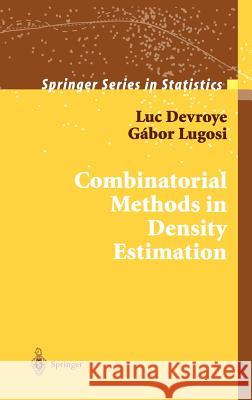
Luc Devroye; Gabor Lugosi; Gabor Lugosi
Combinatorial Methods in Density Estimation Luc Devroye Gabor Lugosi Gabor Lugosi 9780387951171 Springer - książkaWidoczna okładka, to zdjęcie poglądowe, a rzeczywista szata graficzna może różnić się od prezentowanej.

Combinatorial Methods in Density Estimation

ISBN-13: 9780387951171 / Angielski / Twarda / 2001 / 209 str.

Luc Devroye; Gabor Lugosi; Gabor Lugosi
cena 564,88 zł
(netto: 537,98 VAT:  5%)

Najniższa cena z 30 dni: 539,74 zł
Termin realizacji zamówienia:
ok. 22 dni roboczych
Bez gwarancji dostawy przed świętami

Darmowa dostawa!

Density estimation has evolved enormously since the days of bar plots and histograms, but researchers and users are still struggling with the problem of the selection of the bin widths. This text explores a new paradigm for the data-based or automatic selection of the free parameters of density estimates in general so that the expected error is within a given constant multiple of the best possible error. The paradigm can be used in nearly all density estimates and for most model selection problems, both parametric and nonparametric. It is the first book on this topic. The text is intended for first-year graduate students in statistics and learning theory, and offers a host of opportunities for further research and thesis topics. Each chapter corresponds roughly to one lecture, and is supplemented with many classroom exercises. A one year course in probability theory at the level of Feller's Volume 1 should be more than adequate preparation. Gabor Lugosi is Professor at Universitat Pompeu Fabra in Barcelona, and Luc Debroye is Professor at McGill University in Montreal. In 1996, the authors, together with Laszlo Gyorfi, published the successful text, A Probabilistic Theory of Pattern Recognition with Springer-Verlag. Both authors have made many contributions in the area of nonparametric estimation."


Kategorie:
Nauka, Matematyka
Kategorie BISAC:
Mathematics > Kombinatoryka i teorii grafów
Mathematics > Grupy i teoria grup
Mathematics > Prawdopodobieństwo i statystyka
Wydawca:
Springer
Seria wydawnicza:
Springer Series in Statistics
Język:
Angielski
ISBN-13:
9780387951171
Rok wydania:
2001
Wydanie:
2001
Numer serii:
000022130
Ilość stron:
209
Waga:
1.09 kg
Wymiary:
23.5 x 15.5
Oprawa:
Twarda
Wolumenów:
01
Dodatkowe informacje:
Bibliografia

From the reviews of the first edition:

"This book is built around a new look on the important problem of bandwidth selection in density estimation. This new method has been launched in two recent papers of the two authors in the Annals of Statistics. It is based on ideas of minimum distance methods and convergence theory for empirical measures, uniformly over certain classes. The methods aim at finding estimators with universal properties that is valid for all (or nearly all) densities. The book is self-contained because a lot of fundamental inequalities and essential combinatorial techniques are collected in the first part of the book. There is a rich choice of exercises, some of which may be quite hard. This makes it interesting for classroom teaching. It is an attractive book that certainly provides inspiration for further research."
Short Book Reviews, Vol. 21, No. 2, August 2001

"The book deals with probability density estimation from an i.i.d. sample, but the approach is different from those used in other texts on this topic. ... It is the aim of the book to study universal performance properties of these estimates. ... it is well written following the same idea throughout and contains many exercises which complete the different topics. ... I enjoyed reading this nicely written book which can certainly be recommended to all mathematically orientated statisticians interested in the subject." (Ulrich Stadtmüller, Mathematical Reviews, Issue 2002 h)

"This carefully written monograph focuses on nonparametric estimation of a density from i.i.d. data, with the goodness-of-fit being measured in terms of the L1-norm. ... The book is recommended to those who want to get an overview of the state of the art of this approach." (W. Stute, Zentralblatt MATH, Vol. 964, 2001)

1. Introduction.- §1.1. References.- 2. Concentration Inequalities.- §2.1. Hoeffding’s Inequality.- §2.2. An Inequality for the Expected Maximal Deviation.- §2.3. The Bounded Difference Inequality.- §2.4. Examples.- §2.5. Bibliographic Remarks.- §2.6. Exercises.- §2.7. References.- 3. Uniform Deviation Inequalities.- §3.1. The Vapnik-Chervonenkis Inequality.- §3.2. Covering Numbers and Chaining.- §3.3. Example: The Dvoretzky-Kiefer-Wolfowitz Theorem.- §3.4. Bibliographic Remarks.- §3.5. Exercises.- §3.6. References.- 4. Combinatorial Tools.- §4.1. Shatter Coefficients.- §4.2. Vapnik-Chervonenkis Dimension and Shatter Coefficients.- §4.3. Vapnik-Chervonenkis Dimension and Covering Numbers.- §4.4. Examples.- §4.5. Bibliographic Remarks.- §4.6. Exercises.- §4.7. References.- 5. Total Variation.- §5.1. Density Estimation.- §5.2. The Total Variation.- §5.3. Invariance.- §5.4. Mappings.- §5.5. Convolutions.- §5.6. Normalization.- §5.7. The Lebesgue Density Theorem.- §5.8. LeCam’s Inequality.- §5.9. Bibliographic Remarks.- §5.10. Exercises.- §5.11. References.- 6. Choosing a Density Estimate.- §6.1. Choosing Between Two Densities.- §6.2. Examples.- §6.3. Is the Factor of Three Necessary?.- §6.4. Maximum Likelihood Does not Work.- §6.5. L2 Distances Are To Be Avoided.- §6.6. Selection from k Densities.- §6.7. Examples Continued.- §6.8. Selection from an Infinite Class.- §6.9. Bibliographic Remarks.- §6.10. Exercises.- §6.11. References.- 7. Skeleton Estimates.- §7.1. Kolmogorov Entropy.- §7.2. Skeleton Estimates.- §7.3. Robustness.- §7.4. Finite Mixtures.- §7.5. Monotone Densities on the Hypercube.- §7.6. How To Make Gigantic Totally Bounded Classes.- §7.7. Bibliographic Remarks.- §7.8. Exercises.- §7.9. References.- 8. The Minimum Distance Estimate: Examples.- §8.1. Problem Formulation.- §8.2. Series Estimates.- §8.3. Parametric Estimates: Exponential Families.- §8.4. Neural Network Estimates.- §8.5. Mixture Classes, Radial Basis Function Networks.- §8.6. Bibliographic Remarks.- §8.7. Exercises.- §8.8. References.- 9. The Kernel Density Estimate.- §9.1. Approximating Functions by Convolutions.- §9.2. Definition of the Kernel Estimate.- §9.3. Consistency of the Kernel Estimate.- §9.4. Concentration.- §9.5. Choosing the Bandwidth.- §9.6. Choosing the Kernel.- §9.7. Rates of Convergence.- §9.8. Uniform Rate of Convergence.- §9.9. Shrinkage, and the Combination of Density Estimates.- §9.10. Bibliographic Remarks.- §9.11. Exercises.- §9.12. References.- 10. Additive Estimates and Data Splitting.- §10.1. Data Splitting.- §10.2. Additive Estimates.- §10.3. Histogram Estimates.- §10A. Bibliographic Remarks.- §10.5. Exercises.- §10.6. References.- 11. Bandwidth Selection for Kernel Estimates.- §11.1. The Kernel Estimate with Riemann Kernel.- §11.2. General Kernels, Kernel Complexity.- §11.3. Kernel Complexity: Univariate Examples.- §11.4. Kernel Complexity: Multivariate Kernels.- §11.5. Asymptotic Optimality.- §11.6. Bibliographic Remarks.- §11.7. Exercises.- §11.8. References.- 12. Multiparameter Kernel Estimates.- §12.1. Multivariate Kernel Estimates—Product Kernels.- §12.2. Multivariate Kernel Estimates—Ellipsoidal Kernels.- §12.3. Variable Kernel Estimates.- §12.4. Tree-Structured Partitions.- §12.5. Changepoints and Bump Hunting.- §12.6. Bibliographic Remarks.- §12.7. Exercises.- §12.8. References.- 13. Wavelet Estimates.- §13.1. Definitions.- §13.2. Smoothing.- §13.3. Thresholding.- §13.4. Soft Thresholding.- §13.5. Bibliographic Remarks.- §13.6. Exercises.- §13.7. References.- 14. The Transformed Kernel Estimate.- §14.1. The Transformed Kernel Estimate.- §14.2. Box-Cox Transformations.- §14.3. Piecewise Linear Transformations.- §14.4. Bibliographic Remarks.- §14.5. Exercises.- §14.6. References.- 15. Minimax Theory.- §15.1. Estimating a Density from One Data Point.- §15.2. The General Minimax Problem.- §15.3. Rich Classes.- §15.4. Assouad’s Lemma.- §15.5. Example: The Class of Convex Densities.- §15.6. Additional Examples.- §15.7. Tuning the Parameters of Variable Kernel Estimates.- §15.8. Sufficient Statistics.- §15.9. Bibliographic Remarks.- §15.10. Exercises.- §15.11. References.- 16. Choosing the Kernel Order.- §16.1. Introduction.- §16.2. Standard Kernel Estimate: Riemann Kernels.- §16.3. Standard Kernel Estimates: General Kernels.- §16.4. An Infinite Family of Kernels.- §16.5. Bibliographic Remarks.- §16.6. Exercises.- §16.7. References.- 17. Bandwidth Choice with Superkernels.- §17.1. Superkernels.- §17.2. The Trapezoidal Kernel.- §17.3. Bandwidth Selection.- §17.4. Bibliographic Remarks.- §17.5. Exercises.- §17.6. References.- Author Index.

Lugosi, Gabor Gabor Lugosi has been working on various problems ... więcej >


Udostępnij

Facebook - konto krainaksiazek.pl


Opinie o Krainaksiazek.pl na Opineo.pl

Partner Mybenefit

Krainaksiazek.pl w programie rzetelna firma Krainaksiaze.pl - płatności przez paypal

Czytaj nas na:

Facebook - krainaksiazek.pl
  • książki na zamówienie
  • granty
  • książka na prezent
  • kontakt
  • pomoc
  • opinie
  • regulamin
  • polityka prywatności

Zobacz:

  • Księgarnia czeska

  • Wydawnictwo Książkowe Klimaty

1997-2025 DolnySlask.com Agencja Internetowa

© 1997-2022 krainaksiazek.pl
     
KONTAKT | REGULAMIN | POLITYKA PRYWATNOŚCI | USTAWIENIA PRYWATNOŚCI
Zobacz: Księgarnia Czeska | Wydawnictwo Książkowe Klimaty | Mapa strony | Lista autorów
KrainaKsiazek.PL - Księgarnia Internetowa

Polityka prywatnosci - link
Krainaksiazek.pl - płatnośc Przelewy24
Przechowalnia Przechowalnia





