• Wyszukiwanie zaawansowane
  • Kategorie
  • Kategorie BISAC
  • Książki na zamówienie
  • Promocje
  • Granty
  • Książka na prezent
  • Opinie
  • Pomoc
  • Załóż konto
  • Zaloguj się

Colorimetry: Fundamentals and Applications » książka


zaloguj się | załóż konto
Logo Krainaksiazek.pl

koszyk

konto

szukaj
topmenu
Księgarnia internetowa
Szukaj
Książki na zamówienie
Promocje
Granty
Książka na prezent
Moje konto
Pomoc
 
 
Wyszukiwanie zaawansowane
Pusty koszyk
Bezpłatna dostawa dla zamówień powyżej 20 złBezpłatna dostawa dla zamówień powyżej 20 zł

Kategorie główne

• Nauka
 [2946600]
• Literatura piękna
 [1856966]

  więcej...
• Turystyka
 [72221]
• Informatyka
 [151456]
• Komiksy
 [35826]
• Encyklopedie
 [23190]
• Dziecięca
 [619653]
• Hobby
 [140543]
• AudioBooki
 [1577]
• Literatura faktu
 [228355]
• Muzyka CD
 [410]
• Słowniki
 [2874]
• Inne
 [445822]
• Kalendarze
 [1744]
• Podręczniki
 [167141]
• Poradniki
 [482898]
• Religia
 [510455]
• Czasopisma
 [526]
• Sport
 [61590]
• Sztuka
 [243598]
• CD, DVD, Video
 [3423]
• Technologie
 [219201]
• Zdrowie
 [101638]
• Książkowe Klimaty
 [124]
• Zabawki
 [2473]
• Puzzle, gry
 [3898]
• Literatura w języku ukraińskim
 [254]
• Art. papiernicze i szkolne
 [8170]
Kategorie szczegółowe BISAC

Colorimetry: Fundamentals and Applications

ISBN-13: 9780470094723 / Angielski / Twarda / 2005 / 350 str.
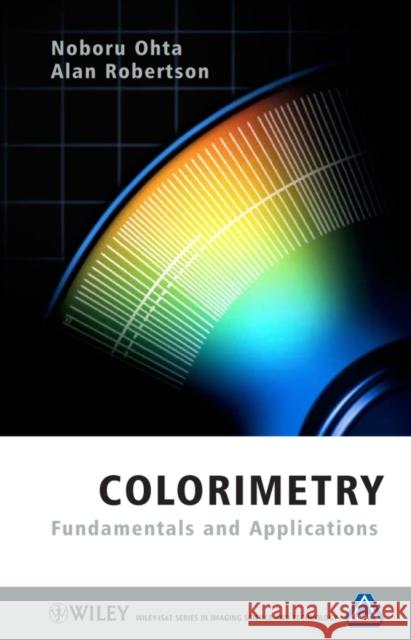
Noboru Ohta; Alan Robertson
Colorimetry: Fundamentals and Applications Ohta, Noboru 9780470094723 John Wiley & Sons - książkaWidoczna okładka, to zdjęcie poglądowe, a rzeczywista szata graficzna może różnić się od prezentowanej.

Colorimetry: Fundamentals and Applications

ISBN-13: 9780470094723 / Angielski / Twarda / 2005 / 350 str.

Noboru Ohta; Alan Robertson
cena 542,89 zł
(netto: 517,04 VAT:  5%)

Najniższa cena z 30 dni: 538,44 zł
Termin realizacji zamówienia:
ok. 30 dni roboczych
Bez gwarancji dostawy przed świętami

Darmowa dostawa!

Colorimetry, the science of quantitvely describing color, is essential for color reproduction technology. This is because it creates standards by which to measure color, using mathematical techniques and software to ensure fidelity across media, allow accurate color mixing, and to develop color optimization.

This book is a comprehensive and thorough introduction to colorimetry, taking the reader from basic concepts through to a variety of industrial applications. Set out in clear, easy-to-follow terminology, Ohta and Robertson explain fundamental principles such as color specification, the CIE (International Commission on Illumination) system, and color vision and appearance models. They also cover the following topics: the optimization of color reproduction;uniform color spaces and color difference formulae, including the CIEDE 2000 formula;applications of metamerism, chromatic adaptation, color appearance and color rendering;mathematical formulae for calculating color mixing, maximising luminous efficacy, and designing illuminants with specific properties.

"Colorimetry: Fundamentals and Applications" is an ideal reference for practising color engineers, color scientists and imaging professionals working on color systems. It is also a practical guide for senior undergraduate and graduate students who want to acquire knowledge in the field.


Kategorie:
Technologie
Kategorie BISAC:
Technology & Engineering > Imaging Systems
Wydawca:
John Wiley & Sons
Seria wydawnicza:
Wiley-IS&T Series in Imaging Science and Technology
Język:
Angielski
ISBN-13:
9780470094723
Rok wydania:
2005
Numer serii:
000305580
Ilość stron:
350
Waga:
0.64 kg
Wymiary:
23.3 x 18.1 x 2.5
Oprawa:
Twarda
Wolumenów:
01
Dodatkowe informacje:
Bibliografia

"This volume will be a useful addition to academic libraries and will be indispensible for basic and clinical researchers in this growing field." ( E–Streams, June 2008)

" a systematic and unambiguous exposition of how color is defined, measured, and seen by humans under different viewing conditions highly recommended." (CHOICE, June 2006)

About the Authors.

Series Preface.

Preface.

Introduction.

1 Light, Vision and Photometry.

1.1 Light.

1.2 Mechanism of the Human Eye.

1.3 Adaptation and Responsivity of the Human Eye.

1.4 Spectral Responsivity and the Standard Photometric Observer.

1.5 Definition of Photometric Quantities.

1.6 Photometric Units.

1.7 Calculation and Measurement of Photometric Quantities.

1.8 Relations Between Photometric Quantities.

Note 1.1 Luminous Exitance, Illuminance, and Luminance of a Perfect Diffusing Plane Light Source.

Note 1.2 Luminance and Brightness.

2 Color Vision and Color Specification Systems.

2.1 Mechanism of Color Vision.

2.2 Chemistry of Color Vision.

2.3 Color Specification and Terminology.

2.4 Munsell Color System.

2.5 Color System Using Additive Color Mixing.

Note 2.1 Colorfulness, Chroma and Saturation.

3 CIE Standard Colorimetric System.

3.1 RGB Color Specification System.

3.2 Conversion into XYZ Color Specification System.

3.3 X10Y10Z10 Color Specification System.

3.4 Tristimulus Values and Chromaticity Coordinates.

3.5 Metamerism.

3.6 Dominant Wavelength and Purity.

3.7 Color Temperature and Correlated Color Temperature.

3.8 Illuminants and Light Sources.

3.9 Standard and Supplementary Illuminants.

Note 3.1 Derivation of Color Matching Functions from Guild and Wright s Results.

Note 3.2 Conversion between Color Specification Systems.

Note 3.3 Conversion into XYZ Color Specification System.

Note 3.4 Imaginary Colors [X] and [Z].

Note 3.5 Photometric Quantities in the X10Y10Z10 Color System.

Note 3.6 Origin of the Term Metamerism .

Note 3.7 Simple Methods for Obtaining Correlated Color Temperature.

Note 3.8 Color Temperature Conversion Filter.

Note 3.9 Spectral Distribution of Black–body Radiation.

4 Uniform Color Spaces.

4.1 Uniform Chromaticity Diagrams.

4.2 Uniform Lightness Scales (ULS).

4.3 CIE Uniform Color Spaces.

4.4 Correlates of Perceived Attributes.

4.5 Comparing CIELAB and CIELUV Color Spaces.

4.6 Conversion of Color Difference.

4.7 Color Difference Equations Based on CIELAB.

Note 4.1 Calculation of Munsell Value V from Luminous Reflectance Y.

Note 4.2 Modified CIELAB and CIELUV Equations for Dark Colors.

Note 4.3 Other Color Difference Formulas.

Note 4.4 Direct Calculation of Hue Difference δH∗.

5 Measurement and Calculation of Colorimetric Values.

5.1 Direct Measurement of Tristimulus Values.

5.2 Spectral Colorimetry.

5.3 Geometrical Conditions for Measurement.

5.4 Calculation of Colorimetric Values.

5.5 Colorimetric Values in CIELAB and CIELUV Uniform Color Spaces.

Note 5.1 Spectral Colorimetry of Fluorescent Materials.

Note 5.2 Reference Standard for Reflection Measurements.

6 Evolution of CIE Standard Colorimetric System.

6.1 Additive Mixing.

6.2 Subtractive Mixing.

6.3 Maximum Value of Luminous Efficacy and Optimal Colors.

6.4 Chromatic Adaptation Process.

6.5 von Kries Predictive Equation for Chromatic Adaptation.

6.6 CIE Predictive Equations for Chromatic Adaptation.

6.7 Color Vision Models.

6.8 Color Appearance Models.

6.9 Analysis of Metamerism.

Note 6.1 Color Mixing Rule.

Note 6.2 Lambert Beer Law.

Note 6.3 Method for Calculating the Maximum Value of the Luminous Efficacy of Radiation.

Note 6.4 Method for Calculating Optimal Colors.

Note 6.5 Method for Obtaining Fundamental Spectral Responsivities.

Note 6.6 Deducing von Kries Predictive Equation for Chromatic Adaptation.

Note 6.7 Application of von Kries Equation for Chromatic Adaptation.

Note 6.8 Application of CIE 1994 Chromatic Adaptation Transform.

Note 6.9 Theoretical Limits for Deviation from Metamerism.

7 Application of CIE Standard Colorimetric System.

7.1 Evaluation of the Color Rendering Properties of Light Sources.

7.2 Evaluation of the Spectral Distribution of Daylight Simulators.

7.3 Evaluation of Whiteness.

7.4 Evaluation of Degree of Metamerism for Change of Illuminant.

7.5 Evaluation of Degree of Metamerism for Change of Observer.

7.6 Designing Spectral Distributions of Illuminants.

7.7 Computer Color Matching.

Note 7.1 Computation Method for Prescribed Spectral Distributions.

Appendix I Basic Units and Terms.

AI.1 SI Units.

AI.2 Prefixes for SI Units.

AI.3 Fundamental Constants.

AI.4 Greek Letters.

Appendix II Matrix Algebra.

AII.1 Addition and Subtraction of Matrices.

AII.2 Multiplication of Matrices.

AII.3 Inverse Matrix.

AII.4 Transpose Matrix.

Appendix III Partial Derivatives.

Appendix IV Tables.

References.

Bibliography.

Index.

Noboru Ohta earned his B.Sci., and Dr.Eng.from the University of Tokyo. In 1968, he joined Fuji Photo Film and From 1973, he spend three y ears under Gunter Wyszecki at the National Research Council of Canada.
He has taught colorimetry and color reproduction at a variety of universities. he joined Rochester Institute of Technology in 1998, and is associated there with the Munsell Color Science Laboratory in the Center for Imaging Science.
He has published more than 100 technical paper sin Japanese and English, and several books on colorimetry and color reproduction in Japanese, Chinese, and Korean. He has been active in a variety of academic societies, and also in standards organizations such as the Japanese Industrial Standards (JIS), the American National Standards Institute (ANSI), and the International Commission on Illumination (CIE).

Alan Robertson earned his B.Sc and Ph.D. from the University of London, where he studied under David Wright. He then joined Gunter Wyszecki at the National Research Council of Canada and Spent 35 years there before retiring in 2000. He has published over 50 papers in journals and conference proceedings and has given more than 60 invited talks in 10 countries. He is former President of the international Color Association (AIC) and Vice President of the International Commission on Illumination (CIE). In 2005, he received the Godlove Award of the Inter–Society Color Council (ISCC) for long–term contributions in the field of color.

Colorimetry, the science of quantitvely describing color, is essential for color reproduction technology. This is because it creates standards by which to measure color, using mathematical techniques and software to ensure fidelity across media, allow accurate color mixing, and to develop color optimization.

This book is a comprehensive and thorough introduction to colorimetry, taking the reader from basic concepts through to a variety of industrial applications. Set out in clear, easy–to–follow terminology, Ohta and Robertson explain fundamental principles such as color specification, the CIE (International Commission on Illumination) system, and color vision and appearance models. They also cover the following topics:

  • the optimization of color reproduction;
  • uniform color spaces and color difference formulae, including the CIEDE 2000 formula;
  • applications of metamerism, chromatic adaptation, color appearance and color rendering;
  • mathematical formulae for calculating color mixing, maximising luminous efficacy, and designing illuminants with specific properties.

Colorimetry: Fundamentals and Applications is an ideal reference for practising color engineers, color scientists and imaging professionals working on color systems. It is also a practical guide for senior undergraduate and graduate students who want to acquire knowledge in the field.

Robertson, Alan Alan Robertson grew up hunting, fishing, and helpi... więcej >


Udostępnij

Facebook - konto krainaksiazek.pl


Opinie o Krainaksiazek.pl na Opineo.pl

Partner Mybenefit

Krainaksiazek.pl w programie rzetelna firma Krainaksiaze.pl - płatności przez paypal

Czytaj nas na:

Facebook - krainaksiazek.pl
  • książki na zamówienie
  • granty
  • książka na prezent
  • kontakt
  • pomoc
  • opinie
  • regulamin
  • polityka prywatności

Zobacz:

  • Księgarnia czeska

  • Wydawnictwo Książkowe Klimaty

1997-2025 DolnySlask.com Agencja Internetowa

© 1997-2022 krainaksiazek.pl
     
KONTAKT | REGULAMIN | POLITYKA PRYWATNOŚCI | USTAWIENIA PRYWATNOŚCI
Zobacz: Księgarnia Czeska | Wydawnictwo Książkowe Klimaty | Mapa strony | Lista autorów
KrainaKsiazek.PL - Księgarnia Internetowa

Polityka prywatnosci - link
Krainaksiazek.pl - płatnośc Przelewy24
Przechowalnia Przechowalnia




