• Wyszukiwanie zaawansowane
  • Kategorie
  • Kategorie BISAC
  • Książki na zamówienie
  • Promocje
  • Granty
  • Książka na prezent
  • Opinie
  • Pomoc
  • Załóż konto
  • Zaloguj się

Collision Detection in Interactive 3D Environments » książka


zaloguj się | załóż konto
Logo Krainaksiazek.pl

koszyk

konto

szukaj
topmenu
Księgarnia internetowa
Szukaj
Książki na zamówienie
Promocje
Granty
Książka na prezent
Moje konto
Pomoc
 
 
Wyszukiwanie zaawansowane
Pusty koszyk
Bezpłatna dostawa dla zamówień powyżej 20 złBezpłatna dostawa dla zamówień powyżej 20 zł

Kategorie główne

• Nauka
 [2950560]
• Literatura piękna
 [1849509]

  więcej...
• Turystyka
 [71097]
• Informatyka
 [151150]
• Komiksy
 [35848]
• Encyklopedie
 [23178]
• Dziecięca
 [617388]
• Hobby
 [139064]
• AudioBooki
 [1657]
• Literatura faktu
 [228597]
• Muzyka CD
 [383]
• Słowniki
 [2855]
• Inne
 [445295]
• Kalendarze
 [1464]
• Podręczniki
 [167547]
• Poradniki
 [480102]
• Religia
 [510749]
• Czasopisma
 [516]
• Sport
 [61293]
• Sztuka
 [243352]
• CD, DVD, Video
 [3414]
• Technologie
 [219456]
• Zdrowie
 [101002]
• Książkowe Klimaty
 [124]
• Zabawki
 [2311]
• Puzzle, gry
 [3459]
• Literatura w języku ukraińskim
 [254]
• Art. papiernicze i szkolne
 [8079]
Kategorie szczegółowe BISAC

Collision Detection in Interactive 3D Environments

ISBN-13: 9781558608016 / Angielski / Twarda / 2003 / 277 str.
Gino Van Den Bergen; Gino Johannes Apolon Bergen
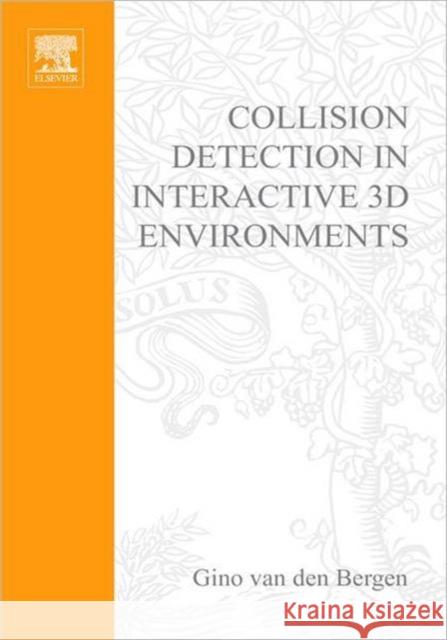
Collision Detection in Interactive 3D Environments Gino Va Gino Johannes Apolon Bergen 9781558608016 Elsevier Science & Technology - książkaWidoczna okładka, to zdjęcie poglądowe, a rzeczywista szata graficzna może różnić się od prezentowanej.

Collision Detection in Interactive 3D Environments

ISBN-13: 9781558608016 / Angielski / Twarda / 2003 / 277 str.

Gino Van Den Bergen; Gino Johannes Apolon Bergen
cena 437,16
(netto: 416,34 VAT:  5%)

Najniższa cena z 30 dni: 428,13
Termin realizacji zamówienia:
ok. 22 dni roboczych
Dostawa w 2026 r.

Darmowa dostawa!

The heart of any system that simulates the physical interaction between objects is collision detection-the ability to detect when two objects have come into contact. This system is also one of the most difficult aspects of a physical simulation to implement correctly, and invariably it is the main consumer of CPU cycles. Practitioners, new to the field or otherwise, quickly discover that the attempt to build a fast, accurate, and robust collision detection system takes them down a long path fraught with perils and pitfalls unlike most they have ever encountered. Without in-depth knowledge and understanding of the issues associated with engineering a collision detection system, the end of that path is an abyss that has swallowed many a good programmer Gino van den Bergen's new book is the story of his successful journey down that path. The outcome is his well-known collision detection system, the SOftware Library for Interference Detection (SOLID). Along the way, he covers the topics of vector algebra and geometry, the various geometric primitives of interest in a collision system, the powerful method of separating axes for the purposes of intersection testing, and the equally powerful Gilbert-Johnson-Keerthi (GJK) algorithm for computing the distance between convex objects. But this book provides much more than a good compendium of the ideas that go into building a collision system. The curse of practical computational geometry is floating-point arithmetic. Algorithms with straightforward implementations when using exact arithmetic can have catastrophic failures in a floating-point system. Specifically, intersection and distance algorithms implemented in a floating-point system tend to fail exactly in the most important case in a collision system-when two objects are just touching. Great care must be taken to properly handle floating-point round off errors. Gino's ultimate accomplishment in this book is his presentation on how to correctly implement the GJK distance algorithm in the presence of single-precision floating-point arithmetic. And what better way to illustrate this than with a case study, the final chapter on the design and implementation of SOLID.About the CD-ROMThe companion CD-ROM includes the full C++ source code of SOLID 3.5 as well as API documentation in HTML and PDF formats. Both single (32bit) and double (64bit) precision versions of the SOLID SDK plus example programs can be compiled for Linux platforms using GNU g++ version 2.95 to 3.3 and for Win32 platforms using Microsoft Visual C++ version 6.0 to 7.1. Use of the SOLID source code is governed by the terms of either the GNU GPL or the Trolltech QPL (see CD-ROM documentation for details).About the AuthorGino van den Bergen is a game developer living and working in The Netherlands. He is the creator of SOLID and holds a Ph.D. in computing science from Eindhoven University of Technology. Gino implemented collision detection and physics in NaN Technologies' Blender, a creation suite for interactive 3D content.


Kategorie:
Informatyka, Bazy danych
Kategorie BISAC:
Computers > Operating Systems - General
Computers > Software Development & Engineering - Computer Graphics
Computers > Computer Science
Wydawca:
Elsevier Science & Technology
Seria wydawnicza:
Morgan Kaufmann Series in Interactive 3D Technology
Język:
Angielski
ISBN-13:
9781558608016
Rok wydania:
2003
Numer serii:
000286578
Ilość stron:
277
Waga:
0.71 kg
Wymiary:
24.59 x 18.54 x 2.06
Oprawa:
Twarda
Wolumenów:
01
Dodatkowe informacje:
Bibliografia
Wydanie ilustrowane

"Having read this book from cover to cover, I can summarize my opinion in two words from a mathematician's lexicon: elegant and beautiful. There is very little to criticize in this exquisite work."
-Ian Ashdown, byHeart Consultants, Inc.

"Building a real-time collision detection system is by no means a trivial task. A firm understanding is required of the geometry and mathematics for intersection testing, especially when the objects are in motion. The skilled use of convexity is essential for distance calculations. The system must be designed carefully to support high-performance physical simulations. In particular, spatial partitioning and tight-fitting bounding volumes must play a role in minimizing the computational requirements of the system. The system is sufficiently large that the principles of software engineering apply to its development. Moreover, collision detection is notoriously difficult to implement robustly when using floating-point arithmetic. The challenges of architecting and implementing a collision detection system are formidable!
Collision Detection in Interactive 3D Environments is an elegantly written treatise on this topic. Gino guides you through the basic concepts, provides insightful discussions on how to cope with the problems inherent in floating-point arithmetic, covers the all-important topic of computing distance between convex objects, and presents an informative summary of the spatial data structures that are commonly encountered in practice. And as an artisan of the field, Gino finishes the story with a case study-the design and implementation of his own working collision detection system, SOLID.
This is the first book to provide all the details necessary to build a collision detection system that really works. I hope you will find, as I did, that the amount of material in this book is incredible, making it an extremely valuable resource."
-Dave Eberly, president, Magic Software, Inc., and author of 3D Game Engine Design, co-author with Philip Schneider of Geometric Tools for Computer Graphics, and author of Game Physics.

1 Introduction
1.1 Problem Domain
1.2 Historical Background
1.3 Organization

2 Concepts
2.1 Geometry
2.1.1 Notational Conventions
2.1.2 Vector Spaces
2.1.3 Affine Spaces
2.1.4 Euclidean Spaces
2.1.5 Affine Transformations
2.1.6 Three-dimensional Space
2.2 Objects
2.2.1 Polytopes
2.2.2 Polygons
2.2.3 Quadrics
2.2.4 Minkowski Addition
2.2.5 Complex Shapes and Scenes
2.3 Animation
2.4 Time
2.5 Response
2.6 Performance
2.6.1 Frame Coherence
2.6.2 Geometric Coherence
2.6.3 Average Time
2.7 Robustness
2.7.1 Floating-Point Numbers
2.7.2 Stability
2.7.3 Coping with Numerical Problems

3 Basic Primitives
3.1 Spheres
3.1.1 Sphere-Sphere Test
3.1.2 Ray-Sphere Test
3.1.3 Line-Segment-Sphere Test
3.2 Axis-Aligned Boxes
3.2.1 Ray-Box Test
3.2.2 Sphere-Box Test
3.3 Separating Axes
3.3.1 Line-Segment-Box Test
3.3.2 Triangle-Box Test
3.3.3 Box-Box Test
3.4 Polygons
3.4.1 Ray-Triangle Test
3.4.2 Line Segment-Triangle Test
3.4.3 Ray-Polygon Test
3.4.4 Triangle-Triangle Test
3.4.5 Polygon-Polygon Test
3.4.6 Triangle-Sphere Test
3.4.7 Polygon-Volume Tests

4 Convex Objects
4.1 Proximity Queries
4.2 Overview of Algorithms for Polytopes
4.2.1 Finding a Common Point
4.2.2 Finding a Separating Plane
4.2.3 Distance and Penetration Depth Computation
4.3 The Gilbert-Johnson-Keerthi Algorithm
4.3.1 Overview
4.3.2 Convergence and Termination
4.3.3 Johnson's Distance Algorithm
4.3.4 Support Mappings
4.3.5 Implementing the GJK Algorithm
4.3.6 Numerical Aspects of the GJK Algorithm
4.3.7 Testing for Intersections
4.3.8 Penetration Depth

5 Spatial Data Structures
5.1 Nonconvex Polyhedra
5.1.1 Convex Decomposition
5.1.2 Polyhedral Surfaces
5.1.3 Point in Nonconvex Polyhedron
5.2 Space Partitioning
5.2.1 Voxel Grids
5.2.2 Octrees and k-d Trees
5.2.3 Binary Space Partitioning Trees
5.2.4 Discussion
5.3 Model Partitioning
5.3.1 Bounding Volumes
5.3.2 Bounding-Volume Hierarchies
5.3.3 AABB Trees versus OBB Trees
5.3.4 AABB Trees and Deformable Models
5.4 Broad Phase
5.4.1 Sweep and Prune
5.4.2 Implementing the Sweep-and-Prune Algorithm
5.4.3 Ray Casting and AABBs

6 Design of SOLID
6.1 Requirements
6.2 Overview of SOLID
6.3 Design Decisions
6.3.1 Shape Representation
6.3.2 Motion Specification
6.3.3 Response Handling
6.3.4 Algorithms
6.4 Evaluation
6.5 Implementation Notes
6.5.1 Generic Data Types and Algorithms
6.5.2 Fundamental 3D Classes

7 Conclusion
7.1 State of the Art
7.2 Future Work

Bibliography
Index
About the CD-ROM
Trademarks

Gino van den Bergen is a game developer working for the Playlogic Game Factory, Breda, The Netherlands. He is the creator of SOLID and holds a Ph.D. in computing science from Eindhoven University of Technology. Gino implemented collision detection and physics in NaN Technologies' Blender, a creation suite for interactive 3D content.




Udostępnij

Facebook - konto krainaksiazek.pl


Opinie o Krainaksiazek.pl na Opineo.pl

Partner Mybenefit

Krainaksiazek.pl w programie rzetelna firma Krainaksiaze.pl - płatności przez paypal

Czytaj nas na:

Facebook - krainaksiazek.pl
  • książki na zamówienie
  • granty
  • książka na prezent
  • kontakt
  • pomoc
  • opinie
  • regulamin
  • polityka prywatności

Zobacz:

  • Księgarnia czeska

  • Wydawnictwo Książkowe Klimaty

1997-2025 DolnySlask.com Agencja Internetowa

© 1997-2022 krainaksiazek.pl
     
KONTAKT | REGULAMIN | POLITYKA PRYWATNOŚCI | USTAWIENIA PRYWATNOŚCI
Zobacz: Księgarnia Czeska | Wydawnictwo Książkowe Klimaty | Mapa strony | Lista autorów
KrainaKsiazek.PL - Księgarnia Internetowa

Polityka prywatnosci - link
Krainaksiazek.pl - płatnośc Przelewy24
Przechowalnia Przechowalnia



