• Wyszukiwanie zaawansowane
  • Kategorie
  • Kategorie BISAC
  • Książki na zamówienie
  • Promocje
  • Granty
  • Książka na prezent
  • Opinie
  • Pomoc
  • Załóż konto
  • Zaloguj się

Code Biology: A New Science of Life » książka


zaloguj się | załóż konto
Logo Krainaksiazek.pl

koszyk

konto

szukaj
topmenu
Księgarnia internetowa
Szukaj
Książki na zamówienie
Promocje
Granty
Książka na prezent
Moje konto
Pomoc
 
 
Wyszukiwanie zaawansowane
Pusty koszyk
Bezpłatna dostawa dla zamówień powyżej 20 złBezpłatna dostawa dla zamówień powyżej 20 zł

Kategorie główne

• Nauka
 [2946912]
• Literatura piękna
 [1852311]

  więcej...
• Turystyka
 [71421]
• Informatyka
 [150889]
• Komiksy
 [35717]
• Encyklopedie
 [23177]
• Dziecięca
 [617324]
• Hobby
 [138808]
• AudioBooki
 [1671]
• Literatura faktu
 [228371]
• Muzyka CD
 [400]
• Słowniki
 [2841]
• Inne
 [445428]
• Kalendarze
 [1545]
• Podręczniki
 [166819]
• Poradniki
 [480180]
• Religia
 [510412]
• Czasopisma
 [525]
• Sport
 [61271]
• Sztuka
 [242929]
• CD, DVD, Video
 [3371]
• Technologie
 [219258]
• Zdrowie
 [100961]
• Książkowe Klimaty
 [124]
• Zabawki
 [2341]
• Puzzle, gry
 [3766]
• Literatura w języku ukraińskim
 [255]
• Art. papiernicze i szkolne
 [7810]
Kategorie szczegółowe BISAC

Code Biology: A New Science of Life

ISBN-13: 9783319366371 / Angielski / Miękka / 2016 / 224 str.
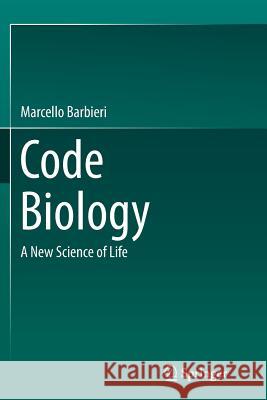
Marcello Barbieri
Code Biology: A New Science of Life Barbieri, Marcello 9783319366371 Springer - książkaWidoczna okładka, to zdjęcie poglądowe, a rzeczywista szata graficzna może różnić się od prezentowanej.

Code Biology: A New Science of Life

ISBN-13: 9783319366371 / Angielski / Miękka / 2016 / 224 str.

Marcello Barbieri
cena 816,65
(netto: 777,76 VAT:  5%)

Najniższa cena z 30 dni: 764,38
Termin realizacji zamówienia:
ok. 10-14 dni roboczych
Bez gwarancji dostawy przed świętami

Darmowa dostawa!

This book is the study of all codes of life with the standard methods of science. The genetic code and the codes of culture have been known for a long time and represent the historical foundation of this book. What is really new in this field is the study of all codes that came after the genetic code and before the codes of culture. The existence of these organic codes, however, is not only a major experimental fact. It is one of those facts that have extraordinary theoretical implications. The first is that most events of macroevolution were associated with the origin of new organic codes, and this gives us a completely new reconstruction of the history of life. The second implication is that codes involve meaning and we need therefore to introduce in biology not only the concept of information but also the concept of biological meaning. The third theoretical implication comes from the fact that the organic codes have been highly conserved in evolution, which means that they are the greatest invariants of life. The study of the organic codes, in short, is bringing to light new mechanisms that have operated in the history of life and new fundamental concepts in biology.


Kategorie:
Nauka, Biologia i przyroda
Kategorie BISAC:
Science > Life Sciences - Ecology
Science > Biologia molekularna
Language Arts & Disciplines > Linguistics - Semantics
Wydawca:
Springer
Język:
Angielski
ISBN-13:
9783319366371
Rok wydania:
2016
Wydanie:
Softcover Repri
Ilość stron:
224
Waga:
0.35 kg
Wymiary:
23.39 x 15.6 x 1.32
Oprawa:
Miękka
Wolumenów:
01
Dodatkowe informacje:
Wydanie ilustrowane

"Barbieri (embryology, Univ. of Ferrara, Italy) lays out the case for multiple codes, each corresponding with, and instrumental in the origin of, different levels of biological organization: from the origin of life (genetic), the three kingdoms of life (signal transduction), the nucleus (splicing code), regulation of eukaryotic genomes (histone code), cell division (the cytoskeletal code), to mind and language (the organic code). ... Summing Up: Recommended. Upper-division undergraduates, graduate students, and researchers/faculty." (B. K. Hall, Choice, Vol. 53 (1), September, 2015)

PART I - The Paradigms of Biology
1. Chemistry versus Information

1.1 The Chemical Paradigm
1.2 The Information Paradigm
1.3 Shannon’s Information Theory
1.4 Sequences and specificity
1.5 The ontological claim of the Information paradigm
1.6 The ontological claim of the Chemical paradigm
1.7 The idea that ‘Life is artifact-making
1.8 The origin of linear and digital sequences
1.9 A useful metaphor
1.10 The issue of meaning
1.11 What is mechanism?
2. The Code Paradigm
2.1 Schrödinger’s prophecy
2.2 The ‘special constraints’ solution
2.3 The new observables
2.4 Names and ‘nominable’ entities
2.5 Organic information
2.6 Organic meaning
2.7 The discovery of new worlds
2.8 Life and semiosis
2.9 The Code model of semiosis
2.10 The defining features of signs and meanings
2.11 The sequences of genes and proteins
2.12 Two types of organic signs
2.13 A new beginning
3. A Gallery of Organic Codes
3.1 The Apparatus of protein synthesis
3.2 The Genetic code
3.3 Stereochemistry and arbitrariness
3.4 The Splicing codes
3.5 The Metabolic code
3.6 The Signal Transduction codes
3.7 The Signal Integration codes
3.8 The Histone code
3.9 Is the ‘Histone Code’ an organic code?
3.10 The Tubulin code
3.11 The Sugar code
3.12 The Glycomic code
3.13 The Sequence codes
3.14 Organic codes and biology
PART II - Major Steps in Macroevolution
4. Life before the Cell
4.1 The twin problems of the beginning
4.2 The replication paradigm
4.3 Ribosoids
4.4 Nucleosoids
4.5 Nucleosoid evolution
4.6 Heterosoids
4.7 A primitive apparatus
4.8 Statistical proteins
4.9 First and last common ancestor
4.10 The ancient genetic code
4.11 The modern genetic code
4 12 Steps towards the cell
4.13 The ribotype theory of the cell
5. The First Three Billion Years
5.1 The ‘Stony Carpets’
5.2 The Iron Bands
5.3 The Age of the Protista
5.4 Three primary kingdoms
5.5 The first cells
5.6 Two evolutionary strategies
5.7 The RNA codes
5.8 The fluid genome
5 9 Evolving the cytoplasm
5.10 The cytoskeleton codes
5.11 The compartment codes
5.12 The Tree and the Web
5.13 What happened in the Precambrian?
6. Evolving the Embryos
6.1 The rediscovery of epigenesist
6.2 Body plans and animal phyla
6.3 A cascade of inductions
6.4 Determination and cell memory
6.5 Self-regulating embryonic fields
6.6 Arranging cells in space
6.7 The unexpected from molecular embryology
6.8 The classification of animals
6.9 The Cambrian explosion
6.10 The origin of animals
6.11 The Hox codes
6.12 The codes of the body plans
6.13 The logic of the embryos
7. Brain and Mind
7.1 Evolving the neuron
7.2 The intermediate brain
7.3 The instinctive brain
7.4 Making mental images
7.5 Sensations and perceptions7.6 A universal neural code
7.7 Mechanisms of brain development
7.8 Codes in brain development
7.9 Theories on the brain-mind relationship
7.10 The ‘first-person’ experiences
7.11 The code theory of mind
7 12 The interpretive brain
7.13 Three brain macroevolutions
8. Origins of Language
8.1 Chomsky’s definitions of language
8.2 Sebeok’s definitions of language
8.3 The bone of contention
8.4 A third foundation of language
8.5 A juvenile ape
8.6 Fetalization and brain wiring8.7 Brain size and language genes
8.8 The cerebra bifida model
8.9 Mind and reality
8.10 Steps in the ontogeny of mind
8.11 Interacting brains
8.12 A hidden asymmetry
8.13 Rules of neural development
8.14 Specifically human
8.15 The third modelling system
8 16 Our rational faculties
8 17 The codes of language
PART III - A New Science of Life
9. Biosemiotics
9.1 Matter controlled by symbols
9.2 Physical biosemiotics
9.3 Darwinian biosemiotics
9.4 The Peirce framework
9.5 Zoosemiotics
9.6 Peircean biosemiotics
9.7 Hermeneutic biosemiotics
9.8 A book review for Sebeok
9.9 A pluralistic enterprise
9.10 Organic semiosis
9.11 Animal semiosis
9.12 Sense and reference
9.13 The worlds of semiosis
9.14 Two types of Biosemiotics
9.15 A new beginning
10. Code Biology
10.1 What is the cell?
10.2 The von Neumann machine
10.3 A machine capable of self-assembly
10.4 The concept of Codepoiesis
10.5 Extensions of the Modern Synthesis
10.6 Mechanisms of evolution
10.7 Copying and coding
10.8 Organic codes as constraints
10.9 The Major Steps in Macroevolution
10.10 The characteristics of the codes
10.11 Different types of codes
10.12 Unpredictable features
10.13 The Three Worlds of life
10.14 Code biology
10.15 There was a time
References
Author Index
Subject Index

Marcello Barbieri (born 1940) is professor of embryology at the University of Ferrara, Italy. He has conducted research on embryonic development and ribosome crystallization at the Medical Research Council in Cambridge, UK, the National Institutes of Health in Bethesda, USA, and the Max-Planck-Institut für Molekulare Genetik in Berlin. He has published books on embryology and evolution, and has taught biophysics, molecular embryology and theoretical biology respectively at the Universities of Bologna, Sassari and Turin. His research interests include embryology, evolution and biosemiotics. He is Editor-in-Chief of the journal Biosemiotics, was a co-Editor of the Springer Book Series in Biosemiotics.

The genetic code appeared on Earth at the origin of life, and the codes of culture arrived almost four billion years later. For a long time it has been assumed that these are the only codes that exist in Nature, and if that were true we would have to conclude that codes are extraordinary exceptions that appeared only at the beginning and at the end of the history of life. In reality, various other organic codes have been discovered in the past few decades and it is likely that more will come to light in the future. The existence of many organic codes in Nature is therefore an experimental fact, but also more than that. It is one of those facts that have extraordinary implications. In this book it is shown that the genetic code was a precondition for the origin of the first cells, the signal transduction codes divided the first cells into three primary kingdoms (Archaea, Bacteria and Eukarya), the splicing codes were instrumental to the origin of the eukaryotic nucleus, the histone code provided a new regulation system in eukaryotic genomes, and the cytoskeleton codes allowed the Eukarya to perform internal movements, including those of mitosis and meiosis. It is shown, furthermore, that organic codes had a key role in multicellular life, in particular in the origin of animals, the origin of mind and the origin of language. The great events of macroevolution, in other words, were associated with the appearance of new organic codes, and we can easily understand why. The reason is that a new code brings into existence something that has never existed before because it creates arbitrary associations, relationships that are not determined by physical necessity. Another outstanding implication is the fact that codes involve meaning and we need therefore to introduce in biology, with the standard methods of science, not only the concept of biological information but also that of biological meaning. The research on biological codes, in conclusion, is bringing to light new mechanisms in evolution and new fundamental concepts in science. This research is the field of Code Biology, the study of all codes of life, from the genetic code to the codes of culture, from the origin of life to the origin of man.

Barbieri, Marcello Professor Barbieri is based in the Department of M... więcej >


Udostępnij

Facebook - konto krainaksiazek.pl


Opinie o Krainaksiazek.pl na Opineo.pl

Partner Mybenefit

Krainaksiazek.pl w programie rzetelna firma Krainaksiaze.pl - płatności przez paypal

Czytaj nas na:

Facebook - krainaksiazek.pl
  • książki na zamówienie
  • granty
  • książka na prezent
  • kontakt
  • pomoc
  • opinie
  • regulamin
  • polityka prywatności

Zobacz:

  • Księgarnia czeska

  • Wydawnictwo Książkowe Klimaty

1997-2025 DolnySlask.com Agencja Internetowa

© 1997-2022 krainaksiazek.pl
     
KONTAKT | REGULAMIN | POLITYKA PRYWATNOŚCI | USTAWIENIA PRYWATNOŚCI
Zobacz: Księgarnia Czeska | Wydawnictwo Książkowe Klimaty | Mapa strony | Lista autorów
KrainaKsiazek.PL - Księgarnia Internetowa

Polityka prywatnosci - link
Krainaksiazek.pl - płatnośc Przelewy24
Przechowalnia Przechowalnia





