• Wyszukiwanie zaawansowane
  • Kategorie
  • Kategorie BISAC
  • Książki na zamówienie
  • Promocje
  • Granty
  • Książka na prezent
  • Opinie
  • Pomoc
  • Załóż konto
  • Zaloguj się

Climate Change and Policy: The Calculability of Climate Change and the Challenge of Uncertainty » książka


zaloguj się | załóż konto
Logo Krainaksiazek.pl

koszyk

konto

szukaj
topmenu
Księgarnia internetowa
Szukaj
Książki na zamówienie
Promocje
Granty
Książka na prezent
Moje konto
Pomoc
 
 
Wyszukiwanie zaawansowane
Pusty koszyk
Bezpłatna dostawa dla zamówień powyżej 20 złBezpłatna dostawa dla zamówień powyżej 20 zł

Kategorie główne

• Nauka
 [2946600]
• Literatura piękna
 [1856966]

  więcej...
• Turystyka
 [72221]
• Informatyka
 [151456]
• Komiksy
 [35826]
• Encyklopedie
 [23190]
• Dziecięca
 [619653]
• Hobby
 [140543]
• AudioBooki
 [1577]
• Literatura faktu
 [228355]
• Muzyka CD
 [410]
• Słowniki
 [2874]
• Inne
 [445822]
• Kalendarze
 [1744]
• Podręczniki
 [167141]
• Poradniki
 [482898]
• Religia
 [510455]
• Czasopisma
 [526]
• Sport
 [61590]
• Sztuka
 [243598]
• CD, DVD, Video
 [3423]
• Technologie
 [219201]
• Zdrowie
 [101638]
• Książkowe Klimaty
 [124]
• Zabawki
 [2473]
• Puzzle, gry
 [3898]
• Literatura w języku ukraińskim
 [254]
• Art. papiernicze i szkolne
 [8170]
Kategorie szczegółowe BISAC

Climate Change and Policy: The Calculability of Climate Change and the Challenge of Uncertainty

ISBN-13: 9783642176999 / Angielski / Twarda / 2011 / 241 str.
Gabriele Gramelsberger; Johann Feichter
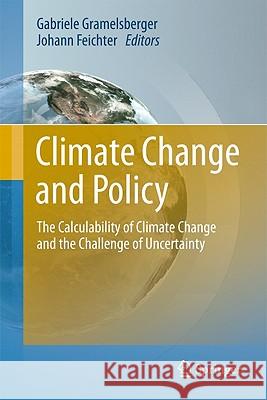
Climate Change and Policy: The Calculability of Climate Change and the Challenge of Uncertainty Gramelsberger, Gabriele 9783642176999 Not Avail - książkaWidoczna okładka, to zdjęcie poglądowe, a rzeczywista szata graficzna może różnić się od prezentowanej.

Climate Change and Policy: The Calculability of Climate Change and the Challenge of Uncertainty

ISBN-13: 9783642176999 / Angielski / Twarda / 2011 / 241 str.

Gabriele Gramelsberger; Johann Feichter
cena 403,47 zł
(netto: 384,26 VAT:  5%)

Najniższa cena z 30 dni: 385,52 zł
Termin realizacji zamówienia:
ok. 22 dni roboczych
Bez gwarancji dostawy przed świętami

Darmowa dostawa!

The debate on how mankind should respond to climate change is diverse, as the appropriate strategy depends on global as well as local circumstances.As scientists are denied the possibility of conducting experiments with the real climate, only climate models can give insights into man-induced climate change, by experimenting with digital climates under varying conditions and by extrapolating past and future states into the future. But the 'nature' of models is a purely representational one. A model is good if it is believed to represent the relevant processes of a natural system well. However, a model and its results, in particular in the case of climate models which interconnect countless hypotheses, is only to some extent testable, although an advanced infrastructure of evaluation strategies has been developed involving strategies of model intercomparison, ensemble prognoses, uncertainty metrics on the system and component levels. The complexity of climate models goes hand in hand with uncertainties, but uncertainty is in conflict with socio-political expectations. However, certain predictions belong to the realm of desires and ideals rather than to applied science. Today's attempt to define and classify uncertainty in terms of likelihood and confidence reflect this awareness of uncertainty as an integral part of human knowledge, in particular on knowledge about possible future developments. The contributions in this book give a first hand insight into scientific strategies in dealing with uncertainty by using simulation models and into social, political and economical requirements in future projections on climate change. Do these strategies and requirements meet each other or fail? The debate on how mankind should respond to climate change is diverse, as the appropriate strategy depends on global as well as local circumstances. As scientists are denied the possibility of conducting experiments with the real climate, only climate models can give insights into man-induced climate change, by experimenting with digital climates under varying conditions and by extrapolating past and future states into the future. But the 'nature' of models is a purely representational one. A model is good if it is believed to represent the relevant processes of a natural system well. However, a model and its results, in particular in the case of climate models which interconnect countless hypotheses, is only to some extent testable, although an advanced infrastructure of evaluation strategies has been developed involving strategies of model intercomparison, ensemble prognoses, uncertainty metrics on the system and component levels. The complexity of climate models goes hand in hand with uncertainties, but uncertainty is in conflict with socio-political expectations. However, certain predictions belong to the realm of desires and ideals rather than to applied science. Today's attempt to define and classify uncertainty in terms of likelihood and confidence reflect this awareness of uncertainty as an integral part of human knowledge, in particular on knowledge about possible future developments. The contributions in this book give a first hand insight into scientific strategies in dealing with uncertainty by using simulation models and into social, political and economical requirements in future projections on climate change. Do these strategies and requirements meet each other or fail? Gabriele Gramelsberger is Principal Investigator of the Collaborative Research Project is Principal Investigator of the Collaborative Research Project


Kategorie:
Nauka, Archeologia
Kategorie BISAC:
Science > Global Warming & Climate Change
Science > Earth Sciences - Meteorology & Climatology
Computers > Computer Simulation
Wydawca:
Not Avail
Język:
Angielski
ISBN-13:
9783642176999
Rok wydania:
2011
Ilość stron:
241
Waga:
0.55 kg
Wymiary:
23.5 x 15.5
Oprawa:
Twarda
Wolumenów:
01
Dodatkowe informacje:
Bibliografia
Glosariusz/słownik
Wydanie ilustrowane

1 Introduction to the Volume.- 2 Modelling the Climate System – An Overview.- 3 Climate Simulation, Uncertainty, and Policy Advice - The Case of the IPCC.- 4 Dealing with Uncertainty – From climate research to integrated assessment of policy options.- 5 Uncertainty in Climate Policy – Impacts on Market Mechanisms.- 6 Insuring climate change – Managing political and economic uncertainties in flood management.- 7 Climate Science, Weather and Climate Engineering, and Scientific Objectivity.- 8 Utilizing participatory scenario-based approaches to design proactive responses to climate change in the face of uncertainties.- 9 Image Politics – Picturing uncertainty. The role of images in climatology and climate policy.- 10 Glossary and Abbreviations.- 11 Authors.- 12 Index.

Gabriele Gramelsberger investigates as a science philosopher at the FU Berlin the influence of computer based simulations as new scientific tools for knowledge production, in particular in climate research. Since 2002 she is a member of the BBAW initiative “Science Policy Studies”. 2007 she received the Blankesee-Colloquium Award from the presidents of the Berlin universities and academies.


            Johann Feichter is head of the group “Aerosols, Clouds and Climate” at the Max Planck Institute for Meteorology Hamburg. He worked on the development of the German climate model and contributed to the 3rd and 4th IPCC assessment reports.

The debate on how mankind should respond to climate change is diverse, as the appropriate strategy depends on global as well as local circumstances.

As scientists are denied the possibility of conducting experiments with the real climate, only climate models can give insights into man-induced climate change, by experimenting with digital climates under varying conditions and by extrapolating past and future states into the future.

But the ‘nature’ of models is a purely representational one. A model is good if it is believed to represent the relevant processes of a natural system well. However, a model and its results, in particular in the case of climate models which interconnect countless hypotheses, is only to some extent testable, although an advanced infrastructure of evaluation strategies has been developed involving strategies of model intercomparison, ensemble prognoses, uncertainty metrics on the system and component levels. The complexity of climate models goes hand in hand with uncertainties, but uncertainty is in conflict with socio-political expectations. However, certain predictions belong to the realm of desires and ideals rather than to applied science. Today’s attempt to define and classify uncertainty in terms of likelihood and confidence reflect this awareness of uncertainty as an integral part of human knowledge, in particular on knowledge about possible future developments. The contributions in this book give a first hand insight into scientific strategies in dealing with uncertainty by using simulation models and into social, political and economical requirements in future projections on climate change. Do these strategies and requirements meet each other or fail?


Udostępnij

Facebook - konto krainaksiazek.pl


Opinie o Krainaksiazek.pl na Opineo.pl

Partner Mybenefit

Krainaksiazek.pl w programie rzetelna firma Krainaksiaze.pl - płatności przez paypal

Czytaj nas na:

Facebook - krainaksiazek.pl
  • książki na zamówienie
  • granty
  • książka na prezent
  • kontakt
  • pomoc
  • opinie
  • regulamin
  • polityka prywatności

Zobacz:

  • Księgarnia czeska

  • Wydawnictwo Książkowe Klimaty

1997-2025 DolnySlask.com Agencja Internetowa

© 1997-2022 krainaksiazek.pl
     
KONTAKT | REGULAMIN | POLITYKA PRYWATNOŚCI | USTAWIENIA PRYWATNOŚCI
Zobacz: Księgarnia Czeska | Wydawnictwo Książkowe Klimaty | Mapa strony | Lista autorów
KrainaKsiazek.PL - Księgarnia Internetowa

Polityka prywatnosci - link
Krainaksiazek.pl - płatnośc Przelewy24
Przechowalnia Przechowalnia






