• Wyszukiwanie zaawansowane
  • Kategorie
  • Kategorie BISAC
  • Książki na zamówienie
  • Promocje
  • Granty
  • Książka na prezent
  • Opinie
  • Pomoc
  • Załóż konto
  • Zaloguj się

Cleanroom Technology: Fundamentals of Design, Testing and Operation » książka


zaloguj się | załóż konto
Logo Krainaksiazek.pl

koszyk

konto

szukaj
topmenu
Księgarnia internetowa
Szukaj
Książki na zamówienie
Promocje
Granty
Książka na prezent
Moje konto
Pomoc
 
 
Wyszukiwanie zaawansowane
Pusty koszyk
Bezpłatna dostawa dla zamówień powyżej 20 złBezpłatna dostawa dla zamówień powyżej 20 zł

Kategorie główne

• Nauka
 [2952079]
• Literatura piękna
 [1850969]

  więcej...
• Turystyka
 [71058]
• Informatyka
 [151066]
• Komiksy
 [35579]
• Encyklopedie
 [23181]
• Dziecięca
 [620496]
• Hobby
 [139036]
• AudioBooki
 [1646]
• Literatura faktu
 [228729]
• Muzyka CD
 [379]
• Słowniki
 [2932]
• Inne
 [445708]
• Kalendarze
 [1409]
• Podręczniki
 [164793]
• Poradniki
 [480107]
• Religia
 [510956]
• Czasopisma
 [511]
• Sport
 [61267]
• Sztuka
 [243299]
• CD, DVD, Video
 [3411]
• Technologie
 [219640]
• Zdrowie
 [100984]
• Książkowe Klimaty
 [124]
• Zabawki
 [2281]
• Puzzle, gry
 [3363]
• Literatura w języku ukraińskim
 [258]
• Art. papiernicze i szkolne
 [8020]
Kategorie szczegółowe BISAC

Cleanroom Technology: Fundamentals of Design, Testing and Operation

ISBN-13: 9780470748060 / Angielski / Twarda / 2010 / 384 str.
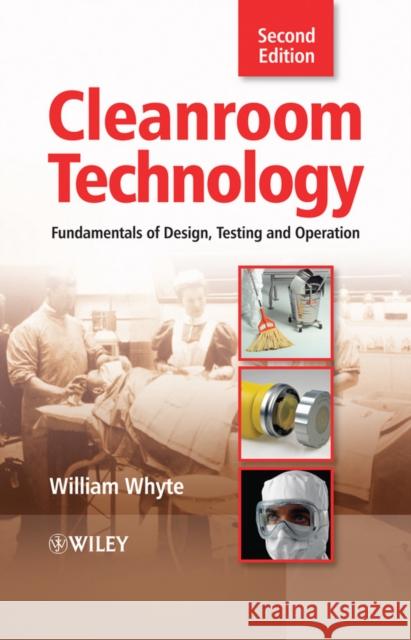
William (University of Glasgow) Whyte
Cleanroom Technology: Fundamentals of Design, Testing and Operation William (University of Glasgow) Whyte 9780470748060 John Wiley & Sons Inc - książkaWidoczna okładka, to zdjęcie poglądowe, a rzeczywista szata graficzna może różnić się od prezentowanej.

Cleanroom Technology: Fundamentals of Design, Testing and Operation

ISBN-13: 9780470748060 / Angielski / Twarda / 2010 / 384 str.

William (University of Glasgow) Whyte
cena 466,99
(netto: 444,75 VAT:  5%)

Najniższa cena z 30 dni: 462,21
Termin realizacji zamówienia:
ok. 30 dni roboczych.

Darmowa dostawa!

A self-contained and practical book providing step-by-step guidance to the design and construction of cleanrooms, appropriate testing methodologies, and operation for the minimization of contamination... This second edition has been comprehensively revised and includes extensive updates to the two chapters that contain information on cleanroom standards and guidelines. The chapter on risk management has been extensively revised, especially the section on risk assessment. Other new subjects that have been added to the various chapters are those on clean-build, determination of air supply volumes for non-unidirectional airflow cleanrooms, RABS (Restricted Access Barrier Systems), contamination recovery test methods, entry of large items into a cleanroom, glove allergy problems, and how to develop a cleanroom cleaning programme. Used for in-house training and a textbook in colleges, this volume is for cleanroom personnel at all levels. It provides novices with an introduction to the state-of-the-art technology and professionals with an accessible reference to the current practices. It is particularly useful in the semiconductor, pharmaceutical, biotechnology and life sciences industries. William Whyte is an international authority in cleanrooms, with over 45 years experience in research, teaching and consulting in the electronic, healthcare and pharmaceutical industries. He is a member of British and International standards committees writing the International Cleanroom standards, and has received numerous awards for his work in Cleanroom Technology. A comment on the first edition: ..".extremely useful and helpful...very well-written, highly organized, easy to understand and follow..." (Environmental Geology, 2003)


Kategorie:
Technologie
Kategorie BISAC:
Technology & Engineering > Industrial Health & Safety
Technology & Engineering > Electrical
Wydawca:
John Wiley & Sons Inc
Język:
Angielski
ISBN-13:
9780470748060
Rok wydania:
2010
Ilość stron:
384
Waga:
0.61 kg
Wymiary:
23.37 x 15.75 x 2.54
Oprawa:
Twarda
Wolumenów:
01
Dodatkowe informacje:
Bibliografia
Wydanie ilustrowane

About the Author.

Preface.

Acknowledgements.

1 Introduction.

1.1 What is a Cleanroom?

1.2 The Need for Cleanrooms.

1.3 Types of Cleanrooms.

1.4 What is Cleanroom Technology?

2 The History of Cleanrooms.

2.1 The Earliest Years.

2.2 Ventilated Operating Rooms.

2.3 Early Industrial Cleanrooms.

2.4 Unidirectional Airflow Cleanrooms.

3 Cleanroom Classification Standards.

3.1 The History of Standards.

3.2 The Basis of Cleanroom Standards.

3.3 Federal Standard 209.

3.4 ISO Standard 14644–1:1999.

3.5 Pharmaceutical Cleanroom Classification.

3.6 Classification of Cleanrooms with Airborne Chemical Contamination.

3.7 Classification of Cleanrooms with Surface Contamination.

4 Information Sources.

4.1 The International Confederation of Contamination Control Societies (ICCCS).

4.2 The ICEB.

4.3 International Cleanroom Standards.

4.4 Cleanroom Books.

4.5 Recommended Practices and Guides of the Institute of Environmental Sciences and Technology (IEST).

4.6 Cleanroom Journals and Magazines.

4.7 Sources of Pharmaceutical Cleanroom Documents.

4.8 Training Videos/DVDs.

5 Non–unidirectional Airflow and Ancillary Cleanrooms.

5.1 Non–unidirectional Airflow Cleanrooms.

5.2 Ancillary Cleanrooms.

6 Unidirectional Airflow Cleanrooms.

6.1 Types of Unidirectional Cleanrooms.

6.2 Vertical Unidirectional Airflow Cleanrooms.

6.3 Horizontal Unidirectional Airflow Rooms.

6.4 The Application of Unidirectional Airflow.

7 Separative Clean Air Devices and Containment Zones.

7.1 Unidirectional Airflow Devices.

7.2 Mini–environments, Isolators and RABS.

7.3 Containment Zones.

8 Construction and Clean–build.

8.1 Constructional Materials and Methods.

8.2 Outgassing and Electrostatic Properties.

8.3 Clean–build.

9 High Efficiency Air Filtration.

9.1 Air Filters Used in Cleanrooms.

9.2 The Construction of High Efficiency Filters.

9.3 Particle Removal Mechanisms.

9.4 Testing of High Efficiency Filters.

9.5 Scan Testing of High Efficiency Filters.

9.6 Filter Housings for High Efficiency Filters.

9.7 Removal of Airborne Chemical Contamination.

10 Cleanroom Testing and Monitoring.

10.1 Principles of Cleanroom Testing.

10.2 Cleanroom Tests.

10.3 Testing in Relation to Room Type and Occupation State.

10.4 Re–testing to Demonstrate Compliance.

10.5 Monitoring of Cleanrooms.

11 Measurement of Air Quantities and Pressure Differences.

11.1 Air Quantities.

11.2 Differential Pressure Tests.

12 Air Movement Control: Containment, Visualization and Recovery.

12.1 Cleanroom Containment Leak Testing.

12.2 Air Movement Control within a Cleanroom.

12.3 Recovery Test Methods.

12.4 Recovery Rate Requirement in the EU GGMP.

13 Filter Installation Leak Testing.

13.1 The Use of Aerosol Test Challenges.

13.2 Artificial Aerosol Test Challenges.

13.3 Apparatus for Measuring Aerosol Penetration.

13.4 Methods of Testing Filters and Filter Housings.

13.5 Repair of Leaks.

14 Airborne Particle Counts.

14.1 Airborne Particle Counters.

14.2 Continuous Monitoring Apparatus for Airborne Particles.

14.3 Particle Counting in Different Occupancy States.

14.4 Measurement of Particle Concentrations.

14.5 Worked Example of ISO 14644–1 Test Method.

15 Microbial Sampling.

15.1 Microbial Sampling of the Air.

15.2 Microbial Deposition onto Surfaces.

15.3 Microbial Surface Sampling.

15.4 Personnel Sampling.

16 Operating a Cleanroom: Managing the Risk from Contamination.

16.1 Step 1: Identification of Sources and Routes of Contamination.

16.2 Step 2: Risk Assessment and the Control of Sources of Contamination.

16.3 Step 3: Establish an Effective Monitoring Programme.

16.4 Step 4: Verification and Reappraisal of the System.

16.5 Step 5: Documentation.

16.6 Step 6: Staff Training.

17 Cleanroom Disciplines.

17.1 People Allowed into Cleanrooms.

17.2 Personal Items Not Allowed into the Cleanroom.

17.3 Disciplines within the Cleanroom.

17.4 Maintenance and Service Personnel.

18 Entry and Exit of Personnel.

18.1 Prior to Arriving at the Cleanroom.

18.2 Changing into Cleanroom Garments.

18.3 Exit Changing Procedures.

19 Materials, Equipment and Machinery.

19.1 Choice of Materials for use in a Cleanroom.

19.2 Items Supplied from Outside Manufacturing Sources.

19.3 Wrapping and Transportation of Materials.

19.4 Transfer of Items and Small Pieces of Equipment through a Material Transfer Airlock.

19.5 Entry of Heavy Machinery and Bulky Items.

19.6 Transfer of Materials through Hatches and Sterilisers.

20 Cleanroom Clothing.

20.1 Sources and Routes of Inert Airborne Particle Dispersion.

20.2 Routes and Sources of Microbial Dispersion.

20.3 Types of Cleanroom Clothing.

20.4 Processing of Cleanroom Garments and Change Frequency.

20.5 The Effect of Laundering and Wear.

20.6 Testing of Cleanroom Clothing.

20.7 Static Dissipative Properties of Clothing.

21 Cleanroom Masks and Gloves.

21.1 Cleanroom Masks.

21.2 Cleanroom Gloves.

22 Cleaning a Cleanroom.

22.1 Why a Cleanroom must be Cleaned.

22.2 Cleaning Methods and the Physics of Cleaning Surfaces.

22.3 Implements Used to Clean Cleanrooms.

22.4 Liquids Used in Cleaning Cleanrooms.

22.5 How Should a Cleanroom be Cleaned?

22.6 Cleaning Programme.

22.7 Test Methods.

Index.

WILLIAM WHYTE is an international authority in cleanrooms, with over 45 years’ experience in research, teaching and consulting in the electronic, healthcare and pharmaceutical industries. He is a member of British and International standards committees writing the International Cleanroom standards, and has received numerous awards for his work in Cleanroom Technology.

A self–contained and practical book providing step–by–step guidance to the design and construction of cleanrooms, appropriate testing methodologies, and operation for the minimization of contamination…

This comprehensively revised second edition includes extensive updates to the two chapters that contain information on cleanroom standards and guidelines. It contains a thoroughly updated chapter on risk management, including an important section on risk assessment. Other new subjects included cover clean–build, determination of air supply volumes for non–unidirectional airflow cleanrooms, RABS (Restricted Access Barrier Systems), contamination recovery test methods, entry of large items into a cleanroom, glove allergy problems, and guidance on how to develop a cleanroom cleaning programme.

Used for in–house training and a textbook in colleges, this volume is for cleanroom personnel at all levels. It provides novices with an introduction to the state–of–the–art technology and professionals with an accessible reference to the current practices. It is particularly useful in the semiconductor, pharmaceutical, biotechnology and life sciences industries.

A comment on the first edition:

“...extremely useful and helpful...very well–written, highly organized, easy to understand and follow...”
—Environmental Geology, 2003


Udostępnij

Facebook - konto krainaksiazek.pl


Opinie o Krainaksiazek.pl na Opineo.pl

Partner Mybenefit

Krainaksiazek.pl w programie rzetelna firma Krainaksiaze.pl - płatności przez paypal

Czytaj nas na:

Facebook - krainaksiazek.pl
  • książki na zamówienie
  • granty
  • książka na prezent
  • kontakt
  • pomoc
  • opinie
  • regulamin
  • polityka prywatności

Zobacz:

  • Księgarnia czeska

  • Wydawnictwo Książkowe Klimaty

1997-2026 DolnySlask.com Agencja Internetowa

© 1997-2022 krainaksiazek.pl
     
KONTAKT | REGULAMIN | POLITYKA PRYWATNOŚCI | USTAWIENIA PRYWATNOŚCI
Zobacz: Księgarnia Czeska | Wydawnictwo Książkowe Klimaty | Mapa strony | Lista autorów
KrainaKsiazek.PL - Księgarnia Internetowa

Polityka prywatnosci - link
Krainaksiazek.pl - płatnośc Przelewy24
Przechowalnia Przechowalnia






