• Wyszukiwanie zaawansowane
  • Kategorie
  • Kategorie BISAC
  • Książki na zamówienie
  • Promocje
  • Granty
  • Książka na prezent
  • Opinie
  • Pomoc
  • Załóż konto
  • Zaloguj się

Clause and Effect: PROLOG Programming for the Working Programmer » książka


zaloguj się | załóż konto
Logo Krainaksiazek.pl

koszyk

konto

szukaj
topmenu
Księgarnia internetowa
Szukaj
Książki na zamówienie
Promocje
Granty
Książka na prezent
Moje konto
Pomoc
 
 
Wyszukiwanie zaawansowane
Pusty koszyk
Bezpłatna dostawa dla zamówień powyżej 20 złBezpłatna dostawa dla zamówień powyżej 20 zł

Kategorie główne

• Nauka
 [2952079]
• Literatura piękna
 [1850969]

  więcej...
• Turystyka
 [71058]
• Informatyka
 [151066]
• Komiksy
 [35579]
• Encyklopedie
 [23181]
• Dziecięca
 [620496]
• Hobby
 [139036]
• AudioBooki
 [1646]
• Literatura faktu
 [228729]
• Muzyka CD
 [379]
• Słowniki
 [2932]
• Inne
 [445708]
• Kalendarze
 [1409]
• Podręczniki
 [164793]
• Poradniki
 [480107]
• Religia
 [510956]
• Czasopisma
 [511]
• Sport
 [61267]
• Sztuka
 [243299]
• CD, DVD, Video
 [3411]
• Technologie
 [219640]
• Zdrowie
 [100984]
• Książkowe Klimaty
 [124]
• Zabawki
 [2281]
• Puzzle, gry
 [3363]
• Literatura w języku ukraińskim
 [258]
• Art. papiernicze i szkolne
 [8020]
Kategorie szczegółowe BISAC

Clause and Effect: PROLOG Programming for the Working Programmer

ISBN-13: 9783540629719 / Angielski / Miękka / 1997 / 143 str.
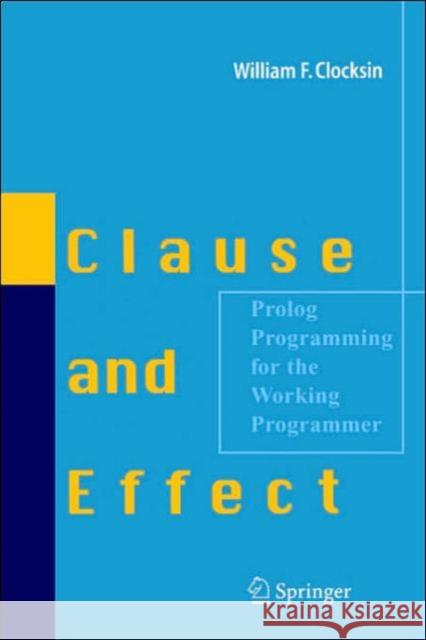
William F. Clocksin; W. F. Clocksin
Clause and Effect: PROLOG Programming for the Working Programmer Clocksin, William F. 9783540629719 Springer - książkaWidoczna okładka, to zdjęcie poglądowe, a rzeczywista szata graficzna może różnić się od prezentowanej.

Clause and Effect: PROLOG Programming for the Working Programmer

ISBN-13: 9783540629719 / Angielski / Miękka / 1997 / 143 str.

William F. Clocksin; W. F. Clocksin
cena 302,60
(netto: 288,19 VAT:  5%)

Najniższa cena z 30 dni: 289,13
Termin realizacji zamówienia:
ok. 22 dni roboczych
Dostawa w 2026 r.

Darmowa dostawa!

This book is for people who have done some programming, either in Prolog or in a language other than Prolog, and who can find their way around a reference manual. The emphasis of this book is on a simplified and disciplined methodology for discerning the mathematical structures related to a problem, and then turning these structures into Prolog programs. This book is therefore not concerned about the particular features of the language nor about Prolog programming skills or techniques in general. A relatively pure subset of Prolog is used, which includes the 'cut', but no input/output, no assert/retract, no syntactic extensions such as if then-else and grammar rules, and hardly any built-in predicates apart from arithmetic operations. I trust that practitioners of Prolog program ming who have a particular interest in the finer details of syntactic style and language features will understand my purposes in not discussing these matters. The presentation, which I believe is novel for a Prolog programming text, is in terms of an outline of basic concepts interleaved with worksheets. The idea is that worksheets are rather like musical exercises. Carefully graduated in scope, each worksheet introduces only a limited number of new ideas, and gives some guidance for practising them. The principles introduced in the worksheets are then applied to extended examples in the form of case studies."


Kategorie:
Informatyka, Programowanie
Kategorie BISAC:
Computers > Languages - General
Computers > Programming - Compilers
Computers > Software Development & Engineering - General
Wydawca:
Springer
Język:
Angielski
ISBN-13:
9783540629719
Rok wydania:
1997
Wydanie:
1997
Ilość stron:
143
Waga:
0.25 kg
Wymiary:
23.55 x 15.62 x 1.09
Oprawa:
Miękka
Wolumenów:
01

1. Getting Started.- 1.1 Syntax.- 1.2 Programs.- 1.3 Unification.- 1.4 Execution Model.- Worksheet 1: Party Pairs.- Worksheet 2: Drinking Pairs.- Worksheet 3: Affordable Journeys.- Worksheet 4: Acyclic Directed Graph.- 2. Data Structures.- 2.1 Square Bracket Notation.- Worksheet 5: Member.- 2.2 Arithmetic.- Worksheet 6: Length of a List.- Worksheet 7: Inner Product.- Worksheet 8: Maximum of a List.- Worksheet 9: Searching a Cyclic Graph.- 3. Mapping.- Worksheet 10: Full Maps.- Worksheet 11: Multiple Choices.- Worksheet 12: Partial Maps.- Worksheet 13: Removing Duplicates.- Worksheet 14: Partial Maps with a Parameter.- Worksheet 15: Multiple Disjoint Partial Maps.- Worksheet 16: Multiple Disjoint Partial Maps.- Worksheet 17: Full Maps with State.- Worksheet 18: Sequential Maps with State.- Worksheet 19: Scattered Maps with State.- 4. Choice and Commitment.- 4.1 The ‘Cut’.- 4.2 A Disjoint Partial Map with Cut.- Worksheet 20: Multiple Choices with Cut.- Worksheet 22: Ordered Search Trees.- Worksheet 23: Frequency Distribution.- 4.3 Taming Cut.- 4.4 Cut and Negation-as-Failure.- 4.5 Negation-as-Failure Can Be Misleading.- Worksheet 24: Negation-as-Failure.- 5. Difference Structures.- Worksheet 25: Concatenating Lists.- Worksheet 26: Rotations of a List.- Worksheet 27: Linearising.- 5.1 Difference Lists.- Worksheet 28: Linearising Efficiently.- Worksheet 29: Linearising Trees.- Worksheet 30: Difference Structures.- Worksheet 31: Rotation Revisited.- Worksheet 32: Max Tree.- 5.2 Solution to Max Tree.- 6. Case Study: Term Rewriting.- 6.1 Symbolic Differentiation.- 6.2 Matrix Products by Symbolic Algebra.- 6.3 The Simplifier.- 7. Case Study: Manipulation of Combinational Circuits.- 7.1 Representing Circuits.- 7.2 Simulation of Circuits.- 7.3 Sums and Products.- 7.4 Simplifying SOP Expressions.- 7.5 Alternative Representation.- 8. Case Study: Clocked Sequential Circuits.- 8.1 Divide-by-Two Pulse Divider.- 8.2 Sequential Parity Checker.- 8.3 Four-Stage Shift Register.- 8.4 Gray Code Counter.- 8.5 Specification of Cascaded Components.- 9. Case Study: A Compiler forThree Model Computers.- 9.1 The Register Machine.- 9.2 The Single-Accumulator Machine.- 9.3 The Stack Machine.- 9.4 Optimisation: Preprocessing the Syntax Tree.- 9.5 Peephole Optimisation.- 10. Case Study: The Fast Fourier Transform in Prolog.- 10.1 Introduction.- 10.2 Notation for Polynomials.- 10.3 The DFT.- 10.4 Example: 8-point DFT.- 10.5 Naive Implementation of the DFT.- 10.6 From DFT to FFT.- 10.7 Merging Common Subexpressions.- 10.8 The Graph Generator.- 10.9 Example Run: 8-point FFT.- 10.10 Bibliographic Notes.- 11. Case Study: Higher-Order Functional Programming.- 11.1 Introduction.- 11.2 A Notation for Functions.- 11.3 The Evaluator.- 11.4 Using Higher-Order Functions.- 11.5 Discussion.- 11.6 Bibliographic Notes.


Udostępnij

Facebook - konto krainaksiazek.pl


Opinie o Krainaksiazek.pl na Opineo.pl

Partner Mybenefit

Krainaksiazek.pl w programie rzetelna firma Krainaksiaze.pl - płatności przez paypal

Czytaj nas na:

Facebook - krainaksiazek.pl
  • książki na zamówienie
  • granty
  • książka na prezent
  • kontakt
  • pomoc
  • opinie
  • regulamin
  • polityka prywatności

Zobacz:

  • Księgarnia czeska

  • Wydawnictwo Książkowe Klimaty

1997-2025 DolnySlask.com Agencja Internetowa

© 1997-2022 krainaksiazek.pl
     
KONTAKT | REGULAMIN | POLITYKA PRYWATNOŚCI | USTAWIENIA PRYWATNOŚCI
Zobacz: Księgarnia Czeska | Wydawnictwo Książkowe Klimaty | Mapa strony | Lista autorów
KrainaKsiazek.PL - Księgarnia Internetowa

Polityka prywatnosci - link
Krainaksiazek.pl - płatnośc Przelewy24
Przechowalnia Przechowalnia





