• Wyszukiwanie zaawansowane
  • Kategorie
  • Kategorie BISAC
  • Książki na zamówienie
  • Promocje
  • Granty
  • Książka na prezent
  • Opinie
  • Pomoc
  • Załóż konto
  • Zaloguj się

Classical Geometry » książka


zaloguj się | załóż konto
Logo Krainaksiazek.pl

koszyk

konto

szukaj
topmenu
Księgarnia internetowa
Szukaj
Książki na zamówienie
Promocje
Granty
Książka na prezent
Moje konto
Pomoc
 
 
Wyszukiwanie zaawansowane
Pusty koszyk
Bezpłatna dostawa dla zamówień powyżej 20 złBezpłatna dostawa dla zamówień powyżej 20 zł

Kategorie główne

• Nauka
 [2946350]
• Literatura piękna
 [1816154]

  więcej...
• Turystyka
 [70666]
• Informatyka
 [151172]
• Komiksy
 [35576]
• Encyklopedie
 [23172]
• Dziecięca
 [611458]
• Hobby
 [135995]
• AudioBooki
 [1726]
• Literatura faktu
 [225763]
• Muzyka CD
 [378]
• Słowniki
 [2917]
• Inne
 [444280]
• Kalendarze
 [1179]
• Podręczniki
 [166508]
• Poradniki
 [469467]
• Religia
 [507199]
• Czasopisma
 [496]
• Sport
 [61352]
• Sztuka
 [242330]
• CD, DVD, Video
 [3348]
• Technologie
 [219391]
• Zdrowie
 [98638]
• Książkowe Klimaty
 [124]
• Zabawki
 [2382]
• Puzzle, gry
 [3525]
• Literatura w języku ukraińskim
 [259]
• Art. papiernicze i szkolne
 [7107]
Kategorie szczegółowe BISAC

Classical Geometry

ISBN-13: 9781118679197 / Angielski / Twarda / 2014 / 496 str.
Ed Leonard; J. E. Lewis; A. C. F. Liu
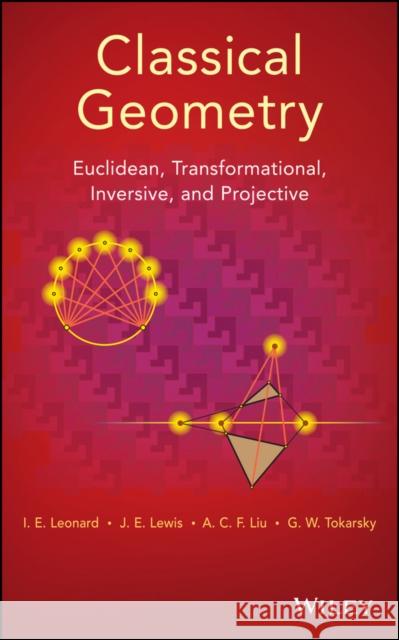
Classical Geometry Leonard, I. E. 9781118679197 John Wiley & Sons - książkaWidoczna okładka, to zdjęcie poglądowe, a rzeczywista szata graficzna może różnić się od prezentowanej.

Classical Geometry

ISBN-13: 9781118679197 / Angielski / Twarda / 2014 / 496 str.

Ed Leonard; J. E. Lewis; A. C. F. Liu
cena 448,27
(netto: 426,92 VAT:  5%)

Najniższa cena z 30 dni: 442,80
Termin realizacji zamówienia:
ok. 30 dni roboczych.

Darmowa dostawa!

Features the classical themes of geometry with plentiful applications in mathematics, education, engineering, and science Accessible and reader-friendly, Classical Geometry: Euclidean, Transformational, Inversive, and Projective introduces readers to a valuable discipline that is crucial to understanding bothspatial relationships and logical reasoning. Focusing on the development of geometric intuitionwhile avoiding the axiomatic method, a problem solving approach is encouraged throughout. The book is strategically divided into three sections: Part One focuses on Euclidean geometry, which provides the foundation for the rest of the material covered throughout; Part Two discusses Euclidean transformations of the plane, as well as groups and their use in studying transformations; and Part Three covers inversive and projective geometry as natural extensions of Euclidean geometry. In addition to featuring real-world applications throughout, Classical Geometry: Euclidean, Transformational, Inversive, and Projective includes:

  • Multiple entertaining and elegant geometry problems at the end of each section for every level of study
  • Fully worked examples with exercises to facilitate comprehension and retention
  • Unique topical coverage, such as the theorems of Ceva and Menalaus and their applications
  • An approach that prepares readers for the art of logical reasoning, modeling, and proofs
The book is an excellent textbook for courses in introductory geometry, elementary geometry, modern geometry, and history of mathematics at the undergraduate level for mathematics majors, as well as for engineering and secondary education majors. The book is also ideal for anyone who would like to learn the various applications of elementary geometry.

Written by well–known mathematical problem solvers, Modern Geometry features up–to–date and applicable coverage of the wide spectrum of modern geometry and aids readers in learning the art of logical reasoning, modeling, and proof.


Kategorie:
Nauka, Matematyka
Kategorie BISAC:
Mathematics > Geometria
Education > Statistics
Mathematics > Matematyka stosowana
Wydawca:
John Wiley & Sons
Język:
Angielski
ISBN-13:
9781118679197
Rok wydania:
2014
Ilość stron:
496
Waga:
0.79 kg
Wymiary:
23.62 x 15.75 x 3.05
Oprawa:
Twarda
Wolumenów:
01
Dodatkowe informacje:
Bibliografia

The book is an extremely valuable compendium of elementary constructions of Euclidean geometry. The text, especially the proofs, is clearly structured and move forward in simple steps, and thus are at the one hand very suitable for a beginner in geometry and at the other hand exemplary for a teacher of geometry.   (Zentralblatt MATH, 1 October 2014)


Preface v

PART I EUCLIDEAN GEOMETRY

1 Congruency 3

1.1 Introduction 3

1.2 Congruent Figures 6

1.3 Parallel Lines 12

1.3.1 Angles in a Triangle 13

1.3.2 Thales′ Theorem 14

1.3.3 Quadrilaterals 17

1.4 More About Congruency 21

1.5 Perpendiculars and Angle Bisectors 24

1.6 Construction Problems 28

1.6.1 The Method of Loci 31

1.7 Solutions to Selected Exercises 33

1.8 Problems 38

2 Concurrency 41

2.1 Perpendicular Bisectors 41

2.2 Angle Bisectors 43

2.3 Altitudes 46

2.4 Medians 48

2.5 Construction Problems 50

2.6 Solutions to the Exercises 54

2.7 Problems 56

3 Similarity 59

3.1 Similar Triangles 59

3.2 Parallel Lines and Similarity 60

3.3 Other Conditions Implying Similarity 64

3.4 Examples 67

3.5 Construction Problems 75

3.6 The Power of a Point 82

3.7 Solutions to the Exercises 87

3.8 Problems 90

4 Theorems of Ceva and Menelaus 95

4.1 Directed Distances, Directed Ratios 95

4.2 The Theorems 97

4.3 Applications of Ceva′s Theorem 99

4.4 Applications of Menelaus′ Theorem 103

4.5 Proofs of the Theorems 115

4.6 Extended Versions of the Theorems 125

4.6.1 Ceva′s Theorem in the Extended Plane 127

4.6.2 Menelaus′ Theorem in the Extended Plane 129

4.7 Problems 131

5 Area 133

5.1 Basic Properties 133

5.1.1 Areas of Polygons 134

5.1.2 Finding the Area of Polygons 138

5.1.3 Areas of Other Shapes 139

5.2 Applications of the Basic Properties 140

5.3 Other Formulae for the Area of a Triangle 147

5.4 Solutions to the Exercises 153

5.5 Problems 153

6 Miscellaneous Topics 159

6.1 The Three Problems of Antiquity 159

6.2 Constructing Segments of Specific Lengths 161

6.3 Construction of Regular Polygons 166

6.3.1 Construction of the Regular Pentagon 168

6.3.2 Construction of Other Regular Polygons 169

6.4 Miquel′s Theorem 171

6.5 Morley′s Theorem 178

6.6 The Nine–Point Circle 185

6.6.1 Special Cases 188

6.7 The Steiner–Lehmus Theorem 193

6.8 The Circle of Apollonius 197

6.9 Solutions to the Exercises 200

6.10 Problems 201

PART II TRANSFORMATIONAL GEOMETRY

7 The Euclidean Transformations or Isometries 207

7.1 Rotations, Reflections, and Translations 207

7.2 Mappings and Transformations 211

7.2.1 Isometries 213

7.3 Using Rotations, Reflections, and Translations 217

7.4 Problems 227

8 The Algebra of Isometries 231

8.1 Basic Algebraic Properties 231

8.2 Groups of Isometries 236

8.2.1 Direct and Opposite Isometries 237

8.3 The Product of Reflections 241

8.4 Problems 246

9 The Product of Direct Isometries 253

9.1 Angles 253

9.2 Fixed Points 255

9.3 The Product of Two Translations 256

9.4 The Product of a Translation and a Rotation 257

9.5 The Product of Two Rotations 260

9.6 Problems 263

10 Symmetry and Groups 269

10.1 More About Groups 269

10.1.1 Cyclic and Dihedral Groups 273

10.2 Leonardo′s Theorem 277

10.3 Problems 281

11 Homotheties 287

11.1 The Pantograph 287

11.2 Some Basic Properties 288

11.2.1 Circles 291

11.3 Construction Problems 293

11.4 Using Homotheties in Proofs 298

11.5 Dilatation 302

11.6 Problems 304

12 Tessellations 311

12.1 Tilings 311

12.2 Monohedral Tilings 312

12.3 Tiling with Regular Polygons 317

12.4 Platonic and Archimedean Tilings 323

12.5 Problems 330

PART III INVERSIVE AND PROJECTIVE GEOMETRIES

13 Introduction to Inversive Geometry 337

13.1 Inversion in the Euclidean Plane 337

13.2 The Effect of Inversion on Euclidean Properties 343

13.3 Orthogonal Circles 351

13.4 Compass–Only Constructions 360

13.5 Problems 369

14 Reciprocation and the Extended Plane 373

14.1 Harmonic Conjugates 373

14.2 The Projective Plane and Reciprocation 383

14.3 Conjugate Points and Lines 393

14.4 Conics 399

14.5 Problems 406

15 Cross Ratios 409

15.1 Cross Ratios 409

15.2 Applications of Cross Ratios 420

15.3 Problems 429

16 Introduction to Projective Geometry 433

16.1 Straightedge Constructions 433

16.2 Perspectivities and Projectivities 443

16.3 Line Perspectivities and Line Projectivities 448

16.4 Projective Geometry and Fixed Points 448

16.5 Projecting a Line to Infinity 451

16.6 The Apollonian Definition of a Conic 455

16.7 Problems 461

Bibliography 464

Index 469

I. E. LEONARD, PHD, is Lecturer in the Department of Mathematical and Statistical Sciences at the University of Alberta, Canada. The author of over fifteen journal articles, his areas of research interest include real analysis and discrete mathematics.

J. E. LEWIS, PHD, is Professor Emeritus in the Department of Mathematical Sciences at the University of Alberta, Canada. He was the recipient of the Faculty of Science Award for Excellence in Teaching in 2004.

A. C. F. LIU, PHD, is Professor in the Department of Mathematical and Statistical Sciences at the University of Alberta, Canada. He has authored over thirty journal articles.

G. W. TOKARSKY, MSC, is Faculty Lecturer in the Department of Mathematical and Statistical Sciences at the University of Alberta, Canada. His areas of research interest include polygonal billiards and symbolic logic.

Features the classical themes of geometry with plentiful applications in mathematics, education, engineering, and science

Accessible and reader–friendly, Classical Geometry: Euclidean, Transformational, Inversive, and Projective introduces readers to a valuable discipline that is crucial to understanding both spatial relationships and logical reasoning. Focusing on the development of geometric intuition while avoiding the axiomatic method, a problem–solving approach is encouraged throughout.

The book is strategically divided into three sections: Part One focuses on Euclidean geometry, which provides the foundation for the rest of the material covered throughout; Part Two discusses Euclidean transformations of the plane, as well as groups and their use in studying transformations; and Part Three covers inversive and projective geometry as natural extensions of Euclidean geometry. In addition to featuring real–world applications throughout, Classical Geometry: Euclidean, Transformational, Inversive, and Projective includes:

  • Multiple entertaining and elegant geometry problems at the end of each section for every level of study
  • Fully worked examples with exercises to facilitate comprehension and retention
  • Unique topical coverage, such as the theorems of Ceva and Menelaus and their applications
  • An approach that prepares readers for the art of logical reasoning, modeling, and proofs

The book is an excellent textbook for courses in introductory geometry, elementary geometry, modern geometry, and history of mathematics at the undergraduate level for mathematics majors, as well as for engineering and secondary education majors. The book is also ideal for anyone who would like to learn the various applications of elementary geometry.

Leonard, Ed J. Edson Leonard has been casting the fly for fres... więcej >


Udostępnij

Facebook - konto krainaksiazek.pl


Opinie o Krainaksiazek.pl na Opineo.pl

Partner Mybenefit

Krainaksiazek.pl w programie rzetelna firma Krainaksiaze.pl - płatności przez paypal

Czytaj nas na:

Facebook - krainaksiazek.pl
  • książki na zamówienie
  • granty
  • książka na prezent
  • kontakt
  • pomoc
  • opinie
  • regulamin
  • polityka prywatności

Zobacz:

  • Księgarnia czeska

  • Wydawnictwo Książkowe Klimaty

1997-2026 DolnySlask.com Agencja Internetowa

© 1997-2022 krainaksiazek.pl
     
KONTAKT | REGULAMIN | POLITYKA PRYWATNOŚCI | USTAWIENIA PRYWATNOŚCI
Zobacz: Księgarnia Czeska | Wydawnictwo Książkowe Klimaty | Mapa strony | Lista autorów
KrainaKsiazek.PL - Księgarnia Internetowa

Polityka prywatnosci - link
Krainaksiazek.pl - płatnośc Przelewy24
Przechowalnia Przechowalnia






