• Wyszukiwanie zaawansowane
  • Kategorie
  • Kategorie BISAC
  • Książki na zamówienie
  • Promocje
  • Granty
  • Książka na prezent
  • Opinie
  • Pomoc
  • Załóż konto
  • Zaloguj się

Choosing and Using a Refracting Telescope » książka


zaloguj się | załóż konto
Logo Krainaksiazek.pl

koszyk

konto

szukaj
topmenu
Księgarnia internetowa
Szukaj
Książki na zamówienie
Promocje
Granty
Książka na prezent
Moje konto
Pomoc
 
 
Wyszukiwanie zaawansowane
Pusty koszyk
Bezpłatna dostawa dla zamówień powyżej 20 złBezpłatna dostawa dla zamówień powyżej 20 zł

Kategorie główne

• Nauka
 [2949965]
• Literatura piękna
 [1857847]

  więcej...
• Turystyka
 [70818]
• Informatyka
 [151303]
• Komiksy
 [35733]
• Encyklopedie
 [23180]
• Dziecięca
 [617748]
• Hobby
 [139972]
• AudioBooki
 [1650]
• Literatura faktu
 [228361]
• Muzyka CD
 [398]
• Słowniki
 [2862]
• Inne
 [444732]
• Kalendarze
 [1620]
• Podręczniki
 [167233]
• Poradniki
 [482388]
• Religia
 [509867]
• Czasopisma
 [533]
• Sport
 [61361]
• Sztuka
 [243125]
• CD, DVD, Video
 [3451]
• Technologie
 [219309]
• Zdrowie
 [101347]
• Książkowe Klimaty
 [123]
• Zabawki
 [2362]
• Puzzle, gry
 [3791]
• Literatura w języku ukraińskim
 [253]
• Art. papiernicze i szkolne
 [7933]
Kategorie szczegółowe BISAC

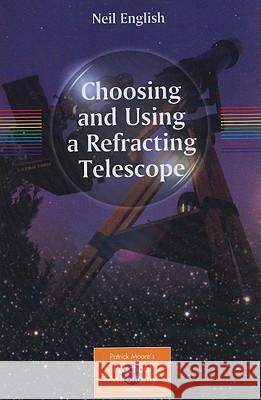
Choosing and Using a Refracting Telescope

ISBN-13: 9781441964021 / Angielski / Miękka / 2010 / 283 str.
English;¬Abar
Choosing and Using a Refracting Telescope English 9781441964021 SPRINGER - książkaWidoczna okładka, to zdjęcie poglądowe, a rzeczywista szata graficzna może różnić się od prezentowanej.

Choosing and Using a Refracting Telescope

ISBN-13: 9781441964021 / Angielski / Miękka / 2010 / 283 str.

English;¬Abar
cena 201,72 zł
(netto: 192,11 VAT:  5%)

Najniższa cena z 30 dni: 173,46 zł
Termin realizacji zamówienia:
ok. 22 dni roboczych
Bez gwarancji dostawy przed świętami

Darmowa dostawa!

Choosing and Using a Refracting Telescope has been written for the many amateur astronomers who already own, or are intending to purchase, a refracting telescope perhaps to complement their existing arsenal of larger reflecting telescopes or for the specialist who requires a particular refractor for serious astronomical applications. Four hundred year ago, during the winter of 1609, a relatively unknown Italian scientist, Galileo Galilei designed a spyglass with two crude lenses and turned it skyward. Since then, refractors have retained their dominance over all types of reflector in studies of the Moon, planets and double stars because of the precision of their optics and lack of a central obstruction in the optical path, which causes diffraction effects in all commercially-made reflectors. Most mature amateur astronomers got started with a 60mm refractor, or something similar. Thirty years ago there was little choice available to the hobbyist, but in the last decade long focus crown-flint achromats have moved aside for some exquisitely crafted apochromatic designs offered by leading commercial manufacturers. There has been a huge increase in the popularity of these telescopes in the last few years, led by a significant increase in the number of companies (particularly, William Optics, Orion USA, Stellarview, Skywatcher and AstroTech) who are now heavily marketing refractors in the amateur astronomical magazines. In Choosing and Using a Refracting Telescope, well-known observer and astronomy writer Neil English celebrates the remarkable history and evolution of the refracting telescope and looks in detail at the instruments, their evolution and their use. A major feature of this book is the way it compares not only different classes of refractor, but also telescopes of each class that are sold by various commercial manufacturers. The author is perhaps uniquely placed to do this, having used and tested literally hundreds of different refracting telescopes over three decades. Because it includes many diverse subjects such as imaging with consumer-level digital cameras, imaging with webcams, and imaging with astronomical CCD cameras that are not covered together in equal depth in any other single volume Choosing and Using a Refracting Telescope could become the refractor bible for amateur astronomers at all levels, especially those who are interested in imaging astronomical objects of every class."


Kategorie:
Nauka, Fizyka
Kategorie BISAC:
Science > Astronomia, przestrzeń i czas
Nature > Star Observation
Science > Scientific Instruments
Wydawca:
SPRINGER
Seria wydawnicza:
Patrick Moores Practical Astro
Język:
Angielski
ISBN-13:
9781441964021
Rok wydania:
2010
Wydanie:
2011
Numer serii:
000307426
Ilość stron:
283
Waga:
0.43 kg
Wymiary:
22.86 x 15.24 x 1.78
Oprawa:
Miękka
Wolumenów:
01
Dodatkowe informacje:
Bibliografia
Wydanie ilustrowane

From the reviews:

"Dr. Neil English is no stranger to the astronomical community ... . His knowledge of telescope optics is highly respected, and here he endeavours to lay down all his knowledge in a concise and thorough manner. He opens the book with a wonderful overview of the history of the telescope ... . this book something you really want to own, as it's a guide not only to what is achievable by anyone with modest equipment, but also what to aspire to. Thoroughly recommended." (Nick Howes, Astronomy Now Online, May, 2011)

"Neil English opens with a brief history of refractor design, including the contributions of Lippershey, Galileo and Huygens, amongst others. ... the text is clearly written and there's plenty of useful data in the appendix. ... it's a valuable resource for anyone thinking about buying a refractor or who wants to learn more about the history and development of this iconic scientific instrument." (Mark Parrish, BBC Sky at Night Magazine, June, 2011)

"Having owned around a dozen refractors over the years-ranging from a 'lowly' 40mm refractor, through several antique examples to a go-to refractor-I was keen to read a book that promised to reinforce my love for 'the prince of telescopes'. ... An excellent, up-to-date book containing much more than I have outlined in this review. English communicates his passion for refractors, and the book comes to life with user accounts of refractors old and new." (Peter Grego, Popular Astronomy, July-August, 2011)

"Value to have accessible a comprehensive guide to the availability and use of refractors, which have a special attraction and romance -- especially for those who have used and appreciated the best of them. ... The short but useful appendices include glossaries of terms and formulae, and data on a selection of double stars which can be used for testing refractors of various apertures. ... Even for those with only the slightest interest, it would certainly inspire them." (R. A. Marriott, The Observatory, Vol. 131 (1224), October, 2011)

Acknowledgments.- Introduction.- About the Author.- Part 1: The Achromatic Refractor.- Chapter 1: The Refracting Telescope - A Brief History.- Chapter 2: The Classical Achromatic.- Chapter 3: Rich-Field Achromats.- Chapter 4: Long Focus Achromats.- Chapter 5: Big Guns.- Chapter 6: Going Retro.- Part II: The Apochromatic Refractor.- Chapter 7: The APO Revolution.- Chapter 8: Doublet Apos.- Chapter 9: Sports Optics.- Chapter 10: Triplet Apos.- Chapter 11: Four Element Apos.- Chapter 12: Refractor Kit.- Chapter 13: Observing Platforms.- Chapter 14: Testing your Refractor.- Chapter 15: Photography with your Refractor.- Chapter 16: Looking Back, Looking Forward.- Appendix A: Refractor Design Through the Centuries.- Appendix B: Double Star Tests for Refractors of Various Apertures.- Appendix C: Useful Formulae.- Appendix D: Glossary.- Index

Dr. Neil English has a PhD in Biochemistry, and also a BSc in Physics & Astronomy. He is a Fellow of the Royal Astronomical Society, and a regular contributor to Astronomy Now (the UK’s major astronomy magazine), as well as to Ireland's Astronomy & Space. He is the author of Guide to Mars (Pole Star Publications, 2003). Neil’s astronomical images have been published in various magazines and journals, including a full page in the June 2006 issue of Astronomy. He has used and tested literally hundreds of refracting telescopes over a period of thirty years and has written about all aspects of this kind of instrument in the magazines. He owns and regularly uses a variety of refractors - both apochromat and achromat - which he uses from his home in rural Scotland.

The refracting telescope has a long and illustrious past. Here’s what the author says about early telescopes and today’s refractors: “Four centuries ago, a hitherto obscure Italian scientist turned a home-made spyglass towards the heavens. The lenses he used were awful by modern standards, inaccurately figured and filled with the scars of their perilous journey from the furnace to the finishing workshop. Yet, despite these imperfections, they allowed him to see what no one had ever seen before – a universe far more complex and dynamic than anyone had dared imagine. But they also proved endlessly useful in the humdrum of human affairs. For the first time ever, you could spy on your neighbor from a distance, or monitor the approach of a war-mongering army, thus deciding the fate of nations. “The refractor is without doubt the prince of telescopes. Compared with all other telescopic designs, the unobstructed view of the refractor enables it to capture the sharpest, highest contrast images and the widest usable field. No other telescope design can beat it on equal terms. From a practical point of view, refractors are the most comfortable and least troublesome telescope to observe with. They require little maintenance and cool down rapidly to allow you to observe in minutes rather than hours. Because a refractor has more back focus than almost any other form of telescope, it can accept the widest range of accessories, including filters, cameras, and binoviewers.” Explore in this book what makes refractors such a good choice for amateur astronomers and how to choose the right one for you. Also get some great tips on how to use your new refractor. Get started now, seeing for yourself the dazzling and complex universe first opened to human sight more just 400 years ago.

English John English is a professor of history at the Univ... więcej >


Udostępnij

Facebook - konto krainaksiazek.pl


Opinie o Krainaksiazek.pl na Opineo.pl

Partner Mybenefit

Krainaksiazek.pl w programie rzetelna firma Krainaksiaze.pl - płatności przez paypal

Czytaj nas na:

Facebook - krainaksiazek.pl
  • książki na zamówienie
  • granty
  • książka na prezent
  • kontakt
  • pomoc
  • opinie
  • regulamin
  • polityka prywatności

Zobacz:

  • Księgarnia czeska

  • Wydawnictwo Książkowe Klimaty

1997-2025 DolnySlask.com Agencja Internetowa

© 1997-2022 krainaksiazek.pl
     
KONTAKT | REGULAMIN | POLITYKA PRYWATNOŚCI | USTAWIENIA PRYWATNOŚCI
Zobacz: Księgarnia Czeska | Wydawnictwo Książkowe Klimaty | Mapa strony | Lista autorów
KrainaKsiazek.PL - Księgarnia Internetowa

Polityka prywatnosci - link
Krainaksiazek.pl - płatnośc Przelewy24
Przechowalnia Przechowalnia





