• Wyszukiwanie zaawansowane
  • Kategorie
  • Kategorie BISAC
  • Książki na zamówienie
  • Promocje
  • Granty
  • Książka na prezent
  • Opinie
  • Pomoc
  • Załóż konto
  • Zaloguj się

Children's Fractional Knowledge » książka


zaloguj się | załóż konto
Logo Krainaksiazek.pl

koszyk

konto

szukaj
topmenu
Księgarnia internetowa
Szukaj
Książki na zamówienie
Promocje
Granty
Książka na prezent
Moje konto
Pomoc
 
 
Wyszukiwanie zaawansowane
Pusty koszyk
Bezpłatna dostawa dla zamówień powyżej 20 złBezpłatna dostawa dla zamówień powyżej 20 zł

Kategorie główne

• Nauka
 [2949965]
• Literatura piękna
 [1857847]

  więcej...
• Turystyka
 [70818]
• Informatyka
 [151303]
• Komiksy
 [35733]
• Encyklopedie
 [23180]
• Dziecięca
 [617748]
• Hobby
 [139972]
• AudioBooki
 [1650]
• Literatura faktu
 [228361]
• Muzyka CD
 [398]
• Słowniki
 [2862]
• Inne
 [444732]
• Kalendarze
 [1620]
• Podręczniki
 [167233]
• Poradniki
 [482388]
• Religia
 [509867]
• Czasopisma
 [533]
• Sport
 [61361]
• Sztuka
 [243125]
• CD, DVD, Video
 [3451]
• Technologie
 [219309]
• Zdrowie
 [101347]
• Książkowe Klimaty
 [123]
• Zabawki
 [2362]
• Puzzle, gry
 [3791]
• Literatura w języku ukraińskim
 [253]
• Art. papiernicze i szkolne
 [7933]
Kategorie szczegółowe BISAC

Children's Fractional Knowledge

ISBN-13: 9781489984661 / Angielski / Miękka / 2014 / 364 str.
Leslie Steffe;John Olive
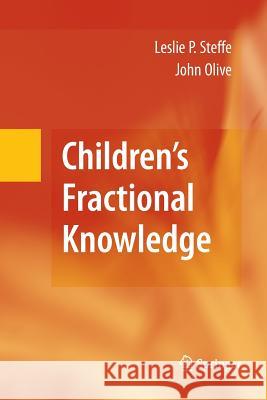
Children's Fractional Knowledge Leslie Steffe John Olive  9781489984661 Springer - książkaWidoczna okładka, to zdjęcie poglądowe, a rzeczywista szata graficzna może różnić się od prezentowanej.

Children's Fractional Knowledge

ISBN-13: 9781489984661 / Angielski / Miękka / 2014 / 364 str.

Leslie Steffe;John Olive
cena 403,47 zł
(netto: 384,26 VAT:  5%)

Najniższa cena z 30 dni: 385,52 zł
Termin realizacji zamówienia:
ok. 22 dni roboczych
Bez gwarancji dostawy przed świętami

Darmowa dostawa!
inne wydania

Children's Fractional Knowledge elegantly tracks the construction of knowledge, both by children learning new methods of reasoning and by the researchers studying their methods. The book challenges the widely held belief that children's whole number knowledge is a distraction from their learning of fractions by positing that their fractional learning involves reorganizing-not simply using or building upon-their whole number knowledge. This hypothesis is explained in detail using examples of actual grade-schoolers approaching problems in fractions including the schemes they construct to relate parts to a whole, to produce a fraction as a multiple of a unit part, to transform a fraction into a commensurate fraction, or to combine two fractions multiplicatively or additively. These case studies provide a singular journey into children's mathematics experience, which often varies greatly from that of adults. Moreover, the authors' descriptive terms reflect children's quantitative operations, as opposed to adult mathematical phrases rooted in concepts that do not reflect-and which in the classroom may even suppress-youngsters' learning experiences. Highlights of the coverage: * Toward a formulation of a mathematics of living instead of being * Operations that produce numerical counting schemes * Case studies: children's part-whole, partitive, iterative, and other fraction schemes * Using the generalized number sequence to produce fraction schemes * Redefining school mathematics This fresh perspective is of immediate importance to researchers in mathematics education. With the up-close lens onto mathematical development found in Children's Fractional Knowledge, readers can work toward creating more effective methods for improving young learners' quantitative reasoning skills.


Kategorie:
Nauka, Matematyka
Kategorie BISAC:
Education > Teaching - Subjects - Mathematics
Mathematics > Teoria liczb
Education > Schools - Levels - Elementary
Wydawca:
Springer
Język:
Angielski
ISBN-13:
9781489984661
Rok wydania:
2014
Wydanie:
2010
Ilość stron:
364
Waga:
0.54 kg
Wymiary:
23.39 x 15.6 x 2.03
Oprawa:
Miękka
Wolumenów:
01
Dodatkowe informacje:
Wydanie ilustrowane

Chapter I. A New Hypothesis Concerning Children's Fractional Knowledge The Interference Hypothesis The Separation Hypothesis Next Steps Chapter II. Perspectives on Children’s Fraction Knowledge On Opening the Trap Fractions as Schemes Mathematics of Living Rather Than Being Chapter III. Operations that Produce Numerical Counting Schemes Complexes of Discrete Units Recognition Templates of Perceptual Counting Schemes Recognition Templates of Figurative Counting Schemes Numerical Patterns and the Initial Number Sequence The Tacitly Nested Number Sequence The Explicitly Nested Number Sequence An Awareness of Numerosity: A Quantitative Property The Generalized Number Sequence An Overview of the Principal Operations of the Numerical Counting Schemes Final Comments Chapter IV: Articulation of the Reorganization Hypothesis Perceptual and Figurative Length Piaget's Gross, Intensive, and Extensive Quantity Composite Structures as Templates for Fragmenting Partitioning and Iterating Final Comments Chapter V: The Partitive and the Part-Whole Schemes The Equi-Partitioning Scheme Segmenting to Produce a Connected Number Making a Connected Number Sequence An Attempt to Use Multiplying Schemes in the Construction of Composite Unit Fractions Laura’s Simultaneous Partitioning Scheme Jason’s Partitive and Laura’s Part-Whole Fraction Schemes Establishing Fractional Meaning for Multiple Parts of a Stick Continued Absence of Fractional Numbers An Attempt to Use Units-Coordinating to Produce Improper Fractions Discussion of the Case Study Chapter VI. The Unit Composition and the Commensurate Schemes The Unit Fraction Composition Scheme Producing Composite Unit Fractions Producing Fractions Commensurate with One-Half ProducingFractions Commensurate With One-Third Producing Fractions Commensurate With Two-Thirds An Attempt to Engage Laura in the Construction of the Unit Fraction Composition Scheme Discussion of the Case Study Chapter VII. The Partitive, the Iterative, and the Unit Composition Schemes Joe’s Attempts to Construct Composite Unit Fractions Attempts to Construct a Unit Fraction of a Connected Number Partitioning and Disembedding Operations Joe’s Construction of a Partitive Fraction Scheme Joe’s Production of an Improper Fraction Patricia’s Recursive Partitioning Operations The Splitting Operation: Corroboration in Joe and Contraindication in Patricia A Lack of Distributive Reasoning Emergence of the Splitting Operation in Patricia Emergence of Joe’s Unit Fraction Composition Scheme Joe’s Reversible Partitive Fraction Scheme Joe’s Construction of the Iterative Fraction Scheme A Constraint in the Children’s Unit Fraction Composition Scheme Fractional Connected Number Sequences Establishing Commensurate Fractions Discussion of the Case Study Chapter VIII. Equi-Partitioning Operations for Connected Numbers: Their Use and Interiorization Melissa’s Initial Fraction Schemes A Reorganization in Melissa’s Units-Coordinating Scheme Melissa’s Construction of a Fractional Connected Number Sequence Testing the Hypothesis that Melissa Could Construct a Commensurate Fractional Scheme Melissa’s Use of the Operations that Produce Three Levels of Units in Re-presentation A Child-Generated Fraction Adding Scheme An Attempt to Bring Forth a Unit Fraction Adding Scheme Discussion of the Case Study Chapter IX. The Construction of Fraction Schemes Using the Generalized Number Sequence The Case of Nathan During his 3rd Grade Multiplication of Fractions and Nested Fractions Equal

Children’s Fractional Knowledge elegantly tracks the construction of knowledge, both by children learning new methods of reasoning and by the researchers studying their methods. The book challenges the widely held belief that children’s whole number knowledge is a distraction from their learning of fractions by positing that their fractional learning involves reorganizing—not simply using or building upon—their whole number knowledge. This hypothesis is explained in detail using examples of actual grade-schoolers approaching problems in fractions including the schemes they construct to relate parts to a whole, to produce a fraction as a multiple of a unit part, to transform a fraction into a commensurate fraction, or to combine two fractions multiplicatively or additively.

These case studies provide a singular journey into children’s mathematics experience, which often varies greatly from that of adults. Moreover, the authors’ descriptive terms reflect children’s quantitative operations, as opposed to adult mathematical phrases rooted in concepts that do not reflect—and which in the classroom may even suppress—youngsters’ learning experiences.

Highlights of the coverage:

  • Toward a formulation of a mathematics of living instead of being
  • Operations that produce numerical counting schemes
  • Case studies: children’s part-whole, partitive, iterative, and other fraction schemes
  • Using the generalized number sequence to produce fraction schemes
  • Redefining school mathematics

This fresh perspective is of immediate importance to researchers in mathematics education. With the up-close lens onto mathematical development found in Children’s Fractional Knowledge, readers can work toward creating more effective methods for improving young learners’ quantitative reasoning skills.


Udostępnij

Facebook - konto krainaksiazek.pl


Opinie o Krainaksiazek.pl na Opineo.pl

Partner Mybenefit

Krainaksiazek.pl w programie rzetelna firma Krainaksiaze.pl - płatności przez paypal

Czytaj nas na:

Facebook - krainaksiazek.pl
  • książki na zamówienie
  • granty
  • książka na prezent
  • kontakt
  • pomoc
  • opinie
  • regulamin
  • polityka prywatności

Zobacz:

  • Księgarnia czeska

  • Wydawnictwo Książkowe Klimaty

1997-2025 DolnySlask.com Agencja Internetowa

© 1997-2022 krainaksiazek.pl
     
KONTAKT | REGULAMIN | POLITYKA PRYWATNOŚCI | USTAWIENIA PRYWATNOŚCI
Zobacz: Księgarnia Czeska | Wydawnictwo Książkowe Klimaty | Mapa strony | Lista autorów
KrainaKsiazek.PL - Księgarnia Internetowa

Polityka prywatnosci - link
Krainaksiazek.pl - płatnośc Przelewy24
Przechowalnia Przechowalnia





