• Wyszukiwanie zaawansowane
  • Kategorie
  • Kategorie BISAC
  • Książki na zamówienie
  • Promocje
  • Granty
  • Książka na prezent
  • Opinie
  • Pomoc
  • Załóż konto
  • Zaloguj się

Characterisation of the Mechanical Properties of Heat-Induced Protein Deposits in Immersed Cleaning Systems » książka


zaloguj się | załóż konto
Logo Krainaksiazek.pl

koszyk

konto

szukaj
topmenu
Księgarnia internetowa
Szukaj
Książki na zamówienie
Promocje
Granty
Książka na prezent
Moje konto
Pomoc
 
 
Wyszukiwanie zaawansowane
Pusty koszyk
Bezpłatna dostawa dla zamówień powyżej 20 złBezpłatna dostawa dla zamówień powyżej 20 zł

Kategorie główne

• Nauka
 [2946600]
• Literatura piękna
 [1856966]

  więcej...
• Turystyka
 [72221]
• Informatyka
 [151456]
• Komiksy
 [35826]
• Encyklopedie
 [23190]
• Dziecięca
 [619653]
• Hobby
 [140543]
• AudioBooki
 [1577]
• Literatura faktu
 [228355]
• Muzyka CD
 [410]
• Słowniki
 [2874]
• Inne
 [445822]
• Kalendarze
 [1744]
• Podręczniki
 [167141]
• Poradniki
 [482898]
• Religia
 [510455]
• Czasopisma
 [526]
• Sport
 [61590]
• Sztuka
 [243598]
• CD, DVD, Video
 [3423]
• Technologie
 [219201]
• Zdrowie
 [101638]
• Książkowe Klimaty
 [124]
• Zabawki
 [2473]
• Puzzle, gry
 [3898]
• Literatura w języku ukraińskim
 [254]
• Art. papiernicze i szkolne
 [8170]
Kategorie szczegółowe BISAC

Characterisation of the Mechanical Properties of Heat-Induced Protein Deposits in Immersed Cleaning Systems

ISBN-13: 9783031218484 / Angielski / Twarda / 2023 / 88 str.
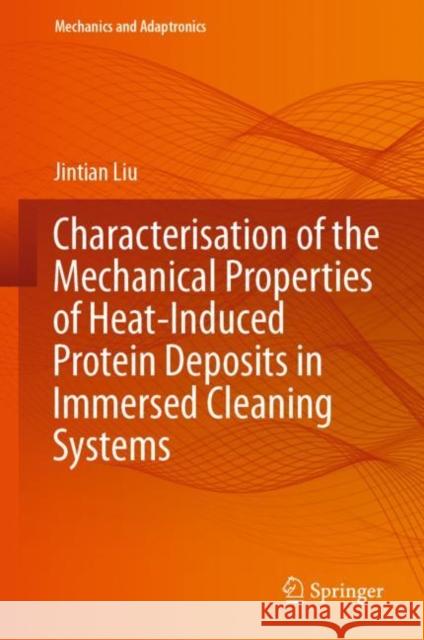
Jintian Liu
Characterisation of the Mechanical Properties of Heat-Induced Protein Deposits in Immersed Cleaning Systems Jintian Liu 9783031218484 Springer - książkaWidoczna okładka, to zdjęcie poglądowe, a rzeczywista szata graficzna może różnić się od prezentowanej.

Characterisation of the Mechanical Properties of Heat-Induced Protein Deposits in Immersed Cleaning Systems

ISBN-13: 9783031218484 / Angielski / Twarda / 2023 / 88 str.

Jintian Liu
cena 605,23 zł
(netto: 576,41 VAT:  5%)

Najniższa cena z 30 dni: 539,74 zł
Termin realizacji zamówienia:
ok. 22 dni roboczych
Bez gwarancji dostawy przed świętami

Darmowa dostawa!
inne wydania

During heat treatment in dairy production, the rapid formation of heat-induced fouling deposits on the plant surface leads to reduced efficiency of heat transfer. Therefore, a regular cleaning process is required to soften the heat-induced protein deposits and then remove them from the plant surface. The mechanical property of the deposits is one of the key issues of the cleaning mechanisms since the non-fractured behaviour dominates the deformation of the fouling layer and the failure behaviour has a great impact on the cohesive removal of fouling deposits. Considering the complicated geometry of fouling deposits and their irregular distribution, indentation experiments were carried out on various kinds of protein deposits. The experimental results reveal the significant influence of the thickness of fouling deposits on their mechanical behaviour and the time-dependent nonlinear behaviour of the deposits.Furthermore, heat-induced whey protein gel was used as the model material for fouling deposits and the non-fractured and fracture behaviour was characterized using compression and wire cutting experiments, respectively. The material parameters identified using the inverse finite element method allow the prediction of fracture behaviour under localized external loads and provide a deeper insight into cohesive removal. To investigate the softening effect during caustic washing, tensile experiments were conducted on chemically treated and untreated whey protein gels. Adequate chemical degradation leads to a softer mechanical response and increased stress relaxation, making whey protein gels more flowable and more resistant to tensile deformation. The experimental results provide useful data on the failure behaviour of chemically treated whey protein gels.


During heat treatment in dairy production, the rapid formation of heat-induced fouling deposits on the plant surface leads to reduced efficiency of heat transfer. Therefore, a regular cleaning process is required to soften the heat-induced protein deposits and then remove them from the plant surface. The mechanical property of the deposits is one of the key issues of the cleaning mechanisms since the non-fractured behaviour dominates the deformation of the fouling layer and the failure behaviour has a great impact on the cohesive removal of fouling deposits. Considering the complicated geometry of fouling deposits and their irregular distribution, indentation experiments were carried out on various kinds of protein deposits. The experimental results reveal the significant influence of the thickness of fouling deposits on their mechanical behaviour and the time-dependent nonlinear behaviour of the deposits.Furthermore, heat-induced whey protein gel was used as the model material for fouling deposits and the non-fractured and fracture behaviour was characterized using compression and wire cutting experiments, respectively. The material parameters identified using the inverse finite element method allow the prediction of fracture behaviour under localized external loads and provide a deeper insight into cohesive removal. To investigate the softening effect during caustic washing, tensile experiments were conducted on chemically treated and untreated whey protein gels. Adequate chemical degradation leads to a softer mechanical response and increased stress relaxation, making whey protein gels more flowable and more resistant to tensile deformation. The experimental results provide useful data on the failure behaviour of chemically treated whey protein gels.

Kategorie:
Technologie
Kategorie BISAC:
Technology & Engineering > Mechanical
Technology & Engineering > Biomedical
Technology & Engineering > Materials Science - General
Wydawca:
Springer
Seria wydawnicza:
Mechanics and Adaptronics
Język:
Angielski
ISBN-13:
9783031218484
Rok wydania:
2023
Dostępne języki:
Numer serii:
001264047
Ilość stron:
88
Oprawa:
Twarda
Dodatkowe informacje:
Wydanie ilustrowane

1 Introduction 

1.1 Motivation   
1.2 Aim of the present work 
1.3 Outline 
2 Background of cleaning in place 
2.1 Heat treatment in the dairy production 
2.2 Fouling and cleaning in the dairy production 
2.2.1 Heat-induced formation of fouling deposits 
2.2.2 The use of whey protein for experimental studies 
2.2.3 Cleaning process for the fouled heating surface 
2.3 The influence factors of cleaning in place 
2.4 Cleaning mechanisms on the mechanical properties of protein deposits 
3 Mechanical behaviour of heat-induced deposits 
3.1 Mechanical behaviour of fouling deposits 
3.1.1 Fouling experiments with raw milk and whey protein solution 
3.1.2 Realisation of quasi-static and dynamic indentation experiments 
3.1.3 Comparison of mechanical responses between milk and whey protein deposits 
3.1.4 Influences of heat treatment on the mechanical behaviour of fouling deposits 
3.2 Mechanical behaviour of whey protein gel 
3.2.1 Gelation of whey protein solution with different heating conditions 
3.2.2 Characterisation of fracture behaviour of WPG 
3.2.3 Degradation of the WPG samples with NaOH solution 
3.2.4 Characterisation of failure behaviour of WPG 
4 Constitutive modelling and numerical simulation 69 
4.1 Kinematics and balance equations 
4.1.1 Kinematics of deformation 
4.1.2 Stress tensors 
4.1.3 Balance equations 
4.2 Constitutive equations for protein deposits 
4.2.1 One-dimensional generalised Maxwell model 
4.2.2 Three-dimensional visco-hyperelastic model 
4.2.3 Parameter identification through inverse finite element method 
4.2.4 Application of modelling approaches 
5 Conclusion and Outlook 

Jintian Liu is a scientific assistant at the Institute of Machanics and Adaptronics (IMA, TU Braunschweig).


Before finishing the dissertation in January 2022, Mr Liu was responsible for the research project "Cleaning mechanisms of immerged systems", which is supported by the Deutsche Forschungsgemeinschaft (DFG) and conducted in cooperation with the Institute for Chemical and Thermal Process Engineering (TU Braunschweig). He used the whey protein gel as a representative material model to study the mechanical properties which are relevant to the cleaning process. In addition, his work involves experimental and numerical characterization of the mechanical behaviour of milk fouling deposits. His research results were presented at the 90th Annual Meeting of the International Association of Applied Mathematics and Mechanics GAMM 2019 in Vienna.


Besides the main research, Mr Liu has modelled the material behaviour of Elymus for the assessment of ecosystem services and experimentally characterized the mechanical strength of polymerized ionic liquids used for drug delivery systems.


Prior to his work at IMA, Mr Liu has finished the Dual Master's Degree Program supported by the German Academic Exchange Service (DAAD) under the cooperation between TU Braunschweig and Tongji University in Shanghai, China.

During heat treatment in dairy production, the rapid formation of heat-induced fouling deposits on the plant surface leads to reduced efficiency of heat transfer. Therefore, a regular cleaning process is required to soften the heat-induced protein deposits and then remove them from the plant surface. The mechanical property of the deposits is one of the key issues of the cleaning mechanisms since the non-fractured behaviour dominates the deformation of the fouling layer and the failure behaviour has a great impact on the cohesive removal of fouling deposits. Considering the complicated geometry of fouling deposits and their irregular distribution, indentation experiments were carried out on various kinds of protein deposits. The experimental results reveal the significant influence of the thickness of fouling deposits on their mechanical behaviour and the time-dependent nonlinear behaviour of the deposits.

Furthermore, heat-induced whey protein gel was used as the model material for fouling deposits and the non-fractured and fracture behaviour was characterized using compression and wire cutting experiments, respectively. The material parameters identified using the inverse finite element method allow the prediction of fracture behaviour under localized external loads and provide a deeper insight into cohesive removal. To investigate the softening effect during caustic washing, tensile experiments were conducted on chemically treated and untreated whey protein gels. Adequate chemical degradation leads to a softer mechanical response and increased stress relaxation, making whey protein gels more flowable and more resistant to tensile deformation. The experimental results provide useful data on the failure behaviour of chemically treated whey protein gels.




Udostępnij

Facebook - konto krainaksiazek.pl


Opinie o Krainaksiazek.pl na Opineo.pl

Partner Mybenefit

Krainaksiazek.pl w programie rzetelna firma Krainaksiaze.pl - płatności przez paypal

Czytaj nas na:

Facebook - krainaksiazek.pl
  • książki na zamówienie
  • granty
  • książka na prezent
  • kontakt
  • pomoc
  • opinie
  • regulamin
  • polityka prywatności

Zobacz:

  • Księgarnia czeska

  • Wydawnictwo Książkowe Klimaty

1997-2025 DolnySlask.com Agencja Internetowa

© 1997-2022 krainaksiazek.pl
     
KONTAKT | REGULAMIN | POLITYKA PRYWATNOŚCI | USTAWIENIA PRYWATNOŚCI
Zobacz: Księgarnia Czeska | Wydawnictwo Książkowe Klimaty | Mapa strony | Lista autorów
KrainaKsiazek.PL - Księgarnia Internetowa

Polityka prywatnosci - link
Krainaksiazek.pl - płatnośc Przelewy24
Przechowalnia Przechowalnia




