Part I: Death penalty debates in the 20th and 21st century: pros and cons 3
Chapter I: Introduction 4
Chapter II: The deterrent effect – from an a priori logic 8
Chapter III: Capital punishment as an inhumane punishment 11
Chapter IV: Necessity or lack of need for capital punishment 20
Chapter V: Miscarriage of justice 27
Chapter VI: The goal of punishment 38
Chapter VII: Economic considerations 42
Chapter VIII: Other reasons for and against capital punishment 47
Part II: A case study of capital punishment in Hungary in the 20th century 58
Chapter IX: Statutory Regulation of Capital Punishment in Hungary during the Horthy Era and World War II. 62
Chapter X: The death penalty in the years after liberation from Nazi occupation and during the establishment of the Soviet dictatorship 71
Chapter XI: Capital punishment in the first decade of state socialism 86
Chapter XII: Capital Punishment in the 60’s and 70’s 95
Chapter XIII: The Act no. IV of 1978 on the Criminal Code of Hungary 106
Chapter XIV: The end time of the death penalty in Hungary: Two steps of the abolition in 1989/90 117
Part III: The politicization of capital punishment in Hungary: renewed controversy 124
Chapter XV: Public opinion in Hungary in the light of the current legal situation and the facts about trends in murder rates 125
Chapter XVI: Revived debate on the death penalty in the political scene 135
Index
Zoltan J. Toth is Associate Professor in the Faculty of Law at Karoli Gaspar University of the Hungarian Reformed Church, Budapest, Hungary.
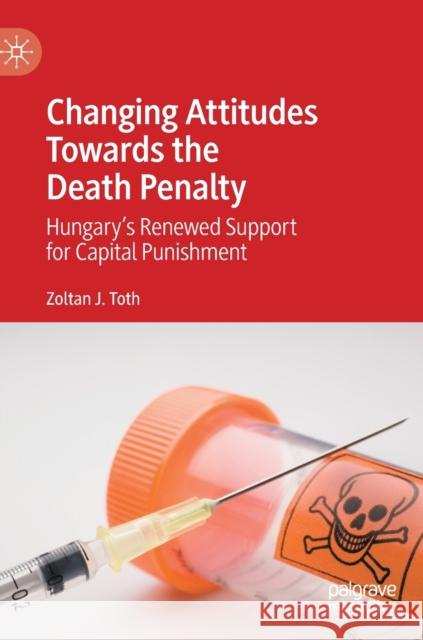
This book explores the pros and cons of the death penalty and the history of capital punishment. In this context, it puts a special emphasis on the situation in Hungary, where, amongst its neighbors, in recent years the demand for the reestablishment of the death penalty has received the strongest political support from many pro-government politicians. Toth presents tendencies toward abolition of the death penalty and to analyze the arguments by which the death penalty can, in principle, be criticized or even defended. The book presents the main issues of the death penalty, arguments of both abolitionists and retentionists, and reviews the modern history of this sanction. The monograph does not seek to convince the reader of the correctness or wrongness of the death penalty, but is specifically intended to present the arguments and counter-arguments objectively, without bias, reviewing the standpoints of both sides authentically, leaving the reader the right to choose and allowing discussion and argumentation to be informed.