• Wyszukiwanie zaawansowane
  • Kategorie
  • Kategorie BISAC
  • Książki na zamówienie
  • Promocje
  • Granty
  • Książka na prezent
  • Opinie
  • Pomoc
  • Załóż konto
  • Zaloguj się

Chance Encounters: Probability in Education » książka


zaloguj się | załóż konto
Logo Krainaksiazek.pl

koszyk

konto

szukaj
topmenu
Księgarnia internetowa
Szukaj
Książki na zamówienie
Promocje
Granty
Książka na prezent
Moje konto
Pomoc
 
 
Wyszukiwanie zaawansowane
Pusty koszyk
Bezpłatna dostawa dla zamówień powyżej 20 złBezpłatna dostawa dla zamówień powyżej 20 zł

Kategorie główne

• Nauka
 [2949965]
• Literatura piękna
 [1857847]

  więcej...
• Turystyka
 [70818]
• Informatyka
 [151303]
• Komiksy
 [35733]
• Encyklopedie
 [23180]
• Dziecięca
 [617748]
• Hobby
 [139972]
• AudioBooki
 [1650]
• Literatura faktu
 [228361]
• Muzyka CD
 [398]
• Słowniki
 [2862]
• Inne
 [444732]
• Kalendarze
 [1620]
• Podręczniki
 [167233]
• Poradniki
 [482388]
• Religia
 [509867]
• Czasopisma
 [533]
• Sport
 [61361]
• Sztuka
 [243125]
• CD, DVD, Video
 [3451]
• Technologie
 [219309]
• Zdrowie
 [101347]
• Książkowe Klimaty
 [123]
• Zabawki
 [2362]
• Puzzle, gry
 [3791]
• Literatura w języku ukraińskim
 [253]
• Art. papiernicze i szkolne
 [7933]
Kategorie szczegółowe BISAC

Chance Encounters: Probability in Education

ISBN-13: 9780792314745 / Angielski / Twarda / 1991 / 267 str.
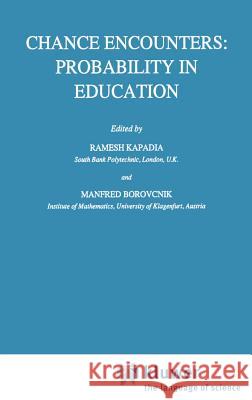
Ramesh Kapadia; Manfred Borovcnik; R. Kapadia
Chance Encounters: Probability in Education Ramesh Kapadia Manfred Borovcnik R. Kapadia 9780792314745 Springer - książkaWidoczna okładka, to zdjęcie poglądowe, a rzeczywista szata graficzna może różnić się od prezentowanej.

Chance Encounters: Probability in Education

ISBN-13: 9780792314745 / Angielski / Twarda / 1991 / 267 str.

Ramesh Kapadia; Manfred Borovcnik; R. Kapadia
cena 887,69
(netto: 845,42 VAT:  5%)

Najniższa cena z 30 dni: 848,19
Termin realizacji zamówienia:
ok. 22 dni roboczych
Bez gwarancji dostawy przed świętami

Darmowa dostawa!

This book has been written to fIll a substantial gap in the current literature in mathemat ical education. Throughout the world, school mathematical curricula have incorporated probability and statistics as new topics. There have been many research papers written on specifIc aspects of teaching, presenting novel and unusual approaches to introducing ideas in the classroom; however, there has been no book giving an overview. Here we have decided to focus on probability, making reference to inferential statistics where appropriate; we have deliberately avoided descriptive statistics as it is a separate area and would have made ideas less coherent and the book excessively long. A general lead has been taken from the fIrst book in this series written by the man who, probably more than everyone else, has established mathematical education as an aca demic discipline. However, in his exposition of didactical phenomenology, Freudenthal does not analyze probability. Thus, in this book, we show how probability is able to organize the world of chance and idealized chance phenomena based on its development and applications. In preparing these chapters we and our co-authors have reflected on our own acquisition of probabilistic ideas, analyzed textbooks, and observed and reflect ed upon the learning processes involved when children and adults struggle to acquire the relevant concepts.


Kategorie:
Nauka, Pedagogika i oświata
Kategorie BISAC:
Psychology > General
Education > General
Mathematics > Prawdopodobieństwo i statystyka
Wydawca:
Springer
Seria wydawnicza:
Developments in Cardiovascular Medicine
Język:
Angielski
ISBN-13:
9780792314745
Rok wydania:
1991
Wydanie:
1991
Numer serii:
000033649
Ilość stron:
267
Waga:
0.57 kg
Wymiary:
23.39 x 15.6 x 1.75
Oprawa:
Twarda
Wolumenów:
01
Dodatkowe informacje:
Bibliografia

' I recommand the book as a refreshing step in providing some snapshots of the fascinating area of stochastic thinking, views of the river of change. ' J. Research in Math. Education 24:1 1993

1: The Educational Perspective.- 1. Aims and Rationale.- 2. Views on Didactics.- Fischer’s open mathematics.- Fischbein’s interplay between intuitions and mathematics.- Freudenthal’s didactical phenomenology.- Bauersfeld’s subjective domains of experience.- 3. Basic Ideas of the Chapters.- A probabilistic perspective.- Empirical research in understanding probability.- Analysis of the probability curriculum.- The theoretical nature of probability in the classroom.- Computers in probability education.- Psychological research in probabilistic understanding.- 2: A Probabilistic Perspective.- 1. History and Philosophy.- Tardy conceptualization of probability.- The rule of ’ favourable to possible’.- Expectation and frequentist applications.- Inference and the normal law.- Foundations and obstacles.- Axiomatization of probability.- Modern views on probability.- 2. The Mathematical Background.- Model-building.- Assigning probabilities.- Conditional probability.- Random variables and distributions.- Central theorems.- Standard situations.- 3. Paradoxes and Fallacies.- Chance assignment.- Expectation.- Independence and dependence.- Logical curiosities.- Concluding comments.- 3: Empirical Research in Understanding Probability.- 1. Research Framework.- Peculiarities of stochastics and its teaching.- Research in psychology and didactics.- 2. Sample Space and Symmetry View.- Nod : Tossing a counter.- No.2: Hat lottery.- 3. Frequentist Interpretation.- No.3: The six children.- No.4: Snowfall.- 4. Independence and Dependence.- No.5: Dependent urns.- No.6: Independent urns.- 5. Statistical Inference.- No.7: Coin tossing.- No.8: Drawing from a bag.- 6. Concluding Comments.- Empirical research.- Teaching consequences.- 4: Analysis of the Probability Curriculum.- 1. General Aims.- Objectives.- Ideas.- Skills.- Inclination to apply ideas and skills.- 2. General Curriculum Issues.- Aspects of the curriculum.- Curriculum sources.- Choice of orientation.- 3. Curriculum Issues in Probability.- Student readiness.- Different approaches to probability curriculum.- 4. Approaches to the Probability Curriculum.- What to look for?.- Research needs.- 5: The Theoretical Nature of Probability in the Classroom.- 1. Approaches towards Teaching.- Structural approaches.- 2. The Theoretical Nature of Stochastic Knowledge.- Approaches to teaching probability.- Theoretical nature of probability.- Objects, signs and concepts.- 3. Didactic Means to Respect the Theoretical Nature of Probability.- Interrelations between mathematics and exemplary applications.- Means of representation and activities.- 4. On the Didactic Organization of Teaching Processes.- The role of teachers.- The role of task systems.- 5. Discussion of an Exemplary Task.- Didactic framework of the task.- Classroom observations.- Implications for task systems.- 6: Computers in Probability Education.- 1. Computers and Current Practice in Probability Teaching.- Pedagogical problems and perspectives.- Changes in probability, statistics, and in their applications.- Changing technology and its influence on pedagogical ideas.- 2. Computers as Mathematical Utilities.- The birthday problem.- Exploring Bayes’ formula.- Binomial probabilities.- Programming languages and other tools.- 3. Simulation as a Problem Solving Method.- Integrating simulation, algorithmics and programming.- Simulation as an alternative to solving problems analytically.- The potential of computer-aided simulation.- Software for simulation and modelling.- Computer generated random numbers.- 4. Simulation and Data Analysis for Providing an Empirical Background for Probability.- Making theoretical objects experiential.- Beginning with’ limited’ technological equipment.- Laws of large numbers and frequentist interpretation.- Random sampling and sampling variation.- Structure in random sequences.- A simulation and modelling tool as companion of the curriculum.- Games and strategy.- 5. Visualization, Graphical Methods and Animation.- 6. Concluding Remarks.- Software/Bibliography.- 7: Psychological Research in Probabilistic Understanding.- 1. Traditional Research Paradigms.- Probability learning.- Bayesian revision.- Disjunctive and conjunctive probabilities.- Correlation.- 2. Current Research Paradigms.- Judgemental heuristics.- Structure and process models of thinking.- Probability calibration.- Event-related brain potential research.- Overview on research paradigms.- 3. Critical Dimensions of Educational Relevance.- The conception of the task.- The conception of the subject.- The conception of the subject-task relation.- 4. Developmental Approaches on the Acquisition of the Probability Concept.- The cognitive-developmental approach of Piaget and Inhelder.- Fischbein’s learning-developmental approach.- Information processing approaches.- Semantic-conceptual and operative knowledge approach.- Discussion of the developmental approaches.- Looking Forward.


Udostępnij

Facebook - konto krainaksiazek.pl


Opinie o Krainaksiazek.pl na Opineo.pl

Partner Mybenefit

Krainaksiazek.pl w programie rzetelna firma Krainaksiaze.pl - płatności przez paypal

Czytaj nas na:

Facebook - krainaksiazek.pl
  • książki na zamówienie
  • granty
  • książka na prezent
  • kontakt
  • pomoc
  • opinie
  • regulamin
  • polityka prywatności

Zobacz:

  • Księgarnia czeska

  • Wydawnictwo Książkowe Klimaty

1997-2025 DolnySlask.com Agencja Internetowa

© 1997-2022 krainaksiazek.pl
     
KONTAKT | REGULAMIN | POLITYKA PRYWATNOŚCI | USTAWIENIA PRYWATNOŚCI
Zobacz: Księgarnia Czeska | Wydawnictwo Książkowe Klimaty | Mapa strony | Lista autorów
KrainaKsiazek.PL - Księgarnia Internetowa

Polityka prywatnosci - link
Krainaksiazek.pl - płatnośc Przelewy24
Przechowalnia Przechowalnia






