• Wyszukiwanie zaawansowane
  • Kategorie
  • Kategorie BISAC
  • Książki na zamówienie
  • Promocje
  • Granty
  • Książka na prezent
  • Opinie
  • Pomoc
  • Załóż konto
  • Zaloguj się

Challenges of a Changing Earth: Proceedings of the Global Change Open Science Conference, Amsterdam, the Netherlands, 10-13 July 2001 » książka


zaloguj się | załóż konto
Logo Krainaksiazek.pl

koszyk

konto

szukaj
topmenu
Księgarnia internetowa
Szukaj
Książki na zamówienie
Promocje
Granty
Książka na prezent
Moje konto
Pomoc
 
 
Wyszukiwanie zaawansowane
Pusty koszyk
Bezpłatna dostawa dla zamówień powyżej 20 złBezpłatna dostawa dla zamówień powyżej 20 zł

Kategorie główne

• Nauka
 [2952079]
• Literatura piękna
 [1850969]

  więcej...
• Turystyka
 [71058]
• Informatyka
 [151066]
• Komiksy
 [35579]
• Encyklopedie
 [23181]
• Dziecięca
 [620496]
• Hobby
 [139036]
• AudioBooki
 [1646]
• Literatura faktu
 [228729]
• Muzyka CD
 [379]
• Słowniki
 [2932]
• Inne
 [445708]
• Kalendarze
 [1409]
• Podręczniki
 [164793]
• Poradniki
 [480107]
• Religia
 [510956]
• Czasopisma
 [511]
• Sport
 [61267]
• Sztuka
 [243299]
• CD, DVD, Video
 [3411]
• Technologie
 [219640]
• Zdrowie
 [100984]
• Książkowe Klimaty
 [124]
• Zabawki
 [2281]
• Puzzle, gry
 [3363]
• Literatura w języku ukraińskim
 [258]
• Art. papiernicze i szkolne
 [8020]
Kategorie szczegółowe BISAC

Challenges of a Changing Earth: Proceedings of the Global Change Open Science Conference, Amsterdam, the Netherlands, 10-13 July 2001

ISBN-13: 9783540433088 / Angielski / Twarda / 2002 / 216 str.
Huang L. Yuan; W. Steffen; J. Jager
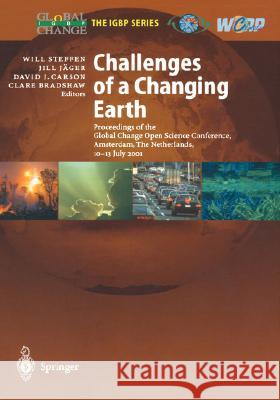
Challenges of a Changing Earth: Proceedings of the Global Change Open Science Conference, Amsterdam, the Netherlands, 10-13 July 2001 Steffen, Will 9783540433088 Springer - książkaWidoczna okładka, to zdjęcie poglądowe, a rzeczywista szata graficzna może różnić się od prezentowanej.

Challenges of a Changing Earth: Proceedings of the Global Change Open Science Conference, Amsterdam, the Netherlands, 10-13 July 2001

ISBN-13: 9783540433088 / Angielski / Twarda / 2002 / 216 str.

Huang L. Yuan; W. Steffen; J. Jager
cena 806,99
(netto: 768,56 VAT:  5%)

Najniższa cena z 30 dni: 771,08
Termin realizacji zamówienia:
ok. 22 dni roboczych
Dostawa w 2026 r.

Darmowa dostawa!

This volume is based on plenary presentations from Challenges of a Changing Earth, a Global Change Open Science Conference held in Amsterdam, The Neth- lands, in July 2001. The meeting brought together about 1400 scientists from 105 co- tries around the world to describe, discuss and debate the latest scientific - derstanding of natural and human-driven changes to our planet. It examined the effects of these changes on our societies and our lives, and explored what the future might hold. The presentations drew upon global change science from an exceptionally wide range of disciplines and approaches. Issues of societal importance the food system, air quality, the carbon cycle, and water resources were highlighted from both policy and science perspectives. Many of the talks presented the exciting scientific advances of the past decade of international research on global change. Several challenged the scientific community in the future. What are the visionary and creative new approaches needed for studying a complex planetary system in which human activities are in- mately interwoven with natural processes? This volume aims to capture the timeliness and excitement of the science p- sented in Amsterdam. The plenary speakers were given a daunting task: to reproduce their presentations in a way that delivers their scientific messages accurately and in sufficient detail but at the same time reaches a very broad audience well beyond their own disciplines. Furthermore, they were required to do this in just a few pages."


Kategorie:
Nauka, Biologia i przyroda
Kategorie BISAC:
Science > Earth Sciences - Geology
Science > Earth Sciences - Meteorology & Climatology
Nature > Environmental Conservation & Protection - General
Wydawca:
Springer
Seria wydawnicza:
Global Change--The Igbp Series,
Język:
Angielski
ISBN-13:
9783540433088
Rok wydania:
2002
Wydanie:
2002
Numer serii:
000253741
Ilość stron:
216
Waga:
1.48 kg
Wymiary:
27.9 x 21.0
Oprawa:
Twarda
Wolumenów:
01
Dodatkowe informacje:
Bibliografia
Wydanie ilustrowane

Praise for Will Steffen's, Challenges of a Changing Earth

American Meteorological Society

"This book presents a state-of-the-science overview of global change and its consequences for human societies. It highlights four areas of critical importance: food, water resources, air quality, and the carbon cycle. From both science and policy prespectives; discusses the new scientific approaches needed to study the Earth system in the future; and summarizes recent advances in understanding in global change science."

I Opening.- 1 Opening Address.- 2 Challenges of a Changing Earth.- References.- II Achievements and Challenges: Part IIa Food, Land, Water, and Oceans.- 3 Toward Integrated Land-Change Science: Advances in 1.5 Decades of Sustained International Research on Land-Use and Land-Cover Change.- 3.1Trends.- 3.2 Causes.- 3.3 Model-Methods.- 3.4 Summary and Observations.- References.- 4 Climate Variability and Ocean Ecosystem Dynamics: Implications for Sustainability.- 4.1 Introduction.- 4.2 Climate Effects on Marine Ecosystems.- 4.3 Implications for Sustainability.- References.- 5 Food in the 21st Century: Global Climate of Disparities.- 5.1 Food in the 21st Century: Global Climate of Disparities.- 5.2 The Critical Role of Knowledge.- 5.3 Environment and Sustainable Development.- 5.4 Global Environmental Change.- 5.5 Global Agro-Ecological Assessment.- 5.6 Global AEZ Findings.- 5.7 Global Warming and Climate Change.- 5.8 Impact of Climate Change on Worldwide Cereal Production.- 5.9 Food Security and Climate Change.- 5.10 Climate Change Impact: Fairness and Equity?.- 5.11 Concluding Remark.- References.- 6 Equity Dimensions of Dam-Based Water Resources Development: Winners and Losers.- 6.1 Introduction.- 6.2 Why is Equity Relevant in River Basin Development Contexts? An Illustration from the Senegal River.- 6.3 Role of Dams in Water Resources Allocation.- 6.4 Addressing Equity Dimensions of Dam-Based Water Resources Development.- 6.4.1 The Concept of Equity.- 6.4.2 Ideas for Improving the Equity Performance of Dam Projects.- 6.5 Conclusions.- References.- IIb Out of Breath: Air Quality in the 21st Century.- 7 Atmospheric Chemistry in the “Anthropocene”.- 8 Fires, Haze and Acid Rain: The Social and Political Framework of Air Pollution in ASEAN and Asia.- 8.0 Introduction: Air Pollution and Asia in Context.- 8.1 Part 1: The Problem in Perspective.- 8.1.1 The Haze: Summary of a Recurring Disaster.- 8.1.2 Northeast Asian Acid Rain: The Smog of GrowthY35.- 8.2 Part 2: International Principles and Practice.- 8.2.1 International Law and Practice in Other Regions.- 8.2.2 The ASEAN Way and Environmental Cooperation.- 8.2.3 Cooperation in Northeast Asia.- 8.3 Part 3: Assessing and Improving Regional Cooperation on the Environment.- 8.3.1 Assessment and Prospects for Improvement.- 8.3.2 How to Improve ASEAN?.- 8.3.3 Northeast Asian Cooperation.- 8.4 Conclusion: Strengthening the Social and Political Frameworks.- General References.- Specific References.- IIc Managing Planetary Metabolism? The Global Carbon Cycle.- 9 Carbon and the Science-Policy Nexus: The Kyoto Challenge.- 9.1 The Global Carbon Cycle.- 9.2 Human Perturbation of the Carbon Cycle.- 9.3 The Terrestrial Sink.- 9.4 Location of the Terrestrial Sink.- 9.5 Variability of the Terrestrial Sink.- 9.6 Origin of the Terrestrial Sink.- 9.7 The Future of the Terrestrial Carbon Cycle.- References.- 10 Industry Response to the CO2 Challenge.- 10.1 Introduction.- 10.2 The Energy Context.- 10.3 The Industry Response.- 10.3.1 Reducing GHG Emissions.- 10.3.2 Future Innovations.- 10.3.3 Renewable Energy.- 10.3.4 Transport Fuels.- 10.4 Relations between Business and the Scientific Community.- 10.5 Summary of the Key Points.- IId Summary: Global Change and the Challenge for the Future.- 11 Global Change and the Challenge for the Future.- III Advances in Understanding: Part IIIa Global Biogeochemistry: Understanding the Metabolic System of the Planet.- 12 Ocean Biogeochemistry: A Sea of Change.- 12.1 Introduction.- 12.2 The Oceanic Carbon Cycle.- 12.3 Ocean Time-Series Programmes.- 12.4 Summary.- References.- 13 The Past, Present and Future of Carbon on Land.- 13.1 What Controls the Behaviour of Biospheric Carbon?.- 13.2 The Carbon Cycle is Constrained by Other Elemental Cycles.- 13.3 The Nitrogen-Carbon Link.- 13.4 Do Land Ecosystems Retain Nitrogen Deposited From the Air?.- 13.5 The Phosphorus-Nitrogen Link.- 13.6 The Carbon Cycle During the Past 420 Thousand Years.- References.- 14 Can New Institutions Solve Atmospheric Problems? Confronting Acid Rain, Ozone Depletion and Climate Change.- 14.1 Does the Regime Have Appropriate Behavioural Mechanisms?.- 14.2 Has the Regime Given Rise to a Robust Social Practice?.- 14.3 Does the Regime Have a Sensitive Steering System?.- 14.4 Implications for the Climate Regime.- References.- IIIb Land-Ocean Interactions: Regional-Global Linkages.- 15 Emissions from the Oceans to the Atmosphere, Deposition from the Atmosphere to the Oceans and the Interactions Between Them.- 15.1 Atmospheric Inputs to the Oceans.- 15.1.1 Nitrogen.- 15.1.2 Iron.- 15.2 Emissions from the Ocean to the Atmosphere.- 15.3 Interacting Cycles — the Challenge for the Future.- References.- 16 The Impact of Dams on Fisheries: Case of the Three Gorges Dam.- 16.1 The Effect of Dams on Deltas and Estuaries.- 16.2 The Case of the Three Gorges Dam.- 16.3 Threat to Other Shelves.- References.- 17 Global Change in the Coastal Zone: The Case of Southeast Asia.- 17.1 Where is the Coastal Zone and Why Southeast Asia?.- 17.2 Pressures on the Coastal Zone: Population and a Resource-Dependent Economy.- References.- IIIc The Climate System: Prediction, Change and Variability.- 18 Climate Change Fore and Aft: Where on Earth Are We Going?.- 19 Climate Change — Past, Present and Future: A Personal Perspective.- 19.1 Lessons from the Past.- 19.2 Global Temperature Change.- 19.3 The Future in Perspective of the Past.- References.- 20 The Changing Cryosphere: Impacts of Global Warming in the High Latitudes.- 20.1 What Is the Cryosphere and How Does It Contribute to Global Climate Change?.- 20.2 What Is the Empirical Evidence of Climate Change in the High Latitudes?.- 20.3 Impacts of Global Warming in the High Latitudes.- 21 The Coupled Climate System: Variability and Predictability.- 21.1 Introduction.- 21.2 Seasonal to Interannual Climate Variability.- 21.3 Decadal Climate Variability.- 21.4 Detection and Attribution of Climate Change.- IIId Hot Spots of Land-Use Change and the Climate System: A Regional or Global Concern.- 22 Hot Spots of Land-Use Change and the Climate System: A Regional or Global Concern?.- References.- 23 Africa: Greening of the Sahara.- 23.1 Africa: A Hot Spot of Nonlinear Atmosphere-Vegetation Interaction.- 23.2 The African Wet Period.- 23.3 Abrupt Changes in North Africa.- 23.4 Will North Africa Become Green Again in the Near Future?.- 23.5 Outlook.- Acknowledgements.- References.- 24 The Role of Large-Scale Vegetation and Land Use in the Water Cycle and Climate in Monsoon Asia.- 24.1 The Asian Monsoon As a Huge Water Cycling System.- 24.2 Atmospheric Water Cycle over Monsoon Asia and the Eurasian Continent.- 24.3 Is Monsoon Rainfall Decreasing? The Impact of Deforestation on the Water Cycle in Thailand.- 24.4 Do Water-Fed Rice Paddy Fields Increase Rainfall in Monsoon Asia?.- 24.5 A Hydro-Climate Memory Effect of the Taiga-Permafrost System in Siberia.- References.- 25 Can Human-Induced Land-Cover Change Modify the Monsoon System?.- 25.1.- 25.2.- 25.3.- 25.4.- 25.5.- References.- 26 The Amazon Basin and Land-Cover Change: A Future in the Balance?.- 26.1 Land-Use Change.- 26.2 Impacts on the Carbon Cycle.- 26.3 Impacts on the Atmosphere.- 26.4 Impacts on Water Chemistry.- 26.5 The Future.- Acknowledgements.- References.- IV Looking to the Future: Part IVa Simulating and Observing the Earth System.- 27 Virtual Realities of the Past, Present and Future.- 27.1 What Are General Circulation Models (GCMs)?.- 27.2 How Do We Use Climate Models?.- 27.3 How Well Do Models Simulate Present Climate?.- 27.4 How Well Do Models Predict Past Climate Change?.- 27.5 What Are the Predictions for the Future?.- 27.6 What Developments Are Likely in the Future?.- 27.7 How Can We Deal with Uncertainty in Predictions?.- 27.8 Concluding Remarks.- References.- 28 Coping with Earth System Complexity and Irregularity.- 28.1 The Challenge.- 28.2 Great Cognitive Barriers.- 28.3 Breaches and Bypasses to Understanding.- 28.4 Adaptive Planetary Stewardship.- References.- 29 Simulating and Observing the Earth System: Summary.- 29.1 Earth System.- 29.2 Simulators.- 29.3 Observations.- 29.4 The Way Forward.- IVb Does the Earth System Need Biodiversity?.- 30 Marine Biodiversity: Why We Need It in Earth System Science.- Reference.- 31 Does Biodiversity Matter to Terrestrial Ecosystem Processes and Services?.- 31.1 Is Biodiversity Important to the Functioning of the Earth System?.- 31.2 What is Biodiversity?.- 31.3 The Most Abundant Plants Are Important for Ecosystem Functioning.- 31.4 The Number of Functionally Similar Species Is Important in Facing Environmental Change.- 31.5 Implications for Conservation and Sustainable Management.- 32 Biodiversity Loss and the Maintenance of Our Life-Support System.- 32.1 How Does Biodiversity Affect Ecosystem Functioning at Small Scales?.- 32.2 Scaling Up in Time: Biodiversity As Insurance Against Environmental Changes.- 32.3 Scaling Up in Space: Biodiversity Effects at Landscape and Regional Scales.- 32.4 Conclusions.- References.- IVc Can Technology Spare the Planet?.- 33 Maglevs and the Vision of St. Hubert - Or the Great Restoration of Nature: Why and How.- 33.1 Introduction.- 33.2 The Vision of St. Hubert.- 33.3 Our Triune Brain.- 33.4 Sparing Sea Life.- 33.5 Sparing Farmland.- 33.6 Sparing Forests.- 33.7 Sparing Pavement.- 33.8 Cardinal Resolutions.- References.- 34 Industrial Transformation: Exploring System Change in Production and Consumption.- 34.1 Human Choice on Issues Involving a Time Scale of Decades to Centuries.- 34.2 Transformation: Why, How Does It Work and What Are the Options.- 34.3 From Green Products to System Transformation.- 34.4 Five Major Foci for Transformation Research.- 34.5 International Cooperation.- 34.6 In Summary.- References.- 35 Will Technology Spare the Planet?.- References.- IVd Towards Global Sustainability.- 36 Challenges and Road Blocks for Local and Global Sustainability.- 36.1 Advances.- 36.2 International Instruments: Urgency of Goals and Synergies.- 36.3 The Biodiversity Convention.- 36.4 The Climate Change Convention.- 36.5 Synergies.- 36.6 New Inputs.- 37 Research Systems for a Transition Toward Sustainability.- Acknowledgements.- References.- 38 Summary: Towards Global Sustainability.- IVe Closing Session.- 39 Closing Address.- 39.1 Science and Policy.- 39.2 Prospects for the Climate Change Negotiations.- 40 The Amsterdam Declaration on Global Change.


Udostępnij

Facebook - konto krainaksiazek.pl


Opinie o Krainaksiazek.pl na Opineo.pl

Partner Mybenefit

Krainaksiazek.pl w programie rzetelna firma Krainaksiaze.pl - płatności przez paypal

Czytaj nas na:

Facebook - krainaksiazek.pl
  • książki na zamówienie
  • granty
  • książka na prezent
  • kontakt
  • pomoc
  • opinie
  • regulamin
  • polityka prywatności

Zobacz:

  • Księgarnia czeska

  • Wydawnictwo Książkowe Klimaty

1997-2025 DolnySlask.com Agencja Internetowa

© 1997-2022 krainaksiazek.pl
     
KONTAKT | REGULAMIN | POLITYKA PRYWATNOŚCI | USTAWIENIA PRYWATNOŚCI
Zobacz: Księgarnia Czeska | Wydawnictwo Książkowe Klimaty | Mapa strony | Lista autorów
KrainaKsiazek.PL - Księgarnia Internetowa

Polityka prywatnosci - link
Krainaksiazek.pl - płatnośc Przelewy24
Przechowalnia Przechowalnia






