• Wyszukiwanie zaawansowane
  • Kategorie
  • Kategorie BISAC
  • Książki na zamówienie
  • Promocje
  • Granty
  • Książka na prezent
  • Opinie
  • Pomoc
  • Załóż konto
  • Zaloguj się

Cellular Neural Networks: Chaos, Complexity and VLSI Processing » książka


zaloguj się | załóż konto
Logo Krainaksiazek.pl

koszyk

konto

szukaj
topmenu
Księgarnia internetowa
Szukaj
Książki na zamówienie
Promocje
Granty
Książka na prezent
Moje konto
Pomoc
 
 
Wyszukiwanie zaawansowane
Pusty koszyk
Bezpłatna dostawa dla zamówień powyżej 20 złBezpłatna dostawa dla zamówień powyżej 20 zł

Kategorie główne

• Nauka
 [2946600]
• Literatura piękna
 [1856966]

  więcej...
• Turystyka
 [72221]
• Informatyka
 [151456]
• Komiksy
 [35826]
• Encyklopedie
 [23190]
• Dziecięca
 [619653]
• Hobby
 [140543]
• AudioBooki
 [1577]
• Literatura faktu
 [228355]
• Muzyka CD
 [410]
• Słowniki
 [2874]
• Inne
 [445822]
• Kalendarze
 [1744]
• Podręczniki
 [167141]
• Poradniki
 [482898]
• Religia
 [510455]
• Czasopisma
 [526]
• Sport
 [61590]
• Sztuka
 [243598]
• CD, DVD, Video
 [3423]
• Technologie
 [219201]
• Zdrowie
 [101638]
• Książkowe Klimaty
 [124]
• Zabawki
 [2473]
• Puzzle, gry
 [3898]
• Literatura w języku ukraińskim
 [254]
• Art. papiernicze i szkolne
 [8170]
Kategorie szczegółowe BISAC

Cellular Neural Networks: Chaos, Complexity and VLSI Processing

ISBN-13: 9783642642326 / Angielski / Miękka / 2011 / 273 str.
Gabriele Manganaro; Paolo Arena; Luigi Fortuna
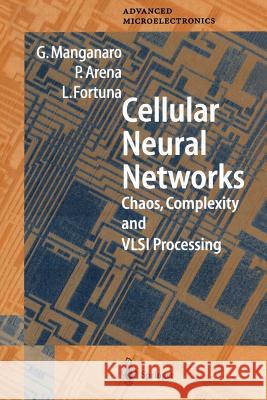
Cellular Neural Networks: Chaos, Complexity and VLSI Processing Manganaro, Gabriele 9783642642326 Springer - książkaWidoczna okładka, to zdjęcie poglądowe, a rzeczywista szata graficzna może różnić się od prezentowanej.

Cellular Neural Networks: Chaos, Complexity and VLSI Processing

ISBN-13: 9783642642326 / Angielski / Miękka / 2011 / 273 str.

Gabriele Manganaro; Paolo Arena; Luigi Fortuna
cena 403,47 zł
(netto: 384,26 VAT:  5%)

Najniższa cena z 30 dni: 385,52 zł
Termin realizacji zamówienia:
ok. 22 dni roboczych
Bez gwarancji dostawy przed świętami

Darmowa dostawa!

The field of cellular neural networks (CNNs) is of growing importance in non linear circuits and systems and it is maturing to the point of becoming a new area of study in general nonlinear theory. CNNs emerged through two semi nal papers co-authored by Professor Leon O. Chua back in 1988. Since then, the attention that CNNs have attracted in the scientific community has been vast. For instance, there are international workshops dedicated to CNNs and their applications, special issues published in both the International Journal of Circuit Theory and in the IEEE Transactions on Circuits and Systems, and there are also Associate Editors appointed in the latter journal especially for the CNN field. All of this bears witness the importance that CNNs are gaining within the scientific community. Without doubt this book is a primer in the field. Its extensive coverage provides the reader with a very comprehensive view of aspects involved in the theory and applications of cellular neural networks. The authors have done an excellent job merging basic CNN theory, synchronization, spatio temporal phenomena and hardware implementation into eight exquisitely written chapters. Each chapter is thoroughly illustrated with examples and case studies. The result is a book that is not only excellent as a professional reference but also very appealing as a textbook. My view is that students as well professional engineers will find this volume extremely useful."


Kategorie:
Nauka, Medycyna
Kategorie BISAC:
Medical > Medycyna
Education > Counseling - Career Development
Technology & Engineering > Telecommunications
Wydawca:
Springer
Seria wydawnicza:
Springer Series in Advanced Microelectronics
Język:
Angielski
ISBN-13:
9783642642326
Rok wydania:
2011
Wydanie:
Softcover Repri
Numer serii:
000142796
Ilość stron:
273
Waga:
0.45 kg
Wymiary:
23.5 x 15.5
Oprawa:
Miękka
Wolumenów:
01

From the reviews:

"The book is divided into eight chapters and each of them guides us through one area where the CNNs can be used ... . I recommend the publication to everybody, who is interested in the CNN and its application and implementation, but also to those who face some of the technologies described there, such as nonlinear dynamics, synchronization, signal processing or motion control, because the CNN can show a quite novel and beneficial point of view." (Václav Dekanovský, Neural Network World, Vol. 15 (5), 2005)

I. Circuit Theory and Applications of CNNs.- 1. CNN Basics.- 1.1 The CNN of Chua and Yang.- 1.1.1 The Cell.- 1.1.2 The CNN Array.- 1.1.3 More About Templates.- 1.1.4 Multilayer CNNs.- 1.1.5 The CNN as an Analog Processor.- 1.1.6 Some Stability Results.- 1.2 Main Generalizations.- 1.2.1 Nonlinear CNNs and Delay CNNs.- 1.2.2 Nonuniform Processor CNNs and Multiple Neighborhood Size CNNs.- 1.2.3 Discrete-Time CNNs.- 1.2.4 The CNN Universal Machine.- 1.3 A Formal Definition.- 1.3.1 The Cells and Their Coupling.- 1.3.2 Boundary Conditions.- 1.4 Summary.- 2. Some Applications of CNNs.- 2.1 CNN-Based Image Pre-processing for the Automatic Classification of Fruits.- 2.1.1 The Pre-filtering.- 2.2 Processing of NMR Spectra.- 2.2.1 Two-Dimensional NMR Spectra.- 2.2.2 Processing of NMR Spectra with CNNs.- 2.2.3 Description of the Dual Algorithm.- 2.3 Air Quality Modeling.- 2.3.1 Models.- 2.3.2 CNNs for Air Quality Modeling.- 2.3.3 Examples.- 2.4 Conclusions.- 3. The CNN as a Generator of Nonlinear Dynamics.- 3.1 The State Controlled CNN Model.- 3.1.1 Discrete Components Realization of SC-CNN Cells.- 3.2 Chua Oscillator Dynamics Generated by the SC-CNN.- 3.2.1 Main Result.- 3.2.2 Experimental Results.- 3.3 Chaotic Dynamics of a Colpitts Oscillator.- 3.4 Hysteresis Hyperchaotic Oscillator.- 3.5 n-Double Scroll Attractors.- 3.5.1 A New Realization of the n-Double Scroll Family.- 3.5.2 n-Double Scrolls in SC-CNNs.- 3.6 Nonlinear Dynamics Potpourri.- 3.6.1 A Non-autonomous Second Order Chaotic Circuit.- 3.6.2 A Circuit with a Nonlinear Reactive Element.- 3.6.3 Canards and Chaos.- 3.6.4 Multimode Chaos in Coupled Oscillators.- 3.6.5 Coupled Circuits.- 3.7 General Case and Conclusions.- 3.7.1 Theoretical Implications.- 3.7.2 Practical Implications.- 4. Synchronization.- 4.1 Background.- 4.1.1 Pecora-Carroll Approach.- 4.1.2 Inverse System Approach.- 4.2 Experimental Signal Transmission Using Synchronized SC-CNN.- 4.2.1 Circuit Description.- 4.2.2 Synchronization: Results of Experiment and Simulation.- 4.2.3 Non-ideal Channel Effects.- 4.2.4 Effects of Additive Noise and Disturbances on the Channel.- 4.3 Chaotic System Identification.- 4.3.1 Description of the Algorithm.- 4.3.2 Identification of the Chua Oscillator.- 4.3.3 Examples.- 4.4 Summary and Conclusions.- 5. Spatio-temporal Phenomena.- 5.1 Analysis of the Cell.- 5.1.1 Fixed Points.- 5.1.2 Limit Cycle and Bifurcations.- 5.1.3 Slow-Fast Dynamics.- 5.1.4 Some Simulation Results.- 5.2 The Two-Layer CNN.- 5.3 Traveling Wavefronts.- 5.3.1 Autowaves.- 5.3.2 Labyrinths.- 5.4 Pattern Formation.- 5.4.1 Condition for the Existence of Turing Patterns in Arrays of Coupled Circuits.- 5.4.2 Turing Patterns in the Two-Layer CNN.- 5.4.3 Simulation Results.- 5.5 Sensitivity to Parametric Uncertainties and Noise.- 5.5.1 Spiral Wave: Parametric Uncertainty.- 5.5.2 Spiral Waves: Presence of Noise in the Initial Conditions.- 5.5.3 Patterns: Parametric Uncertainties.- 5.6 Summary and Conclusions.- 6. Experimental CNN Setup and Applications to Motion Control.- 6.1 The Experimental Setup.- 6.1.1 Realization of the Cell for Autowave Generation.- 6.1.2 Realization of the Cell for Pattern formation.- 6.1.3 Realization of the Laplacian Couplings and Boundary Conditions.- 6.1.4 Realization of the Main Board.- 6.1.5 Autowave Experiments.- 6.2 Pattern Formation and Propagation.- 6.3 CNNs for Generating and Controlling Artificial Locomotion.- 6.3.1 Links to Biological Locomotion.- 6.3.2 WORMBOT: A Ring-Worm-like Walking Robot.- 6.3.3 REXABOT: An Hexapode Reaction-Diffusion Walking Robot.- 6.3.4 READIBELT: Reaction Diffusion Conveyor Belt Autowave Driven.- 6.4 Conclusion.- II. Implementation and Design.- 7. A Four Quadrant S2I Switched-Current Multiplier.- 7.1 Detailed Analysis of the S2I Memory Cell.- 7.2 The Multiplier Architecture.- 7.3 Analysis and Design of the S2I Multiplier.- 7.3.1 Circuit Analysis of the Multiplier.- 7.3.2 Circuit Design.- 7.4 Experimental Performance Evaluation.- 7.5 Summary.- 8. A One-Dimensional Discrete-Time CNN Chip for Audio Signal Processing.- 8.1 System Architecture.- 8.2 The Tapped Delay Line.- 8.3 CNN Cells.- 8.3.1 Multiplier and Ancillary Circuitry.- 8.4 Cell Behavior and Hardware Multiplexing.- 8.5 Results and Example.- 8.6 Summary.- A. Mathematical Background.- A.1 Topology.- A.2 Operations and Functions.- A.3 Matrices.- A.4 Dimension.- A.5 Dynamical Systems: Basic Definitions.- A.6 Steady-State Behavior.- A.6.1 Classification of Asymptotic Behavior.- A.7 Stability.- A.7.1 Stability of equilibrium points.- A.7.2 Stability of Limit Cycles.- A.7.3 Lyapunov Exponents.- A.8 Topological Equivalence and Conjugacy, Structural Stability and Bifurcations.- A.9 Silnikov Method.- A.10 Particular Results for Two-Dimensional Flows.- B. Library of Templates.- References.

The book is about new applications of cellular neural networks, new theoretical results and implementation issues. The reader will find thorough discussion on the subject, ranging from the highest-level aspects treated in rigorous analytic way, to the technological challenges and the circuit design aspects.

This book presents a comprehensive description of the emerging technology of cellular neural networks (CNNs), the first general purpose analog microprocessors with applications including real-time image and audio processing, image recognition, and the solution of partial differential equations. It discusses some realistic industrial applications of CNNs (including automatic fruit classification, nuclear magnetic resonance spectra image processing, environmental modeling and simulation for pollution distribution forecast). Particular attention is paid to the study of CNNs in the context of nonlinear circuit theory. Emphasis is also given to chaotic oscillators and their application in secure communication and spread-spectrum systems. Discussed in addition is the subject of spatio-temporal dynamic phenomena in two-dimensional CNNs. It is shown how traveling wavefronts, spirals, and Turing patterns can develop in a regular and topologically simple array. The book is completed by the description of a real CMOS discrete-time switched-current chip implementation of a CNN. The book offers thorough discussions that range from issues at the system-level, which are characterized by a rigorous analytic approach, to the technological and IC design aspects. Examples, simulation studies and experimental results complement the theoretical results throughout.

Manganaro, Gabriele Gabriele Manganaro is currently an Engineering Dir... więcej >


Udostępnij

Facebook - konto krainaksiazek.pl


Opinie o Krainaksiazek.pl na Opineo.pl

Partner Mybenefit

Krainaksiazek.pl w programie rzetelna firma Krainaksiaze.pl - płatności przez paypal

Czytaj nas na:

Facebook - krainaksiazek.pl
  • książki na zamówienie
  • granty
  • książka na prezent
  • kontakt
  • pomoc
  • opinie
  • regulamin
  • polityka prywatności

Zobacz:

  • Księgarnia czeska

  • Wydawnictwo Książkowe Klimaty

1997-2025 DolnySlask.com Agencja Internetowa

© 1997-2022 krainaksiazek.pl
     
KONTAKT | REGULAMIN | POLITYKA PRYWATNOŚCI | USTAWIENIA PRYWATNOŚCI
Zobacz: Księgarnia Czeska | Wydawnictwo Książkowe Klimaty | Mapa strony | Lista autorów
KrainaKsiazek.PL - Księgarnia Internetowa

Polityka prywatnosci - link
Krainaksiazek.pl - płatnośc Przelewy24
Przechowalnia Przechowalnia





