• Wyszukiwanie zaawansowane
  • Kategorie
  • Kategorie BISAC
  • Książki na zamówienie
  • Promocje
  • Granty
  • Książka na prezent
  • Opinie
  • Pomoc
  • Załóż konto
  • Zaloguj się

Cellular Automata: Analysis and Applications » książka


zaloguj się | załóż konto
Logo Krainaksiazek.pl

koszyk

konto

szukaj
topmenu
Księgarnia internetowa
Szukaj
Książki na zamówienie
Promocje
Granty
Książka na prezent
Moje konto
Pomoc
 
 
Wyszukiwanie zaawansowane
Pusty koszyk
Bezpłatna dostawa dla zamówień powyżej 20 złBezpłatna dostawa dla zamówień powyżej 20 zł

Kategorie główne

• Nauka
 [2949965]
• Literatura piękna
 [1857847]

  więcej...
• Turystyka
 [70818]
• Informatyka
 [151303]
• Komiksy
 [35733]
• Encyklopedie
 [23180]
• Dziecięca
 [617748]
• Hobby
 [139972]
• AudioBooki
 [1650]
• Literatura faktu
 [228361]
• Muzyka CD
 [398]
• Słowniki
 [2862]
• Inne
 [444732]
• Kalendarze
 [1620]
• Podręczniki
 [167233]
• Poradniki
 [482388]
• Religia
 [509867]
• Czasopisma
 [533]
• Sport
 [61361]
• Sztuka
 [243125]
• CD, DVD, Video
 [3451]
• Technologie
 [219309]
• Zdrowie
 [101347]
• Książkowe Klimaty
 [123]
• Zabawki
 [2362]
• Puzzle, gry
 [3791]
• Literatura w języku ukraińskim
 [253]
• Art. papiernicze i szkolne
 [7933]
Kategorie szczegółowe BISAC

Cellular Automata: Analysis and Applications

ISBN-13: 9783319530420 / Angielski / Twarda / 2017 / 467 str.
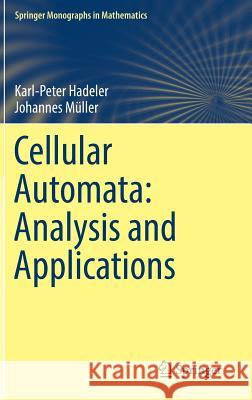
Karl-Peter Hadeler; Johannes Muller
Cellular Automata: Analysis and Applications Karl-Peter Hadeler Johannes Muller 9783319530420 Springer - książkaWidoczna okładka, to zdjęcie poglądowe, a rzeczywista szata graficzna może różnić się od prezentowanej.

Cellular Automata: Analysis and Applications

ISBN-13: 9783319530420 / Angielski / Twarda / 2017 / 467 str.

Karl-Peter Hadeler; Johannes Muller
cena 524,53 zł
(netto: 499,55 VAT:  5%)

Najniższa cena z 30 dni: 501,19 zł
Termin realizacji zamówienia:
ok. 22 dni roboczych
Bez gwarancji dostawy przed świętami

Darmowa dostawa!

This book provides an overview of the main approaches used to analyze the dynamics of cellular automata. Cellular automata are an indispensable tool in mathematical modeling. In contrast to classical modeling approaches like partial differential equations, cellular automata are relatively easy to simulate but difficult to analyze. In this book we present a review of approaches and theories that allow the reader to understand the behavior of cellular automata beyond simulations. The first part consists of an introduction to cellular automata on Cayley graphs, and their characterization via the fundamental Cutis-Hedlund-Lyndon theorems in the context of various topological concepts (Cantor, Besicovitch and Weyl topology). The second part focuses on classification results: What classification follows from topological concepts (Hurley classification), Lyapunov stability (Gilman classification), and the theory of formal languages and grammars (Kůrka classification)? These classifications suggest that cellular automata be clustered, similar to the classification of partial differential equations into hyperbolic, parabolic and elliptic equations. This part of the book culminates in the question of whether the properties of cellular automata are decidable. Surjectivity and injectivity are examined, and the seminal Garden of Eden theorems are discussed. In turn, the third part focuses on the analysis of cellular automata that inherit distinct properties, often based on mathematical modeling of biological, physical or chemical systems. Linearity is a concept that allows us to define self-similar limit sets. Models for particle motion show how to bridge the gap between cellular automata and partial differential equations (HPP model and ultradiscrete limit). Pattern formation is related to linear cellular automata, to the Bar-Yam model for the Turing pattern, and Greenberg-Hastings automata for excitable media. In addition, models for sand piles, the dynamics of infectious diseases, and evolution of predator-prey systems are discussed. Mathematicians will find an essential overview of theory and tools used for the analysis of cellular automata. The book also features an appendix introducing the reader to basic mathematical techniques and notations, so that physicists, chemists and biologists interested in cellular automata beyond pure simulations will also benefit from the book.>


Kategorie:
Nauka, Matematyka
Kategorie BISAC:
Mathematics > Mathematical Analysis
Mathematics > Matematyka stosowana
Mathematics > Równania różniczkowe
Wydawca:
Springer
Seria wydawnicza:
Springer Monographs in Mathematics
Język:
Angielski
ISBN-13:
9783319530420
Rok wydania:
2017
Wydanie:
2017
Numer serii:
000038505
Ilość stron:
467
Waga:
0.84 kg
Wymiary:
23.39 x 15.6 x 2.69
Oprawa:
Twarda
Wolumenów:
01
Dodatkowe informacje:
Wydanie ilustrowane

"I have enjoyed reading this book. It provides a clear account, with many examples and nice proofs, of the most important and general rigorous results of cellular automata in a way that is accessible to a wide readership. Advanced undergraduate and beginning graduate students of several fields ... will find here a valuable toolbox. The book is also valuable for self-study and as a reference, and does a great service in bridging the gap between applications/simulations and rigorous mathematical results." (Vladimir García Morales, Mathematical Reviews, January, 2018)


"This book gives a comprehensive overview of the methods of analysis that are applicable to these dynamical systems. ... this is the first work that gives a comprehensive overview of the methods that have been proposed to derive a cellular automaton from a partial differential equation, and vice versa. ... this book is a must-have for researchers in the field." (Jan Baetens, zbMATH 1382.37001, 2018)

1.Introduction.- 2.Cellular automata - basic definitions.- 3.Cantor topology of cellular automata.- 4.Besicovitch and Weyl topologies.- 5 Attractors.- 6 Chaos and Lyapunov stability.- 7 Language classification of Kůrka.- 8.Turing machines, tiles, and computability.- 9 Surjectivity and injectivity of global maps.- 10.Linear Cellular Automata.- 11 Particle motion.- 12.- Pattern formation.- 13.Applications in various areas.- A.Basic mathematical tools.

Karl Peter Hadeler, Dr.rer.nat. 1965  (U. of Hamburg), Habilitation 1967 (U. of Hamburg). In 1963/1964 visiting Moscow State University (MGU), 1968/1969 Visiting Associate Professor,U. of Minnesota. 1970 Associate Professor, Technical Department, U. of Erlangen. 1971 Professor of Mathematics, U. of Tübingen. Retired 2005, then 2005-2011 Non-permanent Professor, Arizona State University. Visiting Professor Aarhus, Nijmegen, Georgia Tech, Emory. 2009 John von Neumann Professorship, Technical University of Munich. Member of Center of Excellence (DFG/German NSF). Research interests: Ordinary and partial differential equations (reaction diffusion equations), delay equations, matrix theory, mathematical biology. Since 2011 about ten publications in mathematics. 

Johannes Müller studied in Karlsruhe and Tübingen, where he did his habilitation in 2001. After stays in Utrecht and Cologne, he became head of a research group in the Institute for Biomathematics and Biometry in the Helmholtz Center, Munich. Since 2004 he is teaching as a professor at the Technische Universität München. The research interests of Johannes Müller is on the interface of mathematics and life sciences. In particular his research is concerned with the theory of dynamical systems, cellular automata, and stochastic processes respectively their application.

This book focuses on a coherent representation of the main approaches to analyze the dynamics of cellular automata. Cellular automata are an inevitable tool in mathematical modeling. In contrast to classical modeling approaches as partial differential equations, cellular automata are straightforward to simulate but hard to analyze. In this book we present a review of approaches and theories that allow the reader to understand the behavior of cellular automata beyond simulations.
The first part consists of an introduction of cellular automata on Cayley graphs, and their characterization via the fundamental Cutis-Hedlund-Lyndon theorems in the context of different topological concepts (Cantor, Besicovitch and Weyl topology). The second part focuses on classification results: What classification follows from topological concepts (Hurley classification),  Lyapunov stability (Gilman classification), and the theory of formal languages and grammars (Kůrka classification). These classifications suggest to cluster cellular automata, similar to the classification of partial differential equations in hyperbolic, parabolic and elliptic equations. This part of the book  culminates in the question, whether properties of cellular automata are decidable. Surjectivity, and injectivity are examined, and the seminal Garden of Eden theorems are discussed. 
The third part focuses on the analysis of cellular automata that inherit distinct properties, often based on mathematical modeling of biological, physical or chemical systems. Linearity is a concept that allows to define self-similar limit sets. Models for particle motion show how to bridge the gap between cellular automata and partial differential equations (HPP model and ultradiscrete limit). Pattern formation is related to linear cellular automata, to the Bar-Yam model for Turing pattern, and Greenberg-Hastings automata for excitable media. Also models for sandpiles, the dynamics of infectious diseases and evolution of predator-prey systems are discussed. Mathematicians find an overview about theory and tools for the analysis of cellular automata. The book contains an appendix introducing basic mathematical techniques and notations, such that also physicists, chemists and biologists interested in cellular automata beyond pure simulations will  benefit.

Muller, Johannes Johannes Muller is Professor of Paleozoology at th... więcej >


Udostępnij

Facebook - konto krainaksiazek.pl


Opinie o Krainaksiazek.pl na Opineo.pl

Partner Mybenefit

Krainaksiazek.pl w programie rzetelna firma Krainaksiaze.pl - płatności przez paypal

Czytaj nas na:

Facebook - krainaksiazek.pl
  • książki na zamówienie
  • granty
  • książka na prezent
  • kontakt
  • pomoc
  • opinie
  • regulamin
  • polityka prywatności

Zobacz:

  • Księgarnia czeska

  • Wydawnictwo Książkowe Klimaty

1997-2025 DolnySlask.com Agencja Internetowa

© 1997-2022 krainaksiazek.pl
     
KONTAKT | REGULAMIN | POLITYKA PRYWATNOŚCI | USTAWIENIA PRYWATNOŚCI
Zobacz: Księgarnia Czeska | Wydawnictwo Książkowe Klimaty | Mapa strony | Lista autorów
KrainaKsiazek.PL - Księgarnia Internetowa

Polityka prywatnosci - link
Krainaksiazek.pl - płatnośc Przelewy24
Przechowalnia Przechowalnia





