• Wyszukiwanie zaawansowane
  • Kategorie
  • Kategorie BISAC
  • Książki na zamówienie
  • Promocje
  • Granty
  • Książka na prezent
  • Opinie
  • Pomoc
  • Załóż konto
  • Zaloguj się

Cell Migration in Inflammation and Immunity: Methods and Protocols » książka


zaloguj się | załóż konto
Logo Krainaksiazek.pl

koszyk

konto

szukaj
topmenu
Księgarnia internetowa
Szukaj
Książki na zamówienie
Promocje
Granty
Książka na prezent
Moje konto
Pomoc
 
 
Wyszukiwanie zaawansowane
Pusty koszyk
Bezpłatna dostawa dla zamówień powyżej 20 złBezpłatna dostawa dla zamówień powyżej 20 zł

Kategorie główne

• Nauka
 [2946912]
• Literatura piękna
 [1852311]

  więcej...
• Turystyka
 [71421]
• Informatyka
 [150889]
• Komiksy
 [35717]
• Encyklopedie
 [23177]
• Dziecięca
 [617324]
• Hobby
 [138808]
• AudioBooki
 [1671]
• Literatura faktu
 [228371]
• Muzyka CD
 [400]
• Słowniki
 [2841]
• Inne
 [445428]
• Kalendarze
 [1545]
• Podręczniki
 [166819]
• Poradniki
 [480180]
• Religia
 [510412]
• Czasopisma
 [525]
• Sport
 [61271]
• Sztuka
 [242929]
• CD, DVD, Video
 [3371]
• Technologie
 [219258]
• Zdrowie
 [100961]
• Książkowe Klimaty
 [124]
• Zabawki
 [2341]
• Puzzle, gry
 [3766]
• Literatura w języku ukraińskim
 [255]
• Art. papiernicze i szkolne
 [7810]
Kategorie szczegółowe BISAC

Cell Migration in Inflammation and Immunity: Methods and Protocols

ISBN-13: 9781617373572 / Angielski / Miękka / 2010 / 292 str.
Daniele D'Ambrosio; Francesco Sinigaglia
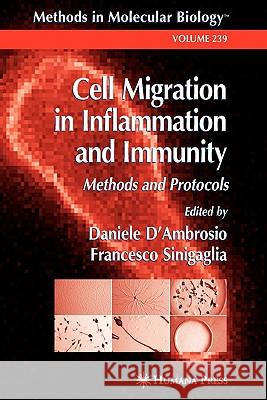
Cell Migration in Inflammation and Immunity: Methods and Protocols D'Ambrosio, Daniele 9781617373572 Springer - książkaWidoczna okładka, to zdjęcie poglądowe, a rzeczywista szata graficzna może różnić się od prezentowanej.

Cell Migration in Inflammation and Immunity: Methods and Protocols

ISBN-13: 9781617373572 / Angielski / Miękka / 2010 / 292 str.

Daniele D'Ambrosio; Francesco Sinigaglia
cena 403,47
(netto: 384,26 VAT:  5%)

Najniższa cena z 30 dni: 385,52
Termin realizacji zamówienia:
ok. 22 dni roboczych
Bez gwarancji dostawy przed świętami

Darmowa dostawa!

Chemokines and their receptors play a central role in the pathogenesis of numerous, perhaps all, acute and chronic inflammatory diseases. About 50 distinct chemokines produced by a variety cell types and tissues either c- stitutively or in response to inflammatory stimuli are involved in a plethora of biological processes. These small secreted proteins exert their exquisitely variegated functions upon binding to a family of seven-transmembrane spanning G-protein coupled receptors (GPCRs) composed of almost 20 distinct entities. The biological activities of chemokines range from the control of leukocyte trafficking in basal and inflammatory conditions to the regulation of hema- poiesis, angiogenesis, tissue architecture, and organogenesis. The basis for such diversified activities rests, on one hand, upon the ubiquitous nature of chemokine production and chemokine receptor expression. Virtually every cell type can produce chemokines and expresses a unique combination of chemokine receptors. On the other hand, chemokine receptors make use of a flexible and complex network of intracellular signaling machineries that can regulate a variety of cellular functions ranging from cell migration, growth, and differentiation to death. As knowledge of the size of chemokine and chemokine receptor families rapidly reaches completeness, much is still to be uncovered in terms of fu- tional architecture of the chemokine system. The disparity between the large number of chemokines and that smaller number of receptors is balanced by the promiscuity in ligand receptor interactions, with multiple chemokines binding to the same receptor and several chemokines binding to more than one receptor."


Kategorie:
Nauka, Medycyna
Kategorie BISAC:
Medical > Diseases
Medical > Immunology
Medical > Microbiology
Wydawca:
Springer
Seria wydawnicza:
Methods in Molecular Biology (Paperback)
Język:
Angielski
ISBN-13:
9781617373572
Rok wydania:
2010
Numer serii:
000203440
Ilość stron:
292
Waga:
0.43 kg
Wymiary:
22.86 x 15.24 x 1.68
Oprawa:
Miękka
Wolumenów:
01
Dodatkowe informacje:
Bibliografia
Wydanie ilustrowane

Chemotaxis and Interaction with Vascular or Lymphatic Endothelium Silvano Sozzani, Annunciata Vecchi, Paola Allavena, and Alberto Mantovani Analysis of Integrin-Dependent Rapid Adhesion Under Laminar-Flow Conditions Carlo Laudanna Posttranslational Processing of Chemokines Paul Proost, Frank Mahieu, Evemie Schutyser, and Jo Van Damme Chemotactic Profiling of Lymphocyte Subpopulations Lucia Colantonio, Andrea Iellem, and Daniele D'Ambrosio Measurement of the Levels of Polymerized Actin (F-Actin) in Chemokine-Stimulated Lymphocytes and GFP-Coupled cDNA Transfected Lymphoid Cells by Flow Cytometry Miguel Vicente-Manzanares, Mariano Vitón, and Francisco Sánchez-Madrid Evaluation of Rho Family Small G-Protein Activity Induced by Integrin Ligation on Human Leukocytes Angela Gismondi, Fabrizio Mainiero, and Angela Santoni Reconstructing Leukocyte Migration in 3D Extracellular Matrix by Time-Lapse Videomicroscopy and Computer-Assisted Tracking Peter Friedl and Eva-B. Bröcker Analyzing Chemotaxis Using Dictyostelium discoideum as a Model System Mark A. Landree and Peter N. Devreotes Conditional Transgenic Models to Study Chemokine Biology Sergio A. Lira, Borna Mehrad, Shu-Cheng Chen, Petronio Zalamea, David J. Kinsley, Maria T. Wiekowski, Elizabeth Coronel, Galya Vassileva, Denise Manfra, and Kristian K. Jensen Intravital Microscopy as a Tool for Studying Recruitment and Chemotaxis Denise C. Cara and Paul Kubes Tracking Antigen-Specific Lymphocytes In Vivo Claire L. Adams, Catherine M. Rush, Karen M. Smith, and Paul Garside Analysis of Homing-Receptor Expression on Infiltrating Leukocytes in Disease States Margherita Mariani and Paola Panina-Bordignon Interaction of Viral Chemokine Inhibitors with Chemokines Antonio Alcami Discovery of Small-Molecule Antagonists ofChemokine Receptors: Screening Strategy and Assays Maria Elena Fuentes Visualization and Analysis of Adhesive Events in Brain Microvessels by Using Intravital Microscopy Gabriela Constantin Animal Models to Study Chemokine Receptor Function In Vivo: Mouse Models of Allergic Airway Inflammation Clare M. Lloyd and Jose-Carlos Gutierrez-Ramos Assessing the Role of Multiple Phosphoinositide 3-Kinases in Chemokine Signaling: Use of Dominant Negative Mutants Controlled by a Tetracycline-Regulated Gene Expression System Adam P. Curnock, Yannis Sotsios, and Stephen G. Ward In Vitro and In Vivo Models to Study Chemokine Regulation of Angiogenesis Giovanni Bernardini, Domenico Ribatti, Gaia Spinetti, Lucia Morbidelli, Marina Ziche, Angela Santoni, Maurizio C. Capogrossi, and Monica Napolitano Real Time In Vitro Assay for Studying Chemoattractant-Triggered Leukocyte Transendothelial Migration Under Physiological Flow Conditions Guy Cinamon and Ronen Alon Generation of Monoclonal Antibodies Against Chemokine Receptors Leonor Kremer and Gabriel Márquez Detection of High-Affinity a4-Integrin Upon Leukocyte Stimulation by Chemoattractants or Chemokines Jason R. Chan and Myron I. Cybulsky Index

Cell migration is now well recognized as a critical component of the inflammatory disease process, so that its proper understanding promises to generate both ground-breaking basic discoveries and the development of novel therapeutics. In Cell Migration in Inflammation and Immunity: Methods and Protocols, leading cell biologists and immunologists present their most widely useful and innovative techniques for studying the molecular and cellular basis of this phenomenon. Describing each method in step-by-step detail, the authors provide a series of focused, cutting-edge techniques proceeding from the in vitro analysis of cell migration and the molecular mechanisms underlying this process, to methodologies for the analysis of cell migration in vivo. Methods for the analysis of rapid leukocyte adhesion under flow conditions in vitro are described, which may prove especially fruitful for scientists exploring the molecular mechanisms underlying both vascular recognition and leukocyte-endothelium interaction. Experimental approaches useful in establishing the role of cell migration in the pathogenesis of both acute and chronic inflammatory diseases are emphasized. Each fully tested protocol includes an introduction explaining the principle behind the technique, equipment and reagent lists, and tips on troubleshooting and how to avoid known pitfalls.
Comprehensive and cutting-edge, Cell Migration in Inflammation and Immunity: Methods and Protocols offers novice and experienced investigators alike a collection of powerful techniques for studying the molecular basis and pathophysiological significance of cell migration in inflammatory and immune diseases, as well as for the development of novel therapeutics.


Udostępnij

Facebook - konto krainaksiazek.pl


Opinie o Krainaksiazek.pl na Opineo.pl

Partner Mybenefit

Krainaksiazek.pl w programie rzetelna firma Krainaksiaze.pl - płatności przez paypal

Czytaj nas na:

Facebook - krainaksiazek.pl
  • książki na zamówienie
  • granty
  • książka na prezent
  • kontakt
  • pomoc
  • opinie
  • regulamin
  • polityka prywatności

Zobacz:

  • Księgarnia czeska

  • Wydawnictwo Książkowe Klimaty

1997-2025 DolnySlask.com Agencja Internetowa

© 1997-2022 krainaksiazek.pl
     
KONTAKT | REGULAMIN | POLITYKA PRYWATNOŚCI | USTAWIENIA PRYWATNOŚCI
Zobacz: Księgarnia Czeska | Wydawnictwo Książkowe Klimaty | Mapa strony | Lista autorów
KrainaKsiazek.PL - Księgarnia Internetowa

Polityka prywatnosci - link
Krainaksiazek.pl - płatnośc Przelewy24
Przechowalnia Przechowalnia






