• Wyszukiwanie zaawansowane
  • Kategorie
  • Kategorie BISAC
  • Książki na zamówienie
  • Promocje
  • Granty
  • Książka na prezent
  • Opinie
  • Pomoc
  • Załóż konto
  • Zaloguj się

Cavitation Reaction Engineering » książka


zaloguj się | załóż konto
Logo Krainaksiazek.pl

koszyk

konto

szukaj
topmenu
Księgarnia internetowa
Szukaj
Książki na zamówienie
Promocje
Granty
Książka na prezent
Moje konto
Pomoc
 
 
Wyszukiwanie zaawansowane
Pusty koszyk
Bezpłatna dostawa dla zamówień powyżej 20 złBezpłatna dostawa dla zamówień powyżej 20 zł

Kategorie główne

• Nauka
 [2948695]
• Literatura piękna
 [1824038]

  więcej...
• Turystyka
 [70868]
• Informatyka
 [151073]
• Komiksy
 [35227]
• Encyklopedie
 [23181]
• Dziecięca
 [621575]
• Hobby
 [138961]
• AudioBooki
 [1642]
• Literatura faktu
 [228651]
• Muzyka CD
 [371]
• Słowniki
 [2933]
• Inne
 [445341]
• Kalendarze
 [1243]
• Podręczniki
 [164416]
• Poradniki
 [479493]
• Religia
 [510449]
• Czasopisma
 [502]
• Sport
 [61384]
• Sztuka
 [243086]
• CD, DVD, Video
 [3417]
• Technologie
 [219673]
• Zdrowie
 [100865]
• Książkowe Klimaty
 [124]
• Zabawki
 [2168]
• Puzzle, gry
 [3372]
• Literatura w języku ukraińskim
 [260]
• Art. papiernicze i szkolne
 [7838]
Kategorie szczegółowe BISAC

Cavitation Reaction Engineering

ISBN-13: 9780306461415 / Angielski / Twarda / 1999 / 352 str.
Yatish T. Shah; Y. T. Shah; A. B. Pandit
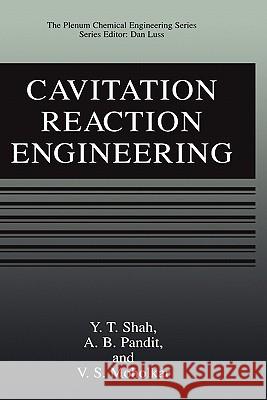
Cavitation Reaction Engineering Yatish T. Shah Y. T. Shah A. B. Pandit 9780306461415 Kluwer Academic Publishers - książkaWidoczna okładka, to zdjęcie poglądowe, a rzeczywista szata graficzna może różnić się od prezentowanej.

Cavitation Reaction Engineering

ISBN-13: 9780306461415 / Angielski / Twarda / 1999 / 352 str.

Yatish T. Shah; Y. T. Shah; A. B. Pandit
cena 1204,83
(netto: 1147,46 VAT:  5%)

Najniższa cena z 30 dni: 1156,64
Termin realizacji zamówienia:
ok. 22 dni roboczych.

Darmowa dostawa!

The literature on cavitation chemistry is ripe with conjectures, possibilities, heuris tic arguments, and intelligent guesses. The chemical effects of cavitation have been explained by means of many theories, consisting of empirical constants, adjustable parameters, and the like. The chemists working with cavitation chemistry agree that the phenomenon is very complex and system specific. Mathematicians and physi cists have offered partial solutions to the observed phenomena on the basis of cavitation parameters, whereas chemists have attempted explanations based on the modes of reaction and the detection of intermediate chemical species. Nevertheless, no one has been able to formulate a unified theme, however crude, for its effects on the basis of the known parameters, such as cavitation and transient chemistry involving extremely high temperatures of nanosecond durations. When one surveys the literature on cavitation-assisted reactions, it is clear that the approach so far has been "Edisonian" in nature. While a large number of reactions have showed either enhanced yields or reduced reaction times, many reactions have remained unaffected in the presence of cavitation. The success or failure of cavitation reactions ultimately depends on the collapse of the cavity. Cavitation chemistry is based on the principles of the formation of small transient cavities, their growth and implosion, which produce chemical reactions caused by the generation of extreme pressures and temperatures and a high degree of micro turbulence.


Kategorie:
Technologie
Kategorie BISAC:
Science > Chemia - Fizyczna
Science > Chemistry - Industrial & Technical
Science > Environmental Science (see also Chemistry - Environmental)
Wydawca:
Kluwer Academic Publishers
Seria wydawnicza:
Plenum Chemical Engineering Library
Język:
Angielski
ISBN-13:
9780306461415
Rok wydania:
1999
Wydanie:
1999
Numer serii:
000145779
Ilość stron:
352
Waga:
1.55 kg
Wymiary:
23.5 x 15.5
Oprawa:
Twarda
Wolumenów:
01
Dodatkowe informacje:
Bibliografia
Wydanie ilustrowane

1. Sources and Types of Cavitation.- 1.1. Introduction.- 1.2. Hydrodynamic Cavitation.- 1.2a. Cavitation Number.- 1.3. Acoustic Cavitation.- 1.4. Optic and Particle Cavitation.- 2. Cavitation Bubble Dynamics.- 2.1. Introduction.- 2.2. Bubble Dynamics.- 2.2a. Bubble Nuclei: Blake Threshold.- 2.2b. Dynamic Equations of a Spherical Bubble: Analysis of an Empty Bubble.- 2.2c. Dynamics of a Gas Bubble.- 2.2d. Equation Involving Compressibility of a Liquid.- 2.2e. Rayleigh Analysis of a Cavity and Its Extensions.- 2.2f. Adiabatic Collapse of a Gas-Filled Cavity.- 2.2g. Damping of Stable Bubbles.- 2.2h. Modifications for Hydrodynamic Cavitation.- 2.3. Cluster Dynamics.- 2.3a. Model Equations for Cluster Dynamics.- 2.4. Heat and Mass Transfer Effects in Cavitation.- 2.4a. Rectified Diffusion.- 2.4b. Rectified Heat Transfer in Bubble Oscillations.- 2.4c. Effect of Simultaneous Diffusion and Evaporation on Bubble Dynamics.- 2.5. Concluding Remarks.- 3. Factors Affecting Cavitation Behavior.- 3.1. Introduction.- 3.2. Factors Affecting Cavity Behavior in Hydrodynamic Cavitation.- 3.2a. Recovered Discharge Pressure and Time of Pressure Recovery.- 3.2b. Downstream Pipe Size.- 3.2c. Orifice-to-Pipe Diameter Ratio.- 3.2d. Initial Bubble Radius and the Noncondensable Gas Fraction in Cavitating Liquids.- 3.3. Factors Affecting Cavity Behavior in Acoustic Cavitation.- 3.3a. Acoustic Frequency.- 3.3b. Acoustic Intensity.- 3.3c. External Pressure.- 3.3d. Nature of the Dissolved Gas.- 3.3e. Physical Properties of the Cavitating Medium.- 3.3f. Pretreatment of the Liquid.- 3.3g. Bulk Liquid Temperature.- 3.3h. Initial Bubble Radius.- 3.4. Factors Affecting Optical Cavitation.- 3.5. Factors Affecting Cavity Cluster Behavior in Hydrodynamic Cavitation.- 3.5a. Effect of Recovery Pressure.- 3.5b. Effect of Time of Pressure Recovery.- 3.5c. Effect of Initial Cluster Radius.- 3.5d. Effect of Bubble Volume Fraction.- 3.6. Factors Affecting Cavity Cluster Behavior in Acoustic Cavitation.- 3.7. Concluding Remarks.- 4. Gas-Liquid Cavitation Chemistry.- 4.1. Introduction.- 4.2. Mechanisms for Cavitation Reaction.- 4.3. Factors Affecting Cavitation Chemistry.- 4.3a. Acoustic Frequency.- 4.3b. Acoustic Intensity.- 4.3c. External Pressure.- 4.3d. Gas Solubility.- 4.3e. Nature of the Gas.- 4.3f. Liquid Properties.- 4.3g. Bulk Temperature.- 4.4. Inorganic and Organic Cavitation Reactions.- 4.4a. Water.- 4.4b. Effect of Other Dissolved Gases.- 4.4c. Inorganic Reactions.- 4.4d. Organic Reactions.- 4.4e. Solute Hydrophobicity and Reactivity.- 4.5. Depolymerization and Repolymerization Reactions.- 4.6. Ultrasound and Homogeneous Oxidation.- 4.7. Ultrasound and Liquid-Liquid Phase-Transfer Reactions.- 5. Gas-Liquid-Solid Cavitation Chemistry.- 5.1. Introduction.- 5.2. General Effects of Ultrasound on Gas-Liquid-Solid Reactions.- 5.2a. Surface Cleaning.- 5.2b. Morphological Changes in Metal Catalysts.- 5.2c. Cavitation Erosion.- 5.2d. Shape, Size, and Specific Area of Particle.- 5.2e. Improved Mass Transport.- 5.2f. Mechanisms for Gas-Liquid-Solid Cavitation Reaction.- 5.3. Specific Role of Ultrasound on Gas-Liquid-Solid Reactions.- 5.3a. Catalyst and Reagent Preparation.- 5.3b. Effects of Ultrasound on Catalyst-Reagent Activation.- 5.3c. Catalyst Induction Period.- 5.3d. Reactions with Continuous Ultrasound.- 5.3e. Effects of Ultrasound on Catalyst Regeneration.- 5.4. Case Studies.- 5.4a. Cavitation Effect on Heterogeneous Catalytic Oxidation.- 5.4b. Cavitation Effect on Liquid-Solid Phase-Transfer Reactions.- 5.4c. Cavitation Effect on Gas-Liquid-Solid Biological Reactions.- 5.4d. Cavitation Effect on Photo-oxidation Reactions.- 5.4e. Cavitation-Induced Microfusion.- 6. Cavitation Reactors.- 6.1. Introduction.- 6.2. Hydrodynamic Cavitation Reactors.- 6.2a. High-Pressure Homogenizer.- 6.3. Acoustic Cavitation Reactors.- 6.3a. Transducers and Horns.- 6.3b. Measurements of Acoustic Power.- 6.3c. Methods for Measuring Amplitude.- 6.3d. Hydrophones.- 6.3e. Sonochemical Reactor Geometries.- 6.3f. Qualitative Considerations for Reactor Choice, Scaleup, and Optimization.- 6.4. Laser Cavitation Reactors.- 6.5. Some Additional Considerations for Flow Reactors.- 6.6. Health and Safety Aspects of Laboratory Reactors.- 6.7. Integration of Cavitation into Existing Scaled-Up Processes.- 6.8. Concluding Remarks.- 7. Models for Cavitation Reactors.- 7.1. Introduction.- 7.2. General Considerations for a Gas-Liquid Cavitation Reactor Model.- 7.2a. Bubble Dynamics.- 7.2b. Pyrolysis Reactions in the Bubble.- 7.2c. Free Radical Reactions in the Liquid Film.- 7.3. Modeling a Batch Gas-Liquid Acoustic Reactor.- 7.3a. Physical Description.- 7.3b. Model Equations and Analysis.- 7.3c. Further Improvements in the Model.- 7.4. Characterization of the Reaction Zone.- 7.4a. Physical Description.- 7.4b. Reaction Zone based on Probability Density function.- 7.5. Reactor Design and Scaleup based on the Concept of Cavitation Yield.- 7.6. Memory Effect in a Loop Cavitation Reactor.- 7.7. Concluding Remarks.- 8. Energy Efficiency and the Economics of the Cavitation Conversion Process.- 8.1. Introduction.- 8.2. Efficiency of Energy Transformation.- 8.2a. Steps for Energy Transformation.- 8.2b. Equipment Efficiency.- 8.2c. Energy Efficiency for the Cavity Implosion.- 8.2d. Cavitation Yield Model.- 8.2e. G-Method for Energy Efficiency.- 8.2f. Case Studies.- 8.3. Economics of Cavitation Conversion Processes.- 8.3a. Case Study 1.- 8.3b. Case Study 2.- 8.3c. Sonochemistry vs. Photochemistry.- 8.4. Concluding Remarks.- 9. CAV-OX Process.- 9.1. Introduction.- 9.2. Description of Process.- 9.3. Process Economics.- 9.4. Case Studies.- Case 1. Superfund Site for Wood-Treatment, Pensacola, Florida.- Case 2. Chevron Service Station, Long Beach, California.- Case 3. Presidio Army Base, San Francisco, California.- Case 4. Chemical Plant, East Coast, United States.- Case 5. Mannesmann Anlagenbau, Salzburg, Austria.- Case 6. Steel Mill, South Korea.- Case 7. Perdue Farms, Bridgewater, Virginia.- Case 8. Southern California Edison, Los Angeles, California.- Case 9. Corporacion Mexicana de Investigacion en Materials, S.A. de C.V. (CMIMSA).- Case 10. University of Natal, Durban, South Africa.- Nomenclature.- References.


Udostępnij

Facebook - konto krainaksiazek.pl


Opinie o Krainaksiazek.pl na Opineo.pl

Partner Mybenefit

Krainaksiazek.pl w programie rzetelna firma Krainaksiaze.pl - płatności przez paypal

Czytaj nas na:

Facebook - krainaksiazek.pl
  • książki na zamówienie
  • granty
  • książka na prezent
  • kontakt
  • pomoc
  • opinie
  • regulamin
  • polityka prywatności

Zobacz:

  • Księgarnia czeska

  • Wydawnictwo Książkowe Klimaty

1997-2026 DolnySlask.com Agencja Internetowa

© 1997-2022 krainaksiazek.pl
     
KONTAKT | REGULAMIN | POLITYKA PRYWATNOŚCI | USTAWIENIA PRYWATNOŚCI
Zobacz: Księgarnia Czeska | Wydawnictwo Książkowe Klimaty | Mapa strony | Lista autorów
KrainaKsiazek.PL - Księgarnia Internetowa

Polityka prywatnosci - link
Krainaksiazek.pl - płatnośc Przelewy24
Przechowalnia Przechowalnia





