Calvin's Doctrine of the State » książka





Calvin's Doctrine of the State
ISBN-13: 9781606080733 / Angielski / Miękka / 2009 / 148 str.
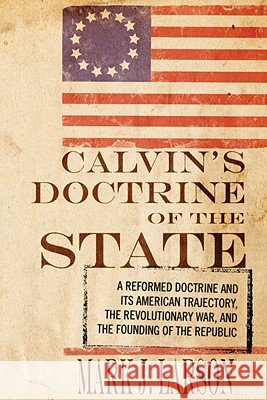
Calvin's Doctrine of the State
ISBN-13: 9781606080733 / Angielski / Miękka / 2009 / 148 str.
(netto: 84,18 VAT: 5%)
Najniższa cena z 30 dni: 86,22
ok. 16-18 dni roboczych.
Darmowa dostawa!
Contemporary treatments of Calvin's political views often imply that he embraced a theocratic civil polity and that he was committed to holy war doctrine. On the basis of the primary sources, the first half of this volume argues that neither position is correct. Calvin, in his political thought, maintained the superiority of a republic as a civil polity. In addition, he placed himself firmly within the medieval just war tradition that was established by Augustine of Hippo and later reaffirmed by Thomas Aquinas. In terms of his commitment to classical just war teaching, Calvin stood in continuity with Martin Luther, even while he distanced himself from the holy war perspective of the Zurich Reformers Henry Bullinger and Peter Martyr Vermigli. In the thinking of Calvin, a war could only be authorized by the state, not the church. War had to be prosecuted with humanity and restraint, and not in the tradition of the medieval crusade. The second half of the book sets forth what Calvin actually believed on the matter of government and war. Here we examine his teaching on parliamentary resistance to monarchical tyranny and the full dimensions of his commitment to justice of war categories. Unlike Luther and Bullinger, Calvin provided a parliamentary remedy for the perennial evil of tyranny. With Vermigli and Theodore Beza siding with Calvin on this right, a body of Reformed doctrine was established to which succeeding generations could appeal for teaching, direction, and justification for taking up arms. It is clear that Calvin's political legacy is profoundly evident in the American Revolutionary War and in the constitutional determination for a republic in the United States of America. Calvin's ecclesiastical republicanism, as it came to fruition in Presbyterian church government, was a powerful impetus toward the creation of republican institutions in civil government. ""Mark Larson has performed an important service by showing . . . that John Calvin is no advocate of 'Holy War.' Rather, Calvin fits comfortably and self-consciously within the 'just-war' tradition."" --William R. Stevenson, Jr., Professor of Political Science, Calvin College ""Mark Larson's study . . . offers a careful and balanced account of Calvin's views on church-state relations and of warfare in the early modern era. Of particular importance is Larson's account of Calvin's place in the development of modern just-war theory, in which Calvin is shown to have integrated his views on just war into his approach to the rule and responsibilities of the magistrate."" --Richard A. Muller, P. J. Zondervan Professor of Historical Theology, Calvin Theological Seminary ""In an age when secularists fear theocratic oppression and bellicosity, Larson's book brings a welcome word from Calvin himself . . . There is a great deal of instruction here for pastors and political leaders alike."" --David C. Innes, Assistant Professor of Politics, The King's College in New York City Mark J. Larson holds a BA in Bible from Cedarville University, a ThM in systematic theology from Westminster Theological Seminary, and a PhD in historical theology from Calvin Theological Seminary.
Contemporary treatments of Calvins political views often imply that he embraced a theocratic civil polity and that he was committed to holy war doctrine. On the basis of the primary sources, the first half of this volume argues that neither position is correct. Calvin, in his political thought, maintained the superiority of a republic as a civil polity. In addition, he placed himself firmly within the medieval just war tradition that was established by Augustine of Hippo and later reaffirmed by Thomas Aquinas. In terms of his commitment to classical just war teaching, Calvin stood in continuity with Martin Luther, even while he distanced himself from the holy war perspective of the Zurich Reformers Henry Bullinger and Peter Martyr Vermigli. In the thinking of Calvin, a war could only be authorized by the state, not the church. War had to be prosecuted with humanity and restraint, and not in the tradition of the medieval crusade. The second half of the book sets forth what Calvin actually believed on the matter of government and war. Here we examine his teaching on parliamentary resistance to monarchical tyranny and the full dimensions of his commitment to justice of war categories. Unlike Luther and Bullinger, Calvin provided a parliamentary remedy for the perennial evil of tyranny. With Vermigli and Theodore Beza siding with Calvin on this right, a body of Reformed doctrine was established to which succeeding generations could appeal for teaching, direction, and justification for taking up arms. It is clear that Calvins political legacy is profoundly evident in the American Revolutionary War and in the constitutional determination for a republic in the United States of America. Calvins ecclesiastical republicanism, as it came to fruition in Presbyterian church government, was a powerful impetus toward the creation of republican institutions in civil government.""Mark Larson has performed an important service by showing . . . that John Calvin is no advocate of Holy War. Rather, Calvin fits comfortably and self-consciously within the just-war tradition.""--William R. Stevenson, Jr., Professor of Political Science, Calvin College""Mark Larsons study . . . offers a careful and balanced account of Calvins views on church-state relations and of warfare in the early modern era. Of particular importance is Larsons account of Calvins place in the development of modern just-war theory, in which Calvin is shown to have integrated his views on just war into his approach to the rule and responsibilities of the magistrate.""--Richard A. Muller, P. J. Zondervan Professor of Historical Theology, Calvin Theological Seminary""In an age when secularists fear theocratic oppression and bellicosity, Larsons book brings a welcome word from Calvin himself . . . There is a great deal of instruction here for pastors and political leaders alike.""--David C. Innes, Assistant Professor of Politics, The Kings College in New York CityMark J. Larson holds a BA in Bible from Cedarville University, a ThM in systematic theology from Westminster Theological Seminary, and a PhD in historical theology from Calvin Theological Seminary.




Czytaj nas na:
KrainaKsiazek.PL - Księgarnia Internetowa


