• Wyszukiwanie zaawansowane
  • Kategorie
  • Kategorie BISAC
  • Książki na zamówienie
  • Promocje
  • Granty
  • Książka na prezent
  • Opinie
  • Pomoc
  • Załóż konto
  • Zaloguj się

CSCW and Artificial Intelligence » książka


zaloguj się | załóż konto
Logo Krainaksiazek.pl

koszyk

konto

szukaj
topmenu
Księgarnia internetowa
Szukaj
Książki na zamówienie
Promocje
Granty
Książka na prezent
Moje konto
Pomoc
 
 
Wyszukiwanie zaawansowane
Pusty koszyk
Bezpłatna dostawa dla zamówień powyżej 20 złBezpłatna dostawa dla zamówień powyżej 20 zł

Kategorie główne

• Nauka
 [2946600]
• Literatura piękna
 [1856966]

  więcej...
• Turystyka
 [72221]
• Informatyka
 [151456]
• Komiksy
 [35826]
• Encyklopedie
 [23190]
• Dziecięca
 [619653]
• Hobby
 [140543]
• AudioBooki
 [1577]
• Literatura faktu
 [228355]
• Muzyka CD
 [410]
• Słowniki
 [2874]
• Inne
 [445822]
• Kalendarze
 [1744]
• Podręczniki
 [167141]
• Poradniki
 [482898]
• Religia
 [510455]
• Czasopisma
 [526]
• Sport
 [61590]
• Sztuka
 [243598]
• CD, DVD, Video
 [3423]
• Technologie
 [219201]
• Zdrowie
 [101638]
• Książkowe Klimaty
 [124]
• Zabawki
 [2473]
• Puzzle, gry
 [3898]
• Literatura w języku ukraińskim
 [254]
• Art. papiernicze i szkolne
 [8170]
Kategorie szczegółowe BISAC

CSCW and Artificial Intelligence

ISBN-13: 9783540198161 / Angielski / Miękka / 1994 / 192 str.
John H. Connolly;Ernest A. Edmonds
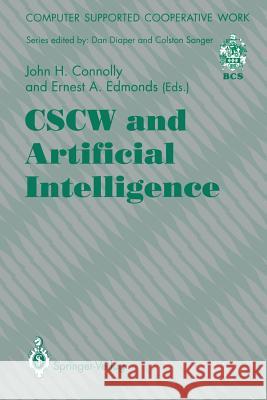
CSCW and Artificial Intelligence John H. Connolly, Ernest A. Edmonds 9783540198161 Springer-Verlag Berlin and Heidelberg GmbH &  - książkaWidoczna okładka, to zdjęcie poglądowe, a rzeczywista szata graficzna może różnić się od prezentowanej.

CSCW and Artificial Intelligence

ISBN-13: 9783540198161 / Angielski / Miękka / 1994 / 192 str.

John H. Connolly;Ernest A. Edmonds
cena 201,72 zł
(netto: 192,11 VAT:  5%)

Najniższa cena z 30 dni: 192,74 zł
Termin realizacji zamówienia:
ok. 22 dni roboczych
Bez gwarancji dostawy przed świętami

Darmowa dostawa!

Computing, despite the relative brevity of its history, has already evolved into a subject in which a fairly large number of subdisciplines can be identified. Moreover, there has been a noticeable tendency for the different branches of the subject each to develop its own intellectual culture, tradition and momentum. This is not, of course, to suggest that any individ- ual subdiscipline has become a watertight compartment or that developments in one branch of the subject have tended to take place in total isolation from developments in other related areas. Nevertheless, it does mean that a deliberate effort is required in order to bring different subdisciplines together in a fruitful and beneficial manner. Artificial Intelligence (AI) and Computer Supported Coopera- tive Work (CSCW) jointly constitute a good example of two branches of computing that have emerged separately and given rise to largely distinct research communities and initiatives. On the one hand, the history of AI can be traced back to the 1950s, the term II Artificial Intelligence" being generally attributed to John McCarthy, who first used it in print in 1956. "Computer Supported Cooperative Work," on the other hand, is a term of more recent coinage, having'been devised by Irene Greif and Paul Cashman in 1984.


Kategorie:
Informatyka, Bazy danych
Kategorie BISAC:
Computers > Artificial Intelligence - General
Business & Economics > Information Management
Computers > Speech & Audio Processing
Wydawca:
Springer-Verlag Berlin and Heidelberg GmbH &
Seria wydawnicza:
Computer Supported Cooperative Work
Język:
Angielski
ISBN-13:
9783540198161
Rok wydania:
1994
Dostępne języki:
Angielski
Wydanie:
Softcover Repri
Numer serii:
000124737
Ilość stron:
192
Waga:
0.34 kg
Wymiary:
23.523.5 x 15.5
Oprawa:
Miękka
Wolumenów:
01

1 Towards a Cooperative Software Agent.- 1.1 Introduction.- 1.1.1 The Concept of Software Agents.- 1.1.2 A Description of Software Agents.- 1.1.3 Agents as Processes.- 1.1.4 An Analogy Based on Human Agents.- 1.1.5 Characteristics of an Interface Agent.- 1.2 Cooperation: A Behavioural Metaphor for Software Agents.- 1.2.1 Factors that Induce and Maintain Human Cooperation.- 1.2.2 Task Factors that Support Cooperation.- 1.2.3 Advantages of Cooperation During Problem Solving.- 1.2.4 Human-Computer Interaction.- 1.3 The Cooperative Machine.- 1.3.1 The Underlying Mechanisms of a Cooperative Machine.- 1.3.2 An Exemplarof Human-Computer Cooperation.- 1.4 Conclusions.- 2 A Framework for Negotiation.- 2.1 Introduction.- 2.2 Context.- 2.3 The Framework.- 2.4 Communications Support.- 2.5 Task Support.- 2.6 Group Support.- 2.6.1 Conference Agent.- 2.6.2 Floor Agent.- 2.6.3 Representation Agent.- 2.6.4 History Agent.- 2.6.5 Workstation Agent.- 2.6.6 Facilitator Agent.- 2.6.7 Data Agent.- 2.7 Conclusion.- 3 Environments for Cooperating Agents: Designing the Interface as Medium.- 3.1 Introduction.- 3.2 History.- 3.3 Active and Passive Interfaces.- 3.4 The Interface as Medium.- 3.5 Adaptive Interfaces.- 3.6 An Experiment in Embodied Adaptivity.- 3.7 Conferences and Cooperation.- 3.8 Designing the Medium.- 3.8.1 Separation.- 3.8.2 Access.- 3.8.3 Using Models of Interpersonal Communication.- 3.8.4 Using Models from Application Interfaces.- 3.9 Conclusions.- 4 Domain Knowledge Agents for Information Retrieval.- 4.1 Introduction.- 4.1.1 Scope of Chapter.- 4.2 Agent Architecture.- 4.2.1 Document Agents.- 4.2.2 Knowledge Agents.- 4.2.3 Query Agents.- 4.3 Document Agents and their Co-Agents.- 4.4 Knowledge Agents.- 4.4.1 The “Agent Maker”.- 4.4.2 Automatically Generated Agents.- 4.4.3 Task-Specific Knowledge Agents.- 4.5 Object-Oriented Implementation.- 4.6 Conclusion.- 5 Autonomous Agents in the Support of Cooperative Authorship.- 5.1 Introduction.- 5.1.1 Scope of Chapter.- 5.2 A Model of Cooperative Authorship.- 5.3 The Definition of Loquacious-Agents and their Document Environment.- 5.3.1 Definition1.- 5.3.2 Definition2.- 5.3.3 Definition3.- 5.3.4 Definition4.- 5.3.5 Definition5.- 5.3.6 Definition6.- 5.3.7 Definition7.- 5.3.8 Definition8.- 5.4 The Four-Layer Model of Agent Communication.- 5.5 An Example Using an Ls-Agent: Rapporteur.- 5.6 Discussion and Conclusion.- 6 Agency within CSCW: Towards the Development of Active Cooperative Working Environments.- 6.1 Introduction.- 6.2 Related Research.- 6.3 The Cooperative Working Platform.- 6.3.1 Objectives.- 6.3.2 Design of the Cooperative Working Platform.- 6.3.3 Implementation Details.- 6.4 Conclusions.- 7 A Model for Supporting Interacting Knowledge Sources.- 7.1 Introduction.- 7.2 The Scope for AI in CSCW.- 7.3 Organizational Decision Making and Interacting Knowledge Sources.- 7.4 A Model for Supporting Interacting Knowledge Sources.- 7.5 Modelling Communication in Multiparticipant Settings.- 7.6 Conclusion.- 8 A Functional Model of Interacting Systems: A Semiotic Approach.- 8.1 Introduction.- 8.2 An Overview of Interaction.- 8.3 A Detailed View of Interaction.- 8.3.1 The Receptor.- 8.3.2 Deriving Semantics.- 8.3.3 Information and Knowledge.- 8.3.4 Transmission.- 8.3.5 Summary H.- 8.4 Discussion H.- 8.5 Conclusion.- Appendix A: Examples of the Model in Action.- A. l The Broadway Example.- A. 2 Insert New Line Example.- 9 Supporting Human Experts’ Collaborative Work: Modelling Organizational Context Knowledge in Cooperative Information Systems.- 9.1 Introduction.- 9.2 Related Work.- 9.3 FRESCO: Cooperating Expert Systems in Banking.- 9.3.1 Overview.- 9.3.2 The Cooperative Problem Solving Scenario.- 9.3.3 Shortcomings: An Organizational Perspective.- 9.4 Modelling Organizational Context Knowledge.- 9.5 A Multi-Layered Reference Coordination Architecture.- 9.6 Conclusions.- 10 Artificial Intelligence and Computer Supported Cooperative Working in International Contexts.- 10.1 Introduction.- 10.2 Communication Issues.- 10.2.1 Methods of Communication.- 10.2.2 The Internationalization of the Human-Computer Interface.- 10.2.3 The Social Dimension.- 10.3 Relevant Branches of AI.- 10.4 Communication Problems and the Role of AI.- 10.4.1 Intervention in the Communication Process.- 10.4.2 Support for System Users and Designers.- 10.5 Conclusion.- 11 On the Definition and Desirability of Autonomous User Agents in CSCW.- 11.1 Introduction.- 11.2 Incorporating the Differing Viewpoints of Social Scientists and Computer Scientists.- 11.3 CSCW Task Domains.- 11.4 Group Stages and Group Functions.- 11.5 Conclusions.- 11.5.1 How Intelligent Will Agents Be?.- 11.5.2 How Will They Be Displayed?.- 11.5.3 How Will They Support Group Working?.- 11.5.4 A Case Example.- References.- Name Index.


Udostępnij

Facebook - konto krainaksiazek.pl


Opinie o Krainaksiazek.pl na Opineo.pl

Partner Mybenefit

Krainaksiazek.pl w programie rzetelna firma Krainaksiaze.pl - płatności przez paypal

Czytaj nas na:

Facebook - krainaksiazek.pl
  • książki na zamówienie
  • granty
  • książka na prezent
  • kontakt
  • pomoc
  • opinie
  • regulamin
  • polityka prywatności

Zobacz:

  • Księgarnia czeska

  • Wydawnictwo Książkowe Klimaty

1997-2025 DolnySlask.com Agencja Internetowa

© 1997-2022 krainaksiazek.pl
     
KONTAKT | REGULAMIN | POLITYKA PRYWATNOŚCI | USTAWIENIA PRYWATNOŚCI
Zobacz: Księgarnia Czeska | Wydawnictwo Książkowe Klimaty | Mapa strony | Lista autorów
KrainaKsiazek.PL - Księgarnia Internetowa

Polityka prywatnosci - link
Krainaksiazek.pl - płatnośc Przelewy24
Przechowalnia Przechowalnia





